






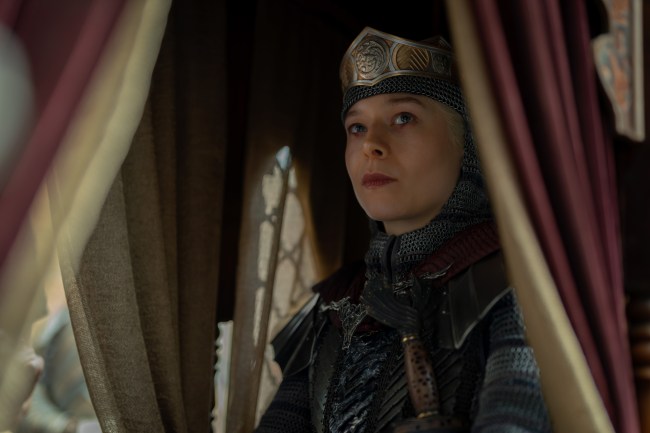
Only a few of us will get the chance to write a world-spanning television epic where dragons get to be army-killing WMDs, elusive pieces on a chessboard, and, occasionally as a treat, “let them fight” kaiju. But of those who do, “House of the Dragon” co-creator and showrunner Ryan Condal’s challenge remains an interesting one.
The HBO adaptation of George R.R. Martin’s historiographical novel of a Targaryen civil war, “Fire and Blood,” rests neither on the pure edgelord realpolitik of “Game of Thrones” nor on the homespun heroics of “A Knight of the Seven Kingdoms.” It’s something in the middle. The HBO series is, as much as anything else, about how power changes people and warps them into a different shape, like the swords that form the Iron Throne.


And so for Season 3, certain aspects of the show also needed to change their shape. In ways both subtle and not, there’s a tonal fraying that happens in Season 3 as almost every character is either cursed with getting exactly what they wanted, like Rhaenyra (Emma D’Arcy) or Rhaena (Phoebe Fox), or is suffering an endless series of No Good, Rotten, Very Bad Days, like Criston Cole (Fabien Frankel) and Gwayne Hightower (Freddie Fox).
“One of my most important lessons in showrunning is that you really need to let the television show speak to you,” Condal told IndieWire on an episode of the Filmmaker Toolkit Podcast. “ What are the things that we’re good at executing? What are the things the actors are good at? Certain people have unknown skills that aren’t apparent to you until you start working with them, and then you want to write to that.”

Some of the things that Condal and his writers have written towards in Season 3 are gifts for the actors, like giving Fox more chances to be hilarious or working closely with D’Arcy and Olivia Cooke to unearth what happens when the power dynamic between Rhaenyra and Alicent changes. But some of what twists in Season 3 is the soundscape, which Condal wanted to have a slightly different, more unstable character.
“I probably worked more closely with [composer Ramin Djawadi] this season than I have in any previous season now that the show has achieved this — not totally new tonality, but there was a shift in the show,” Condal said. “It felt like a lot of the earlier themes didn’t really work to tell the characters’ story anymore, so I really wanted a shift in the aural soundscape.”
For as massive as the show’s nearly 360-degree King’s Landing sets are, for as impossibly photoreal as the VFX team’s dragons, or the SFX team’s chase of their own world-record for most stuntmen lit on fire in a single burn, the score in “House of the Dragon” Season 3 provides things the imagery alone can’t.

For instance, Djawadi worked on a lot of custom pieces of score for Episode 3, “Rhaenyra Triumphant,” where triumph has way more rodents than advertised. Djawadi arranges the nervous strings of the “Rhaenyra Triumphant” cue, recursive and spiraling almost like intrusive thoughts, as a compliment to the skittering and chittering sound effects of the rats that have infested the Red Keep. Everything looks fine, but sonically, there’s no escape for Rhaenyra from the anxiety and grief that haunt her now that she sits the Iron Throne.
“We had the idea during production and talked to Clare [Kilner] and Sara [Hess], the director and the writer, a lot about that. But it took Al Sirkett, the sound designer, coming in and figuring out how we do this subjective headspace thing without it sounding like every other [time that someone goes into] a subjective headspace,” Condal said. “[The rat sounds] felt very specific to ‘House of the Dragon’ — Rhaenyra’s thinking about rats, but the rats are sort of eating her kingdom, literally and figuratively.”


The end note of Season 3 only accelerates all the things that are eating up Rhaenyra from the inside and the sonic changes that are going to continue through the next phase of the story. Condal, D’arcy, and Episode 8 director Andrij Parekh all knew the feeling they wanted for the moment after Rhaenyra discovers the credits-worthy needlework Helaena (Phia Saban) has left behind. Maybe the only thing scarier than all the noise we’ve been hearing dogging Rhaenyra’s steps is the moment that she closes the window, and the sound stops.
“This is the thing that’s going to kick off the rest of Rhaenyra’s story, from here to the endgame. So it was really important for all of us that we had something that worked for all of us. It was a bit of a finding process, visually, to hit that exact moment, and I forget who pitched it first. But the shutting of the window just felt like the right way — a great final shot, cinematically, but also it thematically shows the shutting off of a certain world, of a side of this character,” Condal said.
Season 3 of “House of the Dragon” is streaming on HBO.


