






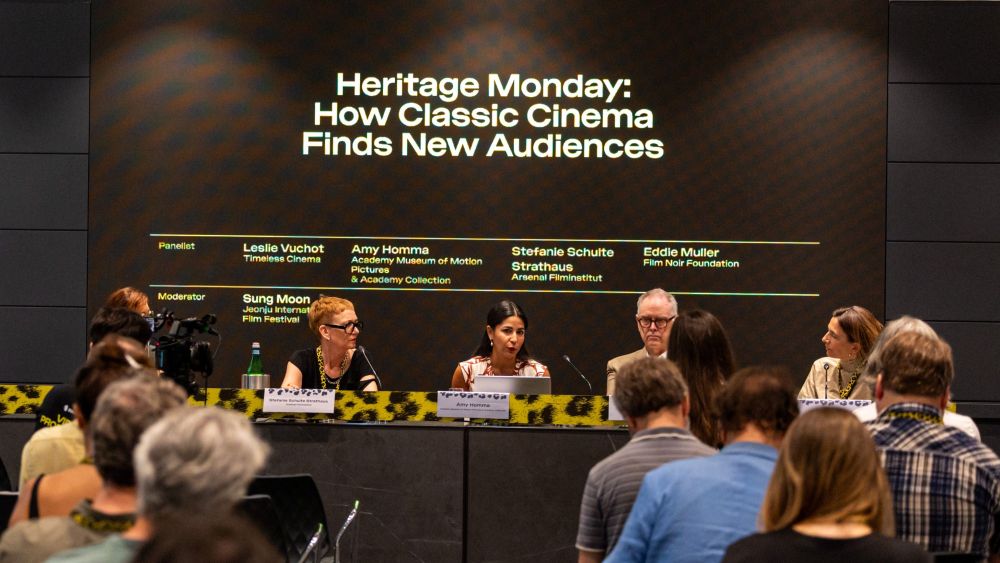
Heritage Monday has become a popular fixture at the industry section of the Locarno Film Festival, reflecting the growing interest in film restoration and retrospective programming. This year’s edition was specifically devoted to the challenge of gaining new young audiences for older films.
The panel, moderated by Sung Moon of the Jeonju International Film Festival, featured contributions from Leslie Vuchot of Timeless Cinema from France, Amy Homma from the Academy Museum of Motion Pictures and Academy Collection in the U.S., Arsenal Filminstitut’s Stefanie Schulte Strathaus from Germany and American author and programmer Eddie Muller from the Film Noir Foundation.
“When we give the chance to younger people to speak about something, it’s almost never about a recent film,” Vuchot said, citing her experience in running Le Lucernaire cinema in Paris. “It’s about something that’s been transmitted, transferred, and that they want to share as well. […] Young people feel the need to go back, even if it’s from books and stuff, to how films were made, going back to the roots and understanding where filmmakers got their inspiration from.”
For Muller, host of TCM’s “Noir Alley,” the key has been to replicate the mid-20th century, film-going experience, with double features and ushers as part of the atmosphere. A virtuous circle is created as the proceeds from festivals are poured into restoring films which can then be shown at festivals. His role as a host on Turner Classic Movies has also proved a turning point, increasing his visibility. He has brought school classes into his festivals and followed it up with lessons in schools and seen how students who had never seen a black and white film before on the big screen reacted to Humphrey Bogart and Lauren Bacall in “To Have and Have Not.” Muller says: “In a class of 35 students, if you’re lucky, you’re going to connect with six that are really into it, and the other kids are using social media to ignore everything that you’re talking about. But those six are really connecting in a way that will make a difference to their lives.”
Despite the ravages of TikTok, Homma argued for pragmatic optimism: “When we’re thinking of our audience, it’s so important for us to try and meet all of our audience members where they’re at, and not assume that they all understand that more cerebral motivation for why we go to a film.” One example to encourage engagement was to bring a real Dalmation — Pogo — to a screening of “101 Dalmations,” with an animator leading live-drawing classes and talking about the techniques used in the film. They also invited Guillermo del Toro to the museum and use the archive to illustrate his talk on films by Alfred Hitchcock.
As well as repertory cinemas such as the Academy and Le Lucernaire presenting films, heritage is also proving popular in general distribution. “There’s an urgent need that comes really from the present,” Schulte Strathaus believes. “Heritage film offers so many potential futures, and in a time where we don’t see a future anymore or it’s hard to see a future, we go back into film history, and see all those told and untold and ignored narratives, all those could have beens like those other potential histories that we didn’t know about or that didn’t make it into the present, and that maybe could have led us into a better present.”
Some problems were identified, such as the perennial need to secure funding whether from private donors or larger organizations or in a more grassroots way. Likewise, securing and even identifying rights continues to be a problem, which can even extend to subtitles, which might be copyrighted and need to be duplicated, causing unnecessary expenses. The solution proposed was more cooperation and coordination between archives, cinematheques and organizations internationally. Climate controlled archives are closing and even an internationally famous body such as the Motion Picture Academy is being overwhelmed by a growing amount of material while operating with the same number of staff and financial resources.
“I’m a forever optimist,” Homma says. “We are seeing more people care about the films.”
For Schulte Strathaus, who specializes in avant-garde film, the solution is to build communities who are not just audiences but who can creatively participate in the restorations, either for educational purposes or as artists helping in the preservation of filmmakers’ work.


