


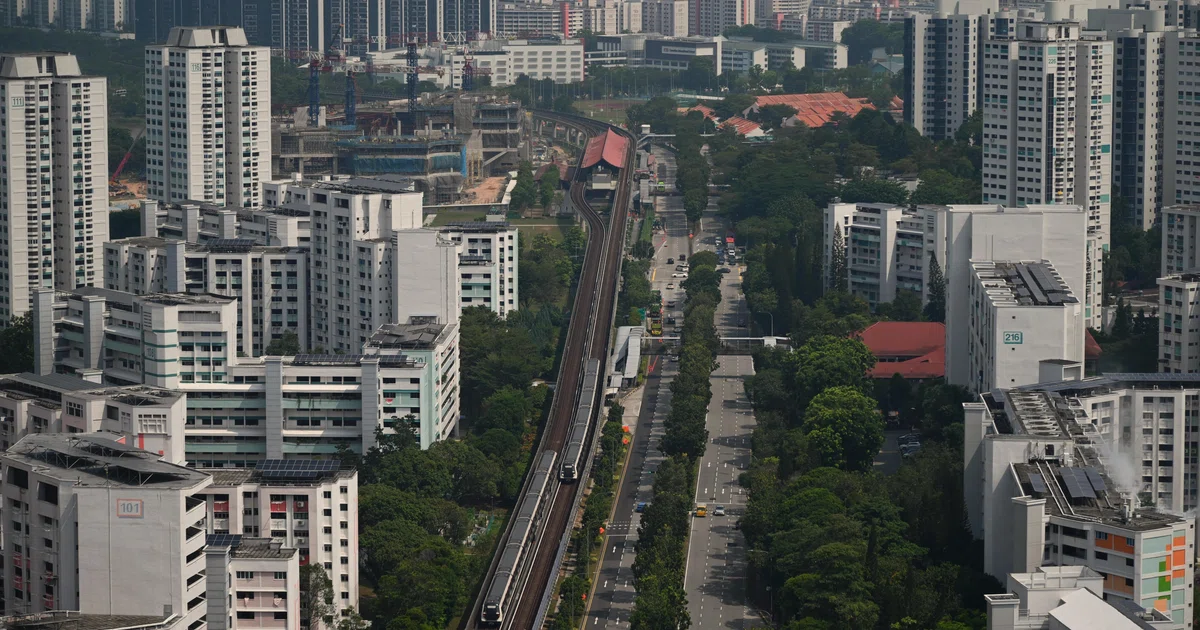
The division is identifying purchases made between 2007 and 2011 by officers involved in rail planning then
[SINGAPORE] The government is undertaking a review to assess if there was misconduct in civil servants’ purchases of property due to privileged information on planned MRT stations, as recently published research contends.
The review follows the publication of a working paper that reported a statistical association between civil servants working in agencies connected to rail planning and their purchases of private property near planned MRT stations, before the station locations were publicly announced.
The pattern was observed for MRT station announcements in or before 2011.
The Public Service Division (PSD) is identifying property purchases made between 2007 and 2011 – the period highlighted in the paper – by officers who were involved in rail planning at that time, and where the properties were close to locations subsequently announced as MRT stations.
“As these transactions took place some time ago, we will need time to retrieve the available records and examine the circumstances of each case. If we find evidence that an officer used non-public information to make a property purchase for personal benefit, the case will be referred to the police for further investigation,” PSD said in a statement released on Friday (Sep 25).
“We take the assertions in the paper seriously,” it said.
“The statistical patterns reported in the paper are a concern. But statistical patterns do not by themselves establish whether any individual officer actually had access to non-public information on MRT station locations at the relevant time, or whether such information influenced a property purchase.”
Research published in September by the National Bureau of Economic Research (NBER), a US-based non-profit organisation, found that mid-level civil servants disproportionately bought homes near MRT stations that were planned but not publicly announced.
The working paper found this behaviour concentrated one to two years before public announcements, and cited an estimated 113 property purchases totalling S$138 million.
SEE ALSO
PSD noted that information or speculation about planned MRT lines and stations may already be in the public domain or used to market new property developments.
“An officer may have purchased a unit in such a development for reasons unrelated to any non-public information. These possibilities do not remove the need for scrutiny, but underscore why each transaction must be examined carefully before any conclusion is drawn,” PSD said.
The NBER paper said that the buying behaviour it found was concentrated among mid-level officials and agencies connected to rail planning, and generated “meaningful private gains”, with pronounced gains over shorter holding periods. It was also observed among relatives, “consistent with information leakage”.
Data studied spanned “universe-level housing transactions” and compared purchases by civil servants against a control group of non-civil servants with similar demographic attributes and housing consumption behaviour.
After formal enforcement was stepped up in 2011 to 2012, a “subsequent decline in misconduct” was observed.
The paper, authored by academics based in the US and Hong Kong, studied “whether social norms inclined towards integrity could substitute for formal enforcement in deterring misconduct by public officials”.
“We find clear evidence of informed trading by civil servants,” wrote the authors Tomasz Piskorski from Columbia University, Amit Seru and Chun Zhao from Stanford University, and Jian Zhang from the University of Hong Kong.
PSD pointed to long-held rules and safeguards that prevent officers from using non-public information for personal benefit. Today, public officers are required to declare all property purchases: residential, commercial and land in Singapore and overseas.
The government also has controls over access to sensitive information and channels for reporting suspected wrongdoing, PSD said.
Officers with access to non-public information that may be relevant to a proposed personal transaction – whether involving property, vehicles or financial instruments – must declare their access and obtain approval before proceeding with the transaction.
Declarations for private property purchase were first introduced in 1996.
In 2011, an Internal Disclosure Policy framework was put in place.
Section 7 of the Public Sector (Governance) Act 2018 criminalises the unauthorised use of non-public information by civil servants for personal gain.
In 2025, reporting systems were enhanced to facilitate requests for private property purchase by public officers with access to non-public information.
“The government expects all public officers to uphold the highest standards of integrity. Where there are grounds to suspect that an officer has misused non-public information for personal benefit, the matter will be investigated and appropriate action taken,” PSD said. “At the same time, conclusions of wrongdoing must be based on evidence and the facts of each case.”
The NBER paper stated that the authors “benefited immensely from discussions” with individuals including economist Li Shengwu, the estranged nephew of Senior Minister Lee Hsien Loong.
It also acknowledged current and former academics at the National University of Singapore, including Sumit Agarwal, Qian Wenlan, Jessica Pan, Ivan Png and Bernard Yeung. Some have since distanced themselves from the publication.
