






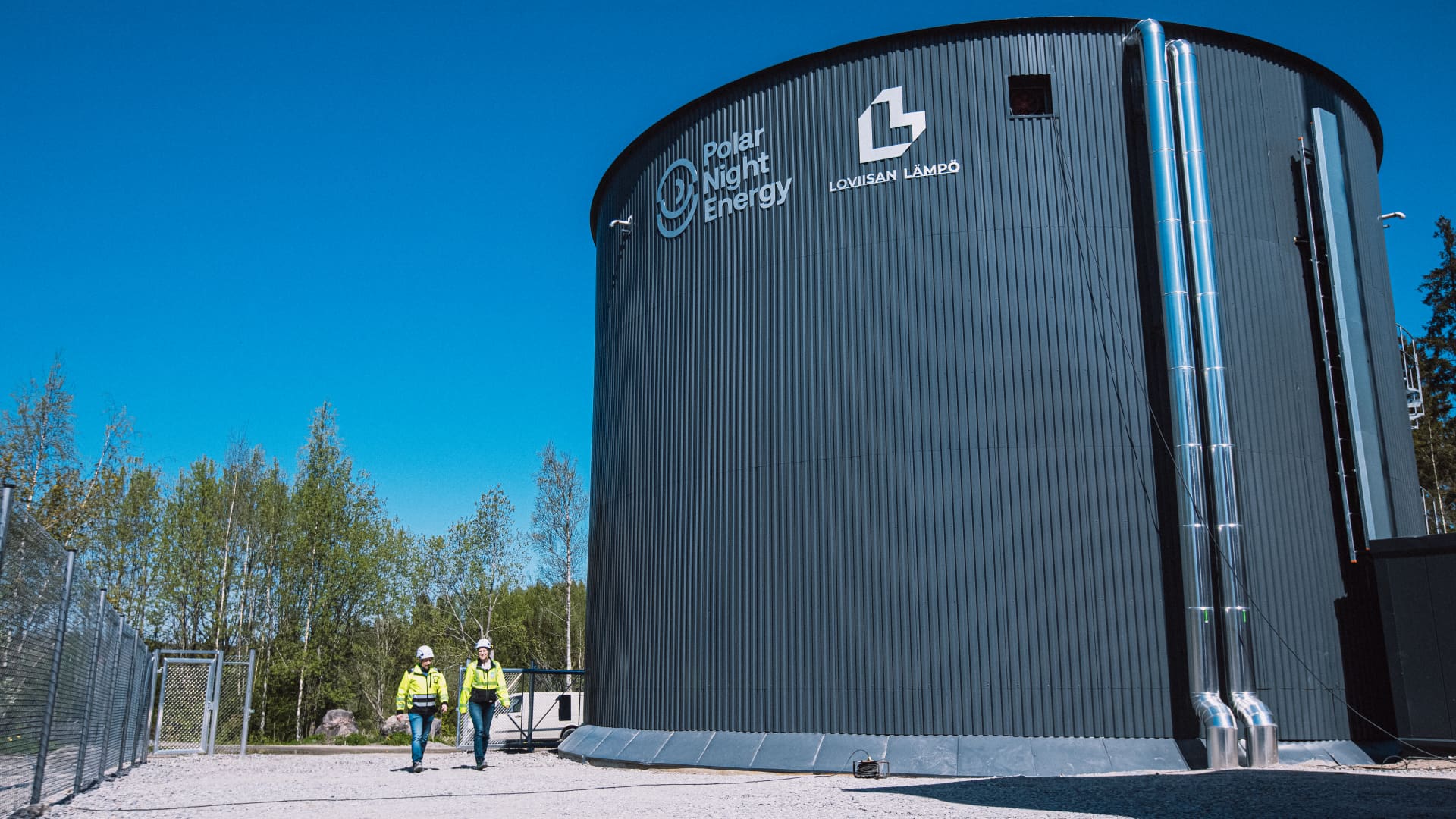
The industrial-scale sand battery in Finland’s Pornainen can cover almost one month of the town’s heating demands in the summer and as much as one week in the winter.
Polar Night Energy
A small town in southern Finland has turned to the world’s largest commercial sand battery to fix what many see as the most critical problem facing renewable energy: intermittency.
Standing at 13 meters tall and 15 meters wide, the eye-catching facility uses 2,000 metric tons of crushed soapstone to store clean energy in the form of heat to provide 100 megawatt-hours of thermal energy.
That’s enough to provide the 5,000 residents of Pornainen with nearly one month of heat demand through the summer — and roughly one week of demand in the winter.
Commissioned by Finnish district heating company Loviisan Lämpö and developed by Polar Night Energy, the giant sand battery launched last year as part of a push to introduce a flexible heat production technology and reduce carbon emissions generated by the local district heating network.
Polar Night Energy said the project is estimated to have slashed greenhouse gas emissions from the heating network by almost 70% and reduced the use of wood chips by about 60%. An existing wood-chip power plant remains in operation as a backup and peak-load facility.
Tommi Eronen, CEO of Polar Night Energy, said Pornainen had previously relied on burning oil and wood chips for its heating needs — but the town’s sand battery was now able to provide combustion-free heating for the majority of the year.


“We’re changing from a world where big power plants were doing the energy production to where solar and wind are producing the energy, then we need a massive amount of storage,” Eronen told CNBC on a video call.
“Hopefully a big portion of those storages could be sand battery-type of storages where we don’t need rare earth materials, like in many chemical batteries, such as lithium-ion batteries.”
The Pornainen project is about 10 times larger than an earlier version launched in the country in 2022, reinforcing the potential for sand batteries to play a more prominent role in cutting emissions both domestically and abroad.
Battery storage is widely expected to play a pivotal role in the energy transition — and sand batteries in particular have shown promise for regional heat storage, but scaling up this technology faces significant hurdles. Some notable criticisms include their ability to efficiently convert heat back to electricity and their relatively low energy density compared to traditional batteries.
How does it work?
Essentially, the sand battery technology operates as something akin to a giant thermos with heat-storing material.
The first step is to get electricity off the grid when there is plenty of wind or solar power, before then heating up the sand to very high temperatures. The heavily insulated silo keeps that heat trapped for days or weeks before being discharged via heat exchangers to warm water for the local district heating network.
“Three steps — and the key to the whole thing is the sand enables you to have a delay between the time you use electricity, and you use the steam,” Polar Night Energy’s Chief Commercial Officer Annette Höglund-Dönnes told CNBC by video call.
“That delay is your business advantage because you can heat up the sand when the electricity is cheap, and you use the steam when normally it would be very expensive to produce steam off the grid, which is the daytime when everybody else is using it,” she added.
The industrial-scale sand battery in Finland’s Pornainen stands at 13 meters tall and 15 meters wide. The facility uses 2,000 metric tons of crushed soapstone to store clean energy in the form of heat.
Polar Night Energy
Höglund-Dönnes compared the process to charging a cell phone overnight given that this can be less expensive than during the day.
Asked whether the project could be replicated internationally, Höglund-Dönnes said Polar Night Energy had been contacted by teams from “every single continent,” particularly by communities dependent on fossil fuels, such as coal and oil.
Climate scientists have repeatedly warned that a substantial reduction in fossil fuel use will be necessary to curb global heating, with the burning of coal, oil, and gas identified as the chief driver of the climate crisis.
Renewable intermittency
Jan Rosenow, professor of energy and climate policy at the U.K.’s University of Oxford, agreed that electrothermal storage technologies, such as sand batteries, were likely to be replicated across the globe.
“You don’t need rare earths, critical raw materials and the beauty is you can also charge up the battery when the electricity is cheap and discharge whenever you need the heat,” Rosenow told CNBC.
“And you can store it for long periods, not just two hours or four hours like lithium-ion batteries, but potentially for days and maybe even weeks.”
Critics of renewable energy, for example, often point out that technologies such as solar and wind only produce energy when the wind is blowing or the sun is shining.
Energy storage systems such as batteries play a pivotal role in smoothing renewable intermittency by absorbing excess solar and wind generation and dispatching it when production dips.
Mikko Paajanen, CEO of Loviisan Lämpö, said the sand battery helps to clear this energy transition hurdle.
“The main thing is that we can separate the electricity procurement from the district heating production because now we are able to deliver this heating during the wintertime for one week, with one charge of the battery, and during the summertime, it even lasts as long as one month,” Paajanen told CNBC by video call.
“So, we can utilize the low spot prices very well.”
Loviisan Lämpö’s’ CEO said the company was aiming to produce between 55% to 60% of the municipality’s district heating production from the sand battery through the first few months of this year, up from roughly 30% in 2025.
Finland’s Climate Minister Sari Multala described the sand battery project in Pornainen as a “very inspiring” and innovative example of how to solve the challenge of energy storage.
“I understood when I also visited the plant when it was opened that they are now also developing solutions for maybe using electricity as well in the future, which would be, of course, groundbreaking — and this would be something that a lot of people would see value in,” Multala told CNBC.


