


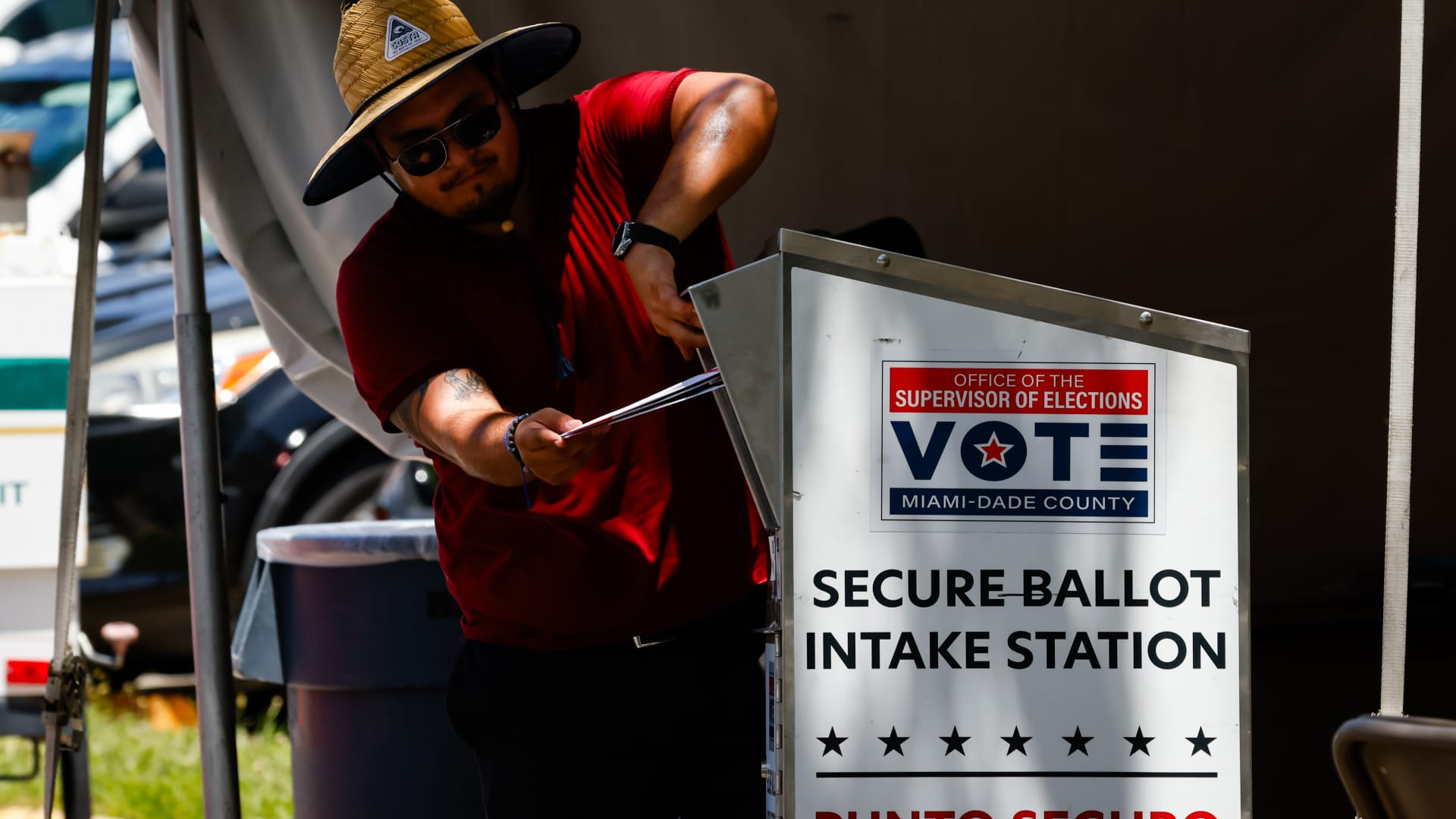
A federal judge on Wednesday lifted the final injunction blocking President Donald Trump’s executive order restricting mail voting, clearing his administration to impose new ballot requirements weeks before the November midterm election.
The decision came as the policy faced a fresh wave of litigation. Democratic-led states filed a new lawsuit earlier Wednesday, while voting-rights groups amended their existing complaint to challenge the finalized U.S. Postal Service rule — the third legal challenge targeting it.
U.S. District Judge Indira Talwani vacated the nationwide preliminary injunction she issued earlier this month, concluding that Monday’s Supreme Court ruling in a related case required her to reconsider it.
The Postal Service had said it would not apply the rule to the 2026 elections unless both injunctions against it were lifted. That condition has now been met, and the new lawsuits do not themselves prevent USPS from moving forward.
USPS did not immediately respond to a request for comment.
Wednesday’s decision and new litigation added to the dizzying back and forth over whether Trump’s desire to add hurdles to voting by mail will come to fruition by the Nov. 3 election. Because the election is less than 10 weeks away, preparations for mail-in voting are already underway in states.
The Postal Service rule requires states to provide lists of mail voters and use federally reviewed ballot envelopes with unique barcodes. USPS could reject ballot mailings that do not comply.
About 30% of voters cast ballots by mail in 2024, according to the states challenging the policy. A Pew Research Center survey after the 2024 election found that 44% of Democratic voters said they voted by mail or absentee, compared with 26% of Republican voters.
Neither Talwani’s decision nor the Supreme Court ruling upheld the policy’s legality. Both turned on whether the challengers had sued before USPS finalized its rule.
Talwani found that the voting-rights groups were unlikely to overcome that procedural issue without amending their complaint “to reflect the fact that a Final Rule has now issued,” she wrote in the nine-page order.
The groups have now made that change, arguing that publication of the rule eliminates the uncertainty identified by the Supreme Court.
“USPS has no such authority,” the groups wrote, arguing that the rule gives the agency an “unprecedented gatekeeping role” in mail voting and intrudes on authority belonging to states and Congress. The groups can now ask Talwani to issue another injunction.
The lawsuit filed Wednesday challenging the finalized rule came from 23 states, Washington, D.C., and Pennsylvania Gov. Josh Shapiro, a Democrat.
The filing follows the path laid out by the Supreme Court, which lifted the states’ earlier injunction Monday because they had challenged Trump’s executive order before federal agencies finalized the policies it directed them to develop.
The justices stressed that their decision did not establish that Trump’s order or the policies implementing it were legal. “On that score, time will tell,” the majority wrote.
“Courts review final rules, not proposed rules — and certainly not antecedent internal directives to propose a rule,” the court wrote.
USPS has now finalized its 95-page rule, giving the states the concrete policy the Supreme Court said was previously missing.
The rule requires election officials to submit each mail voter’s name and address to a new USPS portal, along with unique Intelligent Mail barcodes assigned to the envelopes used to send and return that voter’s ballot. Election officials would also have to submit their outgoing and return ballot-envelope designs to USPS for review.
Before accepting outgoing ballot mailings, postal employees would scan the envelopes to confirm their barcodes appear in the federal portal. Mailings that fail the verification process would not be accepted and would be returned to election officials to correct and resubmit.
The states argue the last-minute requirements could prevent eligible voters from receiving ballots because of administrative errors, technical failures or delays. Election officials have already designed and purchased envelopes and are preparing to send ballots for the midterms, which are less than 10 weeks away, they said.
California Gov. Gavin Newsom, whose state is among the plaintiffs, said in a post on X, Trump “does not run elections. States do.” Newsom pledged California would continue challenging the administration’s actions.
The coalition argues in its complaint that the rule exceeds USPS’ statutory authority, violates the Voting Rights Act and intrudes on states’ constitutional power to administer elections.
The states also contend that requiring them to identify mail voters to USPS violates federal privacy protections governing records of individuals’ First Amendment activity.
USPS says the rule would improve ballot tracking, assist law enforcement and reduce the risk of fraud while leaving decisions about voter eligibility to state election officials. The agency says it would not compare information in the portal against state voter rolls or independently determine whether an individual is eligible to vote.
The new lawsuit does not immediately change the rule’s status. USPS remains barred from implementing it for the November election under a separate nationwide injunction issued in a case brought by the League of Women Voters and other voting-rights groups.
White House spokeswoman Lauren Bis defended the policy, calling Monday’s Supreme Court ruling “a major win for the security of American elections.”
“Radical Democrats continue to oppose commonsense measures that protect the security of mail-in ballots and ensure only Americans are electing American leaders,” Bis said. “The Trump Administration will continue to lawfully enact the agenda President Trump was elected on — which includes the safety and security of our elections.”
