



There was some speculation, when it emerged that Nigel Farage was heading to Threadneedle Street to see the Bank of England governor, that he was about to “do a Trump”.
You might recall, if you follow American politics, how the US president has been, for want of a better word, trolling the chairman of the Federal Reserve, Jerome Powell, threatening to fire him if he didn’t cut interest rates. Might Mr Farage and Reform be about to do the same thing in the UK, raising deep (and, for economists, scary) questions about the independence of the central bank?
The short answer, as far as anyone can tell following today’s meeting, is: no. Instead, Mr Farage and his fellow Reform MP Richard Tice enjoyed a relatively cordial meeting with the governor, where they discussed the intricacies of quantitative easing, the Bank’s reserves policies and even cryptocurrency – a slightly unexpected addition to the agenda which might reflect the fact that Reform is hoping to raise lots of campaign funds from crypto dudes.
Money latest: HMRC can now take money direct from your account if you don’t pay
The main Bank-related issue Reform has been campaigning on – Mr Tice in particular – comes back to something seemingly arcane but certainly important. As you may be aware, in recent years, the Bank of England has, alongside its interest rate policy, been engaged in something called quantitative easing (QE). QE is complex, but it boils down to this: in an effort to boost the economy, the Bank bought up a lot of government bonds and they now sit awkwardly in its balance sheet. In recent months, the Bank has begun to reverse QE (quantitative tightening) – selling off billions of pounds of bonds.
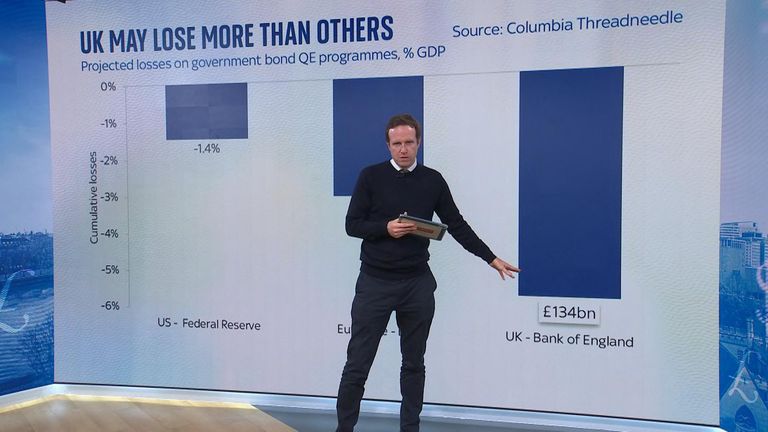
Bank of England’s £134bn gamble
Anyway, reach deeper into the arcane mechanism of how QE works and something interesting leaps out. Two things, actually. First, as part of QE, in order to get hold of those government bonds, the Bank created “reserves” – sort of bank-account-at-the-Bank-of-England – for the high street banks from whom it bought them.
Tens of billions to high street banks
Those reserves earn interest at the Bank’s official interest rate. At the time of QE, the rate was near zero, so no one spent much time thinking about reserves. But since then, rates went up to 5.25%, and are now at 4%, and hence the Bank has recently been paying out a hefty amount – tens of billions of pounds – in interest to high street banks.
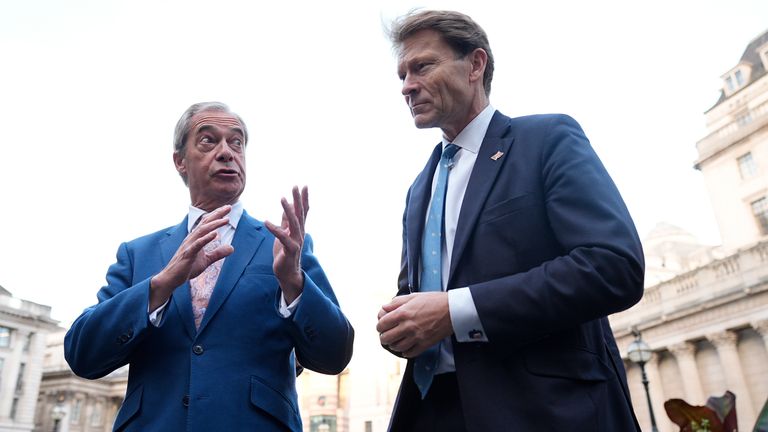
Reform UK leader Nigel Farage (left) and deputy leader Richard Tice speaking to the media outside the Bank Of England in central London. Pic: PA
This, says Richard Tice, is an abomination. In the last Reform manifesto, he said the Bank should stop paying out those reserves. Which, on the face of it, sounds perfectly sensible. However, there are a few catches.
A big bank tax
The first is that while in theory it might help recoup billions of pounds of public money, that money has to come from somewhere, and in this case, it would come from high street banks. In other words, this is, in all but name, a very big bank tax. The Bank of England’s point, when asked about all this, is that if anyone is going to do something like that, it should really be the government, since it’s rightly in charge of taxing and spending.
Read more:
Co-op reveals £80m profit hit from cyber attack disruption – with more to come
Jaguar Land Rover cyber attack: No easy options for taxpayer aid
The other catch is that Bank of England reserves systems are desperately complex. Changing the way they’re structured is a delicate operation. Running a coach and horses through it, as Mr Tice is suggesting, could have all sorts of unintended consequences, including undermining confidence in UK economic policy.
This, by the way, is not the only thing Reform is unhappy about: they also think the Bank should slow down its quantitative tightening programme.
But the point of all the above is that while there are some big question marks about the particular idea Reform is proposing, the worst thing of all would be not to discuss this as publicly as possible.
The worst outcome of all would be for the government and Bank to take certain decisions which affect billions of pounds of public money with only the merest of scrutiny, save at the Treasury Select Committee, whose sessions rarely get much attention beyond the financial pages. And that is more or less the situation we’ve had for the past decade and a half.
The Bank of England has introduced one of the most radical monetary experiments in history, which may or may not have been a success or a failure, but few outside of the City are even aware of it. Mr Tice’s policy platform may be flawed, but his overarching point – that this stuff desperately needs more scrutiny – is quite right.
