


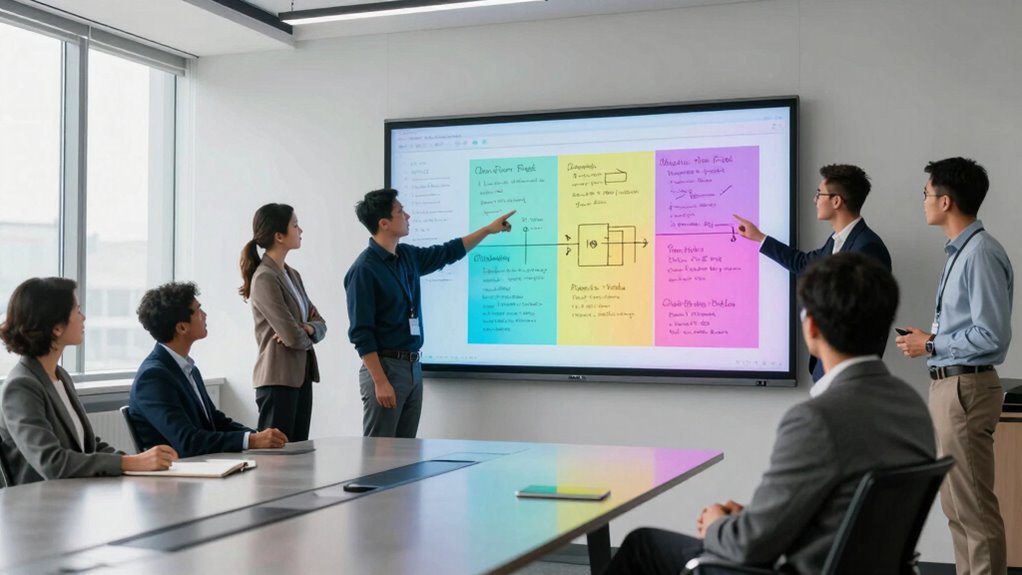
Digital whiteboards are more useful than many remote teams realize because they enable real-time collaboration, making it easy to share ideas instantly and make visual adjustments. They help organize complex information with diagrams and color coding, boosting clarity and team alignment. Plus, they support multimedia content to keep everyone engaged and serve as a central knowledge hub for ongoing projects. Keep exploring to discover how maximizing their potential can transform your team’s workflow.
Key Takeaways
- Facilitate real-time collaboration, allowing teams to work simultaneously and instantly share ideas on a digital canvas.
- Enhance clarity and organization through visual structures like diagrams and color-coding, simplifying complex information.
- Increase engagement and learning by incorporating multimedia elements and transforming meetings into interactive sessions.
- Serve as a central, accessible knowledge repository for ongoing projects and future planning.
- Boost remote team productivity and inclusivity by streamlining workflows and enabling contributions from all locations.
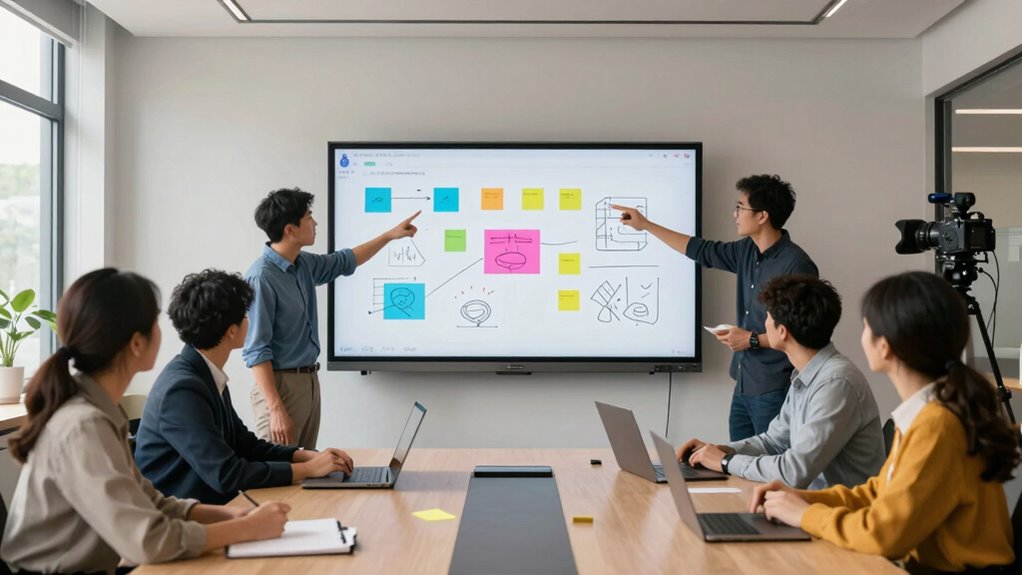
Many remote teams overlook the full potential of digital whiteboards, often using them just for basic note-taking or brainstorming. But these tools offer much more when you harness their capabilities fully. One of the biggest advantages is real-time collaboration. Instead of exchanging endless emails or juggling multiple chat threads, you can work simultaneously on the same digital canvas. Everyone can add ideas, adjust visuals, or provide feedback instantly, which accelerates decision-making and fosters a more dynamic team environment. When you leverage real-time collaboration, you eliminate delays and miscommunications, making your projects run smoother and more efficiently.
Unlock team synergy with real-time collaboration on digital whiteboards for faster decisions and seamless teamwork.
Additionally, understanding the importance of digital whiteboard features can help teams unlock even greater productivity and engagement. Beyond collaboration, digital whiteboards excel at visual organization. You can structure complex information through diagrams, flowcharts, or color-coded notes, making abstract ideas clearer and easier to understand. This visual approach helps you and your team see connections you might miss in text-based formats. For example, with a few clicks, you can group related ideas or highlight priorities, which improves clarity and keeps everyone aligned. Incorporating visual structuring techniques can further enhance clarity, especially when managing large or complicated projects. This technique also taps into the visual learning aspect, which can improve comprehension and retention among team members. Moreover, digital whiteboards often include integrated multimedia support, allowing you to embed videos, images, or links directly into your workspace to enrich your discussions. This visual organization also means you can adapt your board on the fly—adding new insights or rearranging elements as discussions evolve—without losing track of the bigger picture.
Using digital whiteboards in this way transforms your meetings from passive discussions into interactive problem-solving sessions. When you display data visually, it becomes easier for everyone to grasp complex concepts quickly. You can embed images, links, or even multimedia content to enrich your presentations and keep engagement high. The collaborative aspect ensures that all voices are heard, as team members can contribute regardless of their location, fostering inclusivity and diverse perspectives.
Furthermore, digital whiteboards serve as excellent repositories for ongoing work. Instead of losing ideas after a meeting, you keep everything in one accessible place. Over time, this creates a valuable knowledge base that your team can revisit for reference or future projects. Because they are often cloud-based, these boards allow seamless access from any device, supporting flexible work arrangements.
In short, when you move beyond basic uses, digital whiteboards become powerful tools for enhancing communication, fostering creativity, and streamlining workflows. Embracing their full potential means actively utilizing real-time collaboration and visual organization to boost productivity and team cohesion, making remote work feel more connected and effective.
digital whiteboard for remote collaboration
As an affiliate, we earn on qualifying purchases.
As an affiliate, we earn on qualifying purchases.
Frequently Asked Questions
Can Digital Whiteboards Be Integrated With Existing Project Management Tools?
Yes, digital whiteboards can be integrated with your existing project management tools. While some integration challenges may arise, most platforms offer seamless options or plugins to connect with popular tools like Jira or Trello. You’ll need user training to maximize their benefits, ensuring your team understands how to synchronize workflows. Once integrated properly, you’ll find collaboration more streamlined, boosting productivity and team communication.
How Secure Are Digital Whiteboards for Sensitive Company Data?
Think of digital whiteboards as a vault for your data; they’re quite secure if you use the right tools. You can improve security by ensuring they employ data encryption and strict access controls. These features make it difficult for unauthorized users to access or tamper with sensitive company data. So, when chosen carefully, digital whiteboards offer a safe environment for your team’s confidential information.
Do Digital Whiteboards Support Real-Time Collaboration Across Different Time Zones?
Yes, digital whiteboards support real-time collaboration across different time zones through time zone synchronization, guaranteeing everyone stays on the same page. They also facilitate asynchronous collaboration, allowing team members to contribute at their convenience. You can leave notes, update ideas, or review designs anytime, making remote teamwork smoother and more flexible. This combination guarantees seamless coordination, regardless of where your team members are located or their working hours.
What Is the Learning Curve for New Team Members Using Digital Whiteboards?
Think of learning a digital whiteboard as climbing a gentle hill—you’ll get comfortable quickly. For new team members, onboarding challenges are minimal with intuitive interfaces and helpful tutorials. Most tools require only basic training, making the shift smooth. While initial training needs some effort, it’s worth it for the seamless collaboration that follows. You’ll soon navigate digital whiteboards with confidence, turning onboarding hurdles into a quick ascent.
Are There Cost Differences Between Digital Whiteboards and Traditional Whiteboards?
You’ll find that digital whiteboards often have a different cost comparison compared to traditional whiteboards. While digital options usually involve higher upfront costs, they save you money over time through features like easy updates and collaboration tools. Material durability is another factor—digital whiteboards don’t wear out like traditional ones, which can scratch or stain. Overall, digital whiteboards can be a more cost-effective choice in the long run.
Conclusion
By now, you see how digital whiteboards can transform your remote collaboration. They boost engagement, streamline ideas, and foster creativity—all essential for success. Did you know that teams using digital whiteboards report a 30% increase in productivity? So, don’t underestimate their potential. Embrace these tools to make your meetings more dynamic and effective. With digital whiteboards, you’re not just working remotely—you’re working smarter.
