


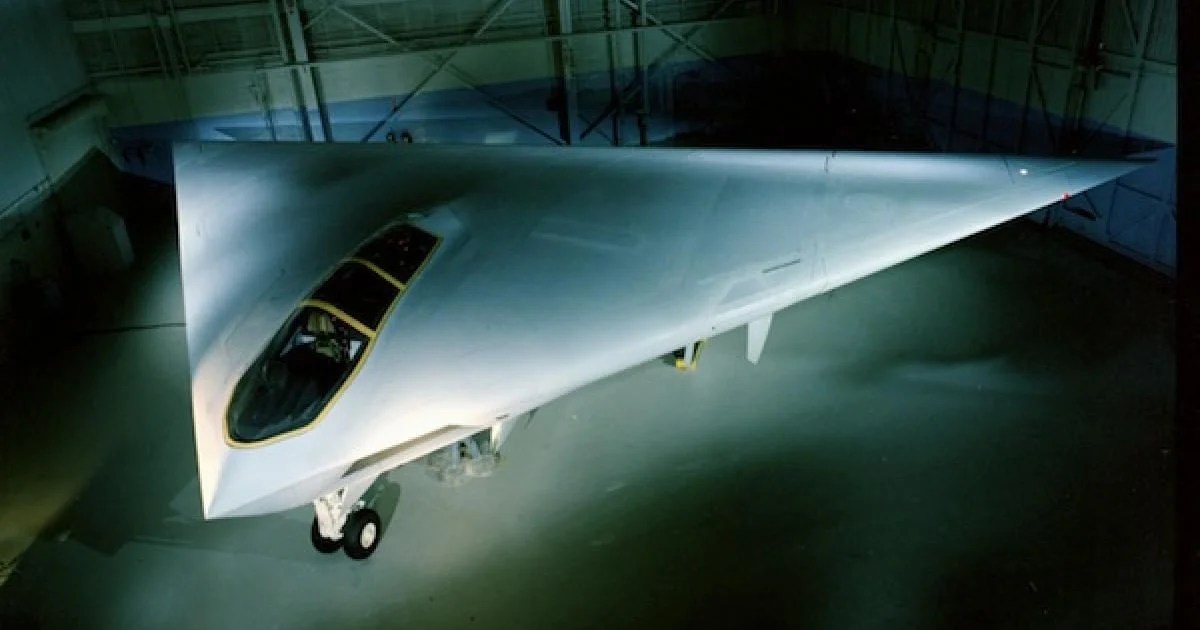

The A-12 Avenger II was to be the Navy’s quantum leap—a stealth, carrier-based bomber capable of penetrating today’s defenses and striking deep into enemy territory. By the late 1980s, the reliable A-6 Intruder was aging, and with tensions running high during the Cold War, the Navy desired something new that would be able to withstand radar-guided missiles and complex air defense networks.

That requirement spawned the Advanced Tactical Aircraft (ATA) program. Its mission was ambitious: design a stealth attack plane that could take off from carriers.

The Air Force had already shocked the world with the F-117 Nighthawk, and the Navy wanted an answer of its own. In 1988, the contract was given to McDonnell Douglas and General Dynamics, and the A-12 Avenger II was conceived—at least on paper.

The design itself raised eyebrows. It was a thin, triangular flying wing that soon acquired the nickname “Flying Dorito.” Weapons were stowed within the fuselage to prevent it from being detected by radar, its body was constructed with sophisticated composite materials, and it sported radar-absorbing coverings. Two personnel would be crammed within, enjoying sophisticated radar, electronic warfare systems, and state-of-the-art avionics. On paper, it offered a staggering range of over 900 nautical miles, much larger than its predecessors.

But turning that vision into reality was much more difficult. Balancing stealth needs with the harsh rigors of carrier takeoffs and landings posed enormous engineering challenges. The plane’s weight got out of hand, raising serious questions about whether it could fly safely for carriers. New materials and unproven construction techniques only brought further delays and technical problems.

Secrecy compounded the problem. Being a classified “black” project, it was protected from the usual layers of scrutiny. Congress and even the Pentagon didn’t fully know how deep the issues went. Contractors played down the problems to keep the show alive, and Navy officials—worried that the project would be canceled—did likewise.

The cost blowout was astronomical. What started as a $4.8 billion program had grown to almost $11 billion, with anticipated unit costs jumping to over $165 million per plane. The A-12 was a year and a half behind schedule, over budget by billions, and still far from flight-worthy by the early months of 1991.

That January, Secretary of Defense Dick Cheney pulled the plug, closing out what would become the single largest contract cancellation in Pentagon history. The only A-12 ever built was a full-size mockup. The aftermath was ugly. A courtroom fight between the government and contractors continued for more than two decades before finally concluding in 2014.

With the A-6 now absent, the Navy relied significantly on the F/A-18 Hornet and then the Super Hornet to make up for it. It wasn’t until the arrival of the stealthy F-35C that the Navy finally had a carrier-capable stealth fighter, but still not the long-range bomber that the A-12 had been intended to be.

Today, the A-12 Avenger II is a cautionary example in American aeronautical history. It serves to remind us of the risk of promising too much with new technology, underestimating complexity, and permitting secrecy to obscure hard realities.

The “Flying Dorito” never took off, but its history changed how the Pentagon treats gargantuan weapons programs, imposing tighter controls and more realistic expectations before embarking on the next giant step in military aviation.
