


In the summer of 2021, a year after Cooper Hoffman finished filming Licorice Pizza — the movie that would make him a movie star practically overnight — he was on the set of Steven Spielberg’s The Fabelmans, working one of the lowest jobs on the crew’s hierarchy.
His official title was COVID production assistant, which meant that he sat at a folding table, clipboard in hand, checking in the cast and crew as they arrived for their daily nasal swabs. Hoffman had been dispatched to the production by Licorice Pizza director Paul Thomas Anderson, who knew about the attention, praise and potential for ego inflation that would come when that film hit theaters in a few short months. “He told me, ‘You’ve seen how this side lives, now you have to see the other side,’ ” says Hoffman. Though Anderson has been minting young talent for decades, this young actor was different: His father is the late Philip Seymour Hoffman, PTA’s close friend and longtime collaborator, whose 2014 death devastated the filmmaking world.

Myles Hendrik
That made his stint as a PA, a job that would typically be anonymous, different too. When Spielberg caught wind of Hoffman’s presence on set, his reaction was, according to Hoffman, “Why didn’t I know about this?” An introduction was quickly arranged. “It was like meeting the president,” Hoffman says with his boisterous laugh. “I stood there with the first AD and a security guard, and they were like, ‘Steven’s approaching.’ He’s 20 feet away, and I can see him walking up. We had maybe a five-minute conversation, but he was lovely and was like, ‘I’m so happy that I got to meet you; Licorice Pizza was fantastic.’ ”
Unsurprisingly for an actor who entered the industry in the shadow of his famous father, after his debut, Hoffman gravitated toward projects that offered some form of familiarity. He took a part in Wildcat, a passion project from Ethan Hawke, who was a member of his father’s LAByrinth Theater Company, that also starred Hawke’s daughter Maya, a childhood friend. He joined the ensemble of Saturday Night, overseen by Jason Reitman, who also grew up in the industry. He did The Long Walk, directed by Francis Lawrence, the last person to work with his father (on The Hunger Games: Mockingjay).
It felt good to be under the tutelage of Philip’s inner circle, working with people who really cared. “Every male actor over 40 wants to be his mentor,” says Andrew Garfield. “I’m one of those people! It’s because we love him and we love his dad. And Cooper laughs about it, like, ‘Yeah, get in line behind Daniel Day-Lewis, buddy, he wants to be my mentor, too.’ ” He didn’t worry about differentiating himself from his father because he’s proud of his legacy and is also smart enough to know that any similarities — his gregariousness, his physicality, his vulnerability — are a strength.
But now, at 23, Hoffman is ready to get uncomfortable — branching beyond the safety net of his father’s inner circle and taking on roles in two of the year’s most provocative films.
He stars in punk filmmaker Gregg Araki’s I Want Your Sex, a boundary-pushing and explicit comedy about a young intern who enters a dom-sub relationship with his famous artist boss (played by Olivia Wilde). He’d never even filmed a sex scene before joining the indie, which sees him in bondage, having a threesome, pegging and masturbating onscreen.
Luca Guadagnino’s highly anticipated OpenAI exposé Artificial will follow. The movie traces the tumultuous period in which ChatGPT founder Sam Altman was fired and rehired in a matter of days; Hoffman plays a “little henchman” to Garfield’s Altman, and though he isn’t allowed to reveal much about the plot, he says Guadagnino told him to play the part “as though your character would leave his wife for Altman.” The movie apparently struck too close to home for Amazon, its original distributor, which dropped the film just months after making a $50 million investment in OpenAI. Neon has since acquired it and plans to release it later in 2026, positioning the film for an awards campaign.
After Hoffman saw an early cut of I Want Your Sex for the first time, and with the liquid courage of a post-screening martini, he decided that he was both really proud of what he’d done and really excited for people to see it. And then he got to Sundance, where the film had its premiere. “I was like, ‘Oh my God, I actually can’t believe this theater is going to watch this,’ ” he says. “And it got to the scene of me masturbating, and all I could think was, ‘Please shut it off. Please shut it off.’ “
With the benefit of time, he’s back to being excited — enough for the press-shy actor to sit for this, his first big cover story. We’re at Cafe Medina in Vancouver, where he’s filming the lead in a Hulu pilot about a washed-up snowboarder pulled into a criminal underworld. He’s still getting used to the day-to-day realities of shooting away from home, away from his things (he’s very particular about lighting, so he really misses his lamps) and away from his people. “Back in New York, I have my mom and my friends, and if some shit went down, I’d always have someone to call,” he says.
Sitting outside, we see the street celebrations erupt when Canada wins its World Cup knockout round game against South Africa. The citywide jubilation exacerbates his homesickness: It reminds him that he missed the ticker-tape parade celebrating the Knicks’ NBA championship. Hoffman has been a lifelong fan thanks to growing up in Manhattan and the influence of his father. He made it to one game of the Finals (with friend and fellow actor Dylan O’Brien), but it was the one that the Knicks lost, which he blames on President Trump’s appearance. “I truly was like, ‘Get the fuck out of MSG —you’re making this miserable for everybody.’ “
He had to watch the rest, including the historic final game, alone on his phone in the middle of the night while he was in London for his girlfriend’s sister’s wedding. “I grew up going to games with my dad, and it was a big part of our relationship, so I always knew that if they won, I would have a multifaceted feeling about it,” he says. “I love this team, I’ve had the privilege of meeting a few of them, and this is a thing I’ve wanted for 23 years. I was sad not to be in New York celebrating with my city, but the only person I really wanted to be celebrating with was my dad. I just feel like it’s such a shame my dad didn’t get to see it.”
MM6 Maison Margiela coat, shirt; Carhartt pants; Hoffman’s
jewelry.
Photographed by Myles Hendrik
***
Hoffman grew up in the West Village, the oldest child to Philip and Mimi O’Donnell, a prominent figure in New York’s theater scene and the former artistic director of LAByrinth. (Despite all the acclaimed actors clamoring to give Hoffman advice, it is his mother’s opinion that he says he holds in highest regard.) He went to public school through eighth grade and spent his days running around the island — playing pickup basketball near the Hudson River, eating BLTs at La Bonbonniere (a diner haunt of his father’s and Ethan Hawke’s) and going to art house movie theaters. His grades were bad, and he didn’t have much academic or career ambition, so when it came time to apply to high school, choices were limited. He wound up at the Harbor School, a marine biology-focused campus on Governors Island. After taking the ferry to first period, he’d watch his fellow students harvest clams and mussels from the Hudson River with fervor, wondering what he was doing there. Eventually, Day-Lewis stepped in and got Hoffman a spot at Calhoun School, a private arts-focused school on the Upper West Side that his son attended.
At Calhoun, Hoffman’s last name didn’t mean much. His father had been a true Hollywood force, a four-time Oscar nominee — for Charlie Wilson’s War, Doubt, The Master and Capote, for which he won best actor — and was admired offscreen, but at school, Hoffman was in a cohort of people with more money than is fathomable. Besides, high school fame operated on a different currency. “New York has these kid celebrities, guys everyone knows, but for no other reason than they sold drugs or had sex earlier than everyone,” he recalls with a laugh. He and his friends all got fake IDs, the expensive kind that actually work, and started going out to East Village bars like Niagara and Pianos.
Life also revolved around going to set. The family had a rule about not going longer than a few weeks without being together, so they would often travel to his father’s productions. “I hated my dad’s job because I was always like, ‘Why are you going away for three months?’ ” Hoffman was only 10 when his dad died, so Anderson stepped in to provide emotional support. (He was “Uncle Paul.”) He nurtured the younger Hoffman’s interest in film, directing home movies with Cooper and his own kids and bringing him to his sets. “The one I remember most is Phantom Thread,” Hoffman says. “My family stayed for three weeks, and I would watch Paul work pretty much every day. I was like, ‘Wait, you just get to bring a bunch of people that you like together and make something?’ I could finally see why my dad was doing it.”
With his soon-to-be Artificial co-star Andrew Garfield.
Michael Kovac/Getty Images for AFI
When Anderson started making his next movie, he didn’t intend to cast Hoffman. He auditioned dozens of young actors and put many of them on tape with co-star Alana Haim, but nothing ever felt right (Anderson has said in the past that he realized he needed a novice in the role). Hoffman, who was 15 at the time, had never acted professionally before, but he had the on-set exposure, the time in front of Anderson’s home camera and the genes. As he remembers it, he had no idea what he was doing. “I fully thought we were going to be shooting on an iPhone, I swear to God,” he says with a laugh. “I just couldn’t wrap my head around it. I couldn’t process: We’re shooting on film, Sean Penn is going to be in this movie, I’m filming with Bradley Cooper. And I’m the lead.”
The specifics of the environment helped. He had Anderson to guide him, of course (“With a new boundary in place because he was my boss now and it’s not like us getting dinner”), but they also shot during COVID with a very tight set. Hoffman, along with his mother and two younger sisters, lived three houses down from Anderson and his partner, Maya Rudolph, during the production. He didn’t have to think about what this film might mean to the outside world because, then, there was no outside world.
“I thought I knew about fame,” he says. “I was surrounded by it for so long. I saw what my dad and his movies meant to the world. I saw the darker side, too, with people hiding behind trash cans to get a photo. Or the even darker side than that, which is you’re at his funeral and you walk out to 200 photographers. But people didn’t care about me, they cared about him. Then, I’m 17 years old and the movie comes out and it’s all on me. People want to take photos of me. They want to talk to me. But I don’t know what the fuck I think about things, I’m only 17 and I’ve done one single movie. Paul held my hand the whole way through. I didn’t know who I was as an actor or a person yet.”
Cooper grew up going to Knicks games with his father. “The only person I really wanted to be celebrating [their 2026 championship was] with was my dad,” he says.
James Devaney/Filmmagic
Hoffman had what he describes as a “massive crash” after the press and awards cycle of Licorice Pizza ended. All of his friends were going off to college, and he was still trying to process the past year and a half. Most young actors would be focused on capitalizing on their big break, thinking about how the role could launch their career. “Because I grew up the way I did, surrounded by film, with an Oscar in my house, the idea of what it would do for me was never something that I thought about.” But luckily, he had those mentors. Most of the advice was about patience, waiting to say yes to things that he felt good about. He did Reitman’s reenactment of the first-ever episode of Saturday Night Live because of the opportunity to work with a host of young actors — O’Brien, Rachel Sennott and Gabriel LaBelle, whom he’d met while checking him in for his COVID test on The Fabelmans. The Long Walk, a dystopian story based on a 1979 Stephen King novel about a group of men walking 15 miles per day under the threat of death, offered the same experience of on-set camaraderie (he’s already collaborated a second time with co-star David Jonsson, on the upcoming The Chaperones, from indie director India Donaldson).
The one thing that he doesn’t do is presume. Despite Anderson casting a few of his Licorice Pizza co-stars for One Battle After Another, Hoffman makes it a point not to harass the director. “Can you imagine if I texted him, like, ‘Part for Coop?’ You don’t do that to Paul.” During the filming of The Long Walk, Lawrence was starting work on the Hunger Games prequel, which would feature a young Plutarch Heavensbee, the part previously inhabited by Hoffman’s father. The two had never gotten a chance to meet until they came together for The Long Walk, and Hoffman says that hearing nice things about his dad from Lawrence was a lovely addition to a shoot that was otherwise focused on their grueling task at hand (the actors logged all the mileage themselves, without stunt doubles). “I will say that meeting Cooper the first time [for my film] was very powerful,” says Lawrence. “To see, and feel, the similarities they both have, it made me emotional.
“I love to work with people over and over, and Cooper is high on that list, but we needed someone who felt considerably older than Cooper is,” says Lawrence of not casting him as the young Plutarch.
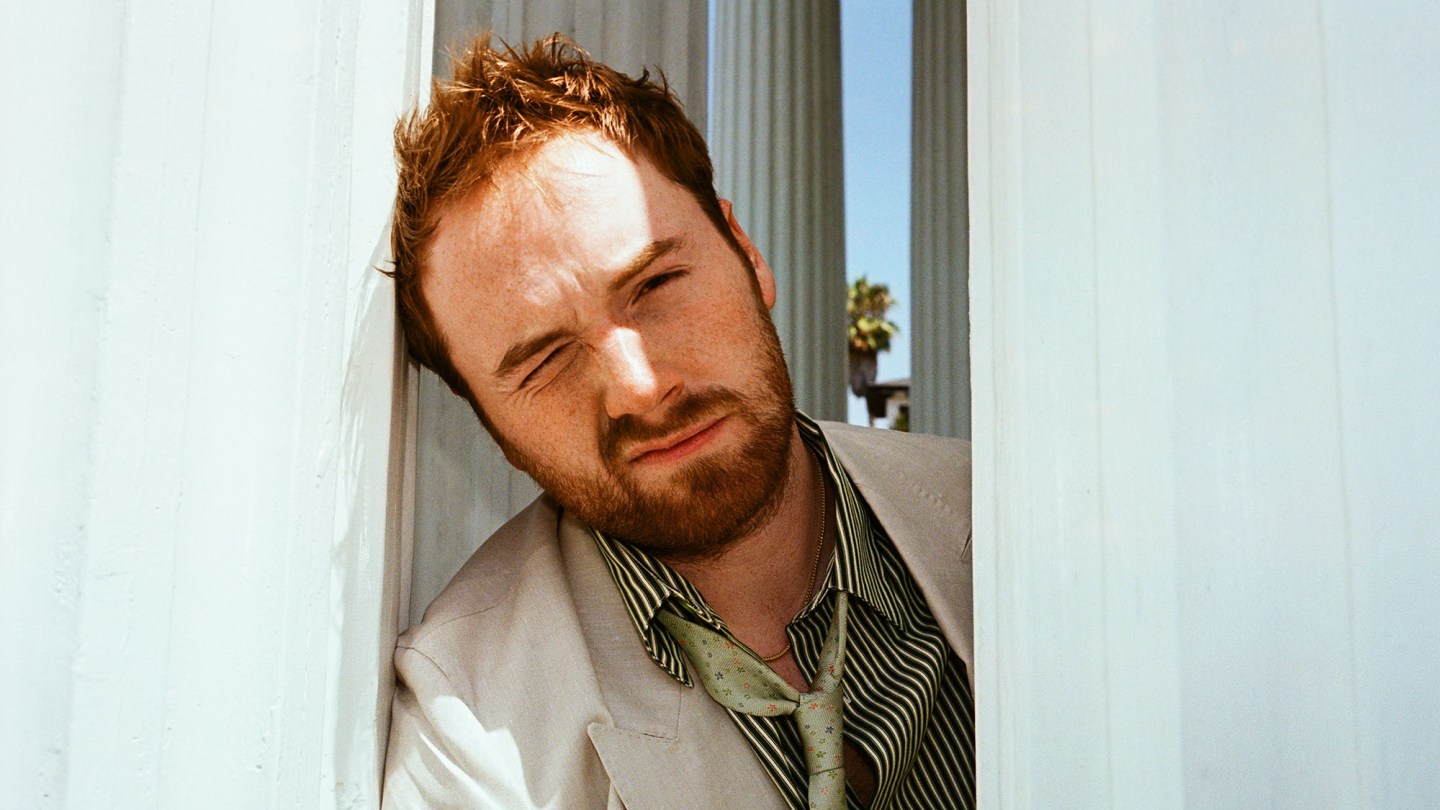
Paul Smith suit, shirt, tie; Hoffman’s jewelry.
Photographed by Myles Hendrik
***
Gregg Araki first started trying to make I Want Your Sex nearly two decades ago. The script originally featured a relationship between a male dom boss and his female sub, but after the #MeToo movement, he decided it needed a gender swap. “I don’t want to kink-shame anybody, but I really didn’t want to have a woman getting dragged around by the hair. Even if it is consensual.” When the financing finally came in, he cast Wilde first and then set about trying to find someone who could be an “equal sparring partner.” Casting saw Hoffman’s self-tape and floated his name. “I was like, the kid from Licorice Pizza? What the fuck? I don’t want to see [Olivia] fucking that kid.” Chase Sui Wonders, who plays Hoffman’s roommate in the film and shares a pivotal threesome scene with him and Wilde, thought something similar. “I was more like, ‘Aw, that kid seems like such a precocious guy,’ ” she says. “But then we started hanging out, and he’s a very old soul. We’ve become good friends, and every time I’m with him and his group of friends, I’m like, ‘Wait, I’m with a group of underage kids?’ ”
A lot of young actors were passing on Araki’s project because they didn’t want to play a sub and, as the director puts it, were wary of the more “unmanly” elements the role came with. “They weren’t secure enough to do it,” he says. Hoffman wasn’t worried about that part and was excited about the nerves he felt when reading the script. He flew himself out to L.A. to do an in-person chemistry read with Wilde. “That cinched it for me,” Araki says. “He’s so young, but he has a lot of gravitas. It reminded me of the way Brady Corbet was; he was 15 when we made Mysterious Skin, but he talked like a 30-year-old.”
The first day on set called for Hoffman to be spanked repeatedly, and day two’s scene was the aforementioned threesome. It turned into a crackup. “There was this very talented, respectful sound guy who had to hold the boom above us, and my whole chest was exposed and I was getting back into my garments and he was making conversation with us while staring up at the ceiling,” recalls Wonders. “That was my first day meeting Cooper, and we could not stop laughing about it.”
Later, Hoffman had to simulate bad, awkward sex with his onscreen girlfriend, played by Charli XCX. “The first time I ever met her, I was like 19 years old and shit-faced at a music festival, so when I found out she was doing this role, the first thing I said during our call was, ‘I’m sorry,’ ” he says.
“He was with a friend who was also shit-faced and quite annoying, but luckily Cooper himself was very funny and charming enough to outweigh his friend’s vibes!” the singer recalls. “We got on. He was cheeky and a good hang, and I was always hoping to cross paths with him in the future.” When Araki approached her to join I Want Your Sex, she was impressed to hear that Hoffman was taking the risks the role required: “He really goes there in the film, and he’s doing things that a lot of actors wouldn’t dare to do. I just think he’s fearless and fabulous.”
Grooming: Kerrie Urban. Fashion Assistant: Elliott Pearson. Coach suit; Vowels shirt; Hoffman’s jewelry;
Adidas sneakers.
Photographed by Myles Hendrik
She invited the cast to the L.A. stop of the BRAT Tour, which took place the night before she started work on the movie, and earlier this summer Hoffman and a friend went to a party she threw. “It is kind of hilarious,” he says of the fact that he can — sort of — call her a friend. “But she’s super chill.”
I Want Your Sex was meant to be bookended pretty tightly with Hoffman’s roles in both Artificial and Poetic License, Maude Apatow’s directorial debut in which her mother, Leslie Mann, audits a college class and develops an inappropriate (but lighthearted) friendship with two students — Hoffman’s first straight comedy. Hoffman met his girlfriend, actress Nico Parker, on set. “But, we didn’t officially start dating until a few weeks after filming, when she came to New York to meet my mom, and I asked her to be my girlfriend,” he says. “It was very sweet.”
In I Want Your Sex, Hoffman surrenders himself as the sexual submissive to his boss, a dominant art world provocateur played by Olivia Wilde.
Courtesy of Magnolia Pictures
Poetic License premiered at last year’s Toronto International Film Festival, eventually getting snapped up by the nascent Row K distribution company after a bidding war. Then Row K, and its financing, began to disintegrate. Hoffman started to notice something was off when the group traveled to the South by Southwest premiere. “They told us Row K isn’t paying for an afterparty, so we had to get Baskin-Robbins to sponsor it,” he says. “We ate ice cream cake. In the back of my mind, I was like, ‘This is weird.’ And then we found out a week later that Row K didn’t have any money.” (Sony Pictures Classics has since acquired the film, and is aiming for a 2027 release).
When Artificial was dropped by Amazon and it looked like there was a chance it might never see the light of day, the first thing Hoffman felt was … relief.
He never auditioned for the film; he’d read for a different Guadagnino project that fell apart. Later, he got a call saying that Guadagnino was going to take on OpenAI and wanted Hoffman to play Greg Brockman, a software engineer who served as its president before briefly quitting in solidarity when Altman was fired. Hoffman said yes immediately — “It’s Luca, you say yes” — and was eager to engage with the conversation around AI.
“I’ve never used it, and I hate it so much. I hate that it feels like the end of the world. I do like my phone, but I want to talk to a real person. If I’m making a reservation, I will only call the restaurant, and if I can’t, I go to a different restaurant.” But then he found himself struggling to find both the character and his confidence on set, mostly because of the way he looks — with a shaved head and black hair. “It got dropped, and I was like, ‘OK, maybe this never needs to come out.’ “
Garfield disagrees. “He’s like a bull in a china shop in this film; there’s a brashness and a brutishness that he found for the character that I really love. And it’s different than his usual style, but it felt lived-in, and I thought he looked fantastic. Very close to the real person he’s playing, too.” (Wonders also has seen some of Hoffman’s footage and agrees: “The perfect tech bro.”)
Hoffman says he has felt this a little bit with every film — that the second he wraps and his job is done, he often doesn’t want to think about his performance again. “Big K.R.I.T. has a line in the song ‘1Train’ that goes, ‘Most rappers hopin’ the world end so they won’t have to drop another album.’ That’s how I feel about movies sometimes.” But until that happens, Hollywood is going to keep calling. And he’s going to keep answering.
Dior sweater, pants, shoes; Iguana vintage shirt; Hoffman’s jewelry.
Photographed by Myles Hendrik
This story appeared in the Aug. 5 issue of The Hollywood Reporter magazine. Click here to subscribe.
