


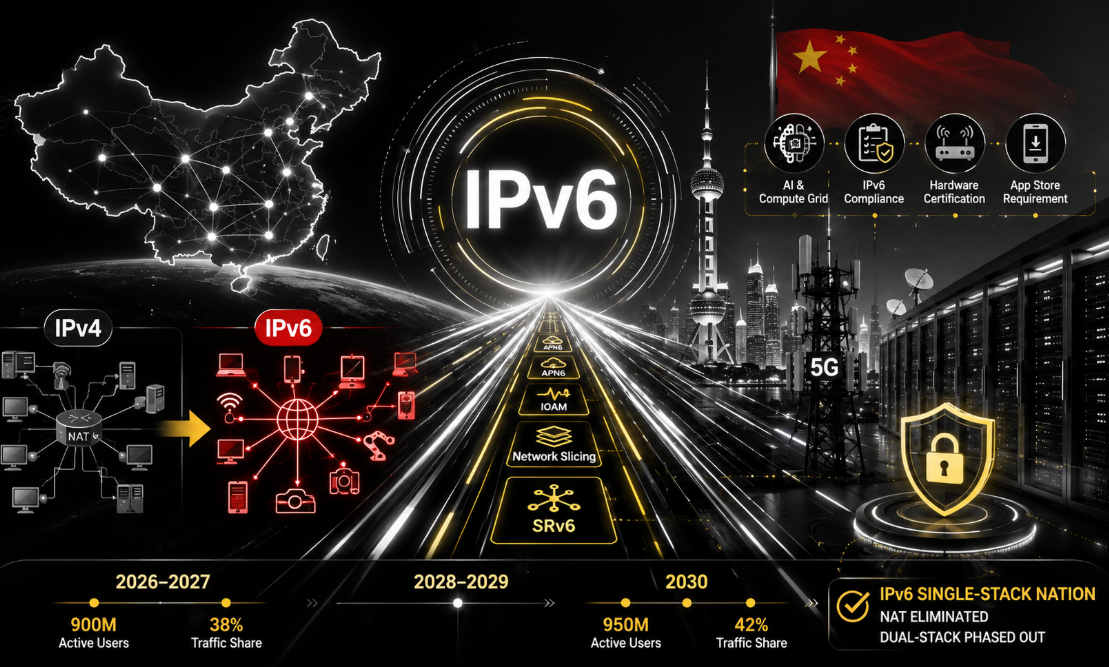
Chinese cyberspace authorities have announced a significant move towards a complete transition to Internet Protocol version 6 (IPv6) by 2030, aiming to phase out legacy IPv4 infrastructure and establish a self-reliant, single-stack national network. The directive issued by the Central Cyberspace Affairs Commission outlines an aggressive policy framework for the period between 2026 and 2030, shifting China’s focus towards an authoritative enforcement phase, compelling key industry players to build an isolated, highly optimized IPv6-native internet architecture.
The new guidance mandates the expansion of China’s active IPv6 user base to 900 million by 2027, with a goal to have 38 percent of the total national network traffic carried over IPv6. By 2030, the target is set to increase to 950 million active users and a 42 percent traffic share. All newly provisioned networks must default to IPv6 addresses while accelerating the decommissioning of dual-stack translation mechanisms.
In contrast to Western networks that typically use dual-stack implementations or Carrier-Grade Network Address Translation (CGNAT), China is pushing for a national transition towards IPv6 single-stack networking. The directive specifically aims to eliminate NAT middleboxes, streamline packet routing, reduce latency, and eliminate the processing overhead associated with IPv4-to-IPv6 translation protocols.
The policy also outlines 36 technical tasks across 10 strategic domains, emphasizing the deployment of enhanced IPv6 protocols collectively known as “IPv6+”. Notably, Segment Routing over IPv6 (SRv6) will replace traditional Multiprotocol Label Switching (MPLS) to enable programmable, source-based routing directly within the IPv6 packet header, allowing dynamic path selection for critical industrial and financial traffic.
