


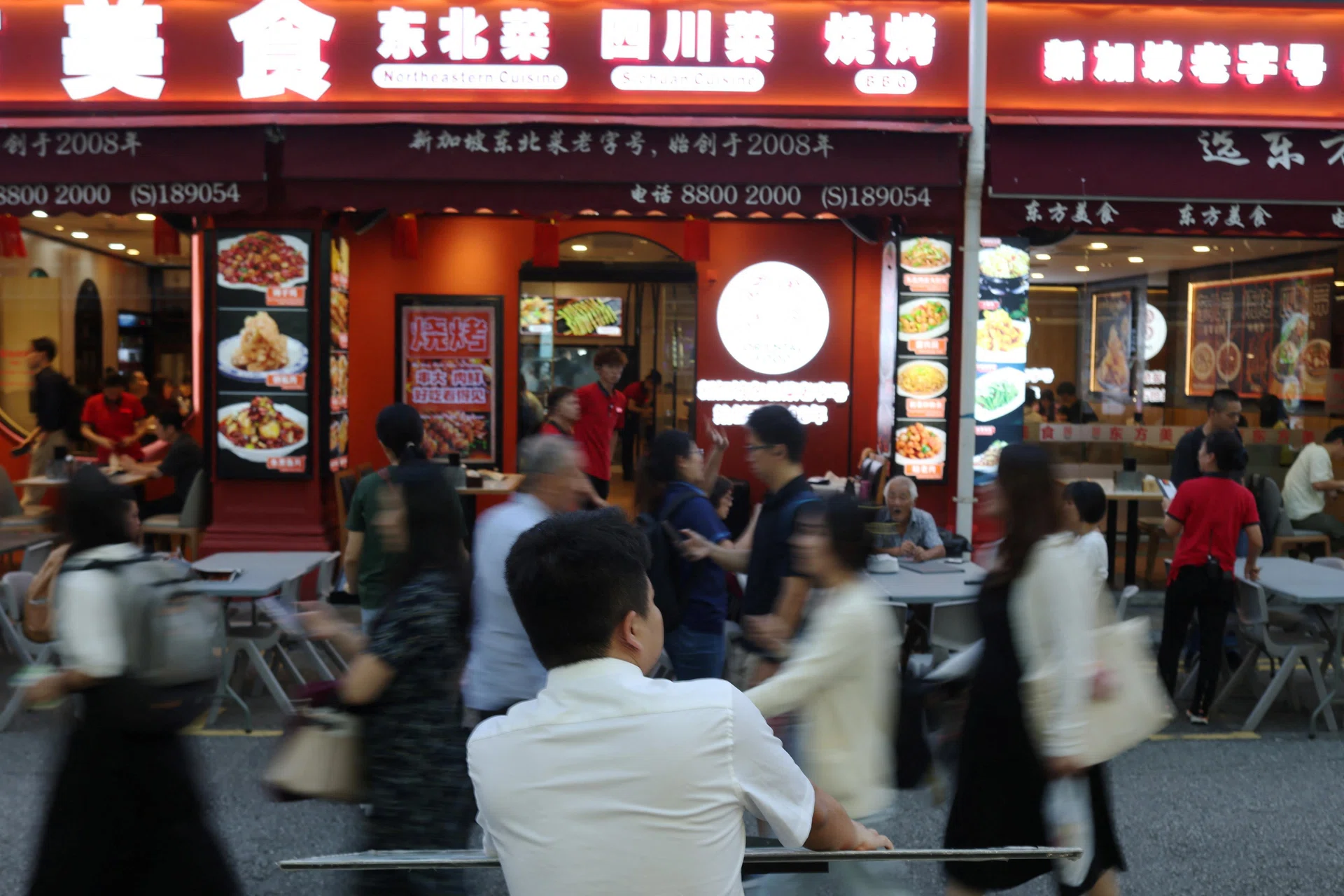
Weak demand has stifled growth in China since the end of Covid-19 lockdown almost three years ago
[SINGAPORE] A record number of Chinese restaurants and cafes have flooded Singapore over the past year, using the island as a test bed for global expansion as they escape pallid consumer demand, extreme price competition and super-squeezed profit margins back home.
Well-known firms such as Luckin Coffee and bubble tea major Mixue joined hotpot and mala restaurant operators in the post-pandemic surge overseas, hoping to draw on the cachet of the internationally oriented city-state in a trend that industry experts and executives expect to accelerate.
“It’s really tough to operate in China now, so many brands are choosing to expand abroad,” said Josie Zhou, overseas general manager of Hunan cuisine restaurant Nong Geng Ji, which picked Singapore for the first stage of its global push.
Persistent price wars are forcing Chinese food and beverage firms to explore new growth models abroad, said Joanna Jia, Singapore manager of bubble tea chain ChaPanda, which opened two franchisee tearooms in the city in July and plans two more.
Weak demand has stifled growth in China since the end of Covid-19 lockdown almost three years ago. A long-time property market slump and US tariffs on Chinese goods have exacerbated price wars in sectors as varied as food and beverages, e-commerce and autos, intensifying deflationary pressure.
In going global, culturally similar Singapore has long acted as a stepping stone for Chinese firms and is a country keen to develop relationships with major economies, including China, at a time when the top economy, the US, is raising trade barriers.
BT in your inbox

Start and end each day with the latest news stories and analyses delivered straight to your inbox.
About 85 Chinese food and beverage brands were operating around 405 outlets in Singapore as at August, more than double the 32 brands running 184 outlets in June last year, according to data from consultancy Momentum Works.
That record growth comes even as local operators, including low-cost hawker stalls, mid-sized firms and even Michelin-star restaurants, grapple with rising costs and lower consumer spending, just as firms do in China.
Officials at Chinese brands said that they are confident of their Singapore prospects as they can draw on the lean business models and supply chain management that helped them survive at home, where a record three million restaurants went bust last year.
Tearoom chain Chagee, for instance, can prepare an iced milk tea with customised amounts of ice and sugar in just eight seconds with the help of machines built by in-house developers, said Jonathan Ng, Chagee’s director of government and public affairs for the Asia-Pacific region.
Such nimble processes and quickly adapting to change in consumer preference by offering a wider variety of drinks at far lower prices helped brands such as Luckin and Mixue blunt the growth of Western rivals, including Starbucks in China.
Starbucks’ market share in the world’s second-largest economy, home to more than a fifth of its cafes, slumped to 14 per cent last year from 34 per cent in 2019, according to data from researcher Euromonitor International. The US company is looking to sell some of its Chinese operations.
“The Singapore market may be tough, but the mainland market is brutal, and they survived,” said Maybank China economist Erica Tay.
These ready-made models, however, have drawn the ire of local businesses. Singapore Tenants United for Fairness, representing 700 business owners, in a June statement on LinkedIn, said domestic companies struggle to compete.
“When an SME from China is often even bigger than our local large enterprises, it should be clear that our small businesses are not on a level playing field with such players. In fact, we are not even in the same stadium,” the cooperative said.
Gateway Singapore
Traditionally a bridge between Eastern and Western cultures, Singapore is an ideal gateway for expansion with its 6.1 million predominantly Chinese population, said officials at Chinese firms. It is also a wealthy, fashionable place so having a presence there is for good branding, they said.
“If we can build up our brand in Singapore, the brand awareness can go to Malaysia and Vietnam, even Indonesia,” said ChaPanda’s Jia.
Some smaller Chinese names are often backed by deep-pocketed investors, allowing them to outbid local rivals for prime locations.
Michelin-starred Yong Fu from Shanghai, for example, entered Singapore last year with an investment of S$10 million.
The sum covered renovation and provides liquidity for rental, staff and other operational costs such as a wine cellar for about five years, said Ye Cheng Zhong, a Yong Fu director and one of three investors.
With Singapore as phase one, he plans to take Yong Fu to London at the end of the year, then New York and Paris next year.
Investment from large Chinese conglomerates, however, has pushed up rent, particularly in high-traffic areas where the supply of commercial space is tight, said Ethan Hsu, head of retail for real estate firm Knight Frank.
Moreover, the influx of Chinese restaurants “dilutes the organic culinary fabric of Singapore,” said food critic KF Seetoh.
Still, such factors are unlikely to stop Chinese companies’ flight from the price wars back home.
“The competition here will only intensify,” said Nong Geng Ji’s Zhou. REUTERS
