


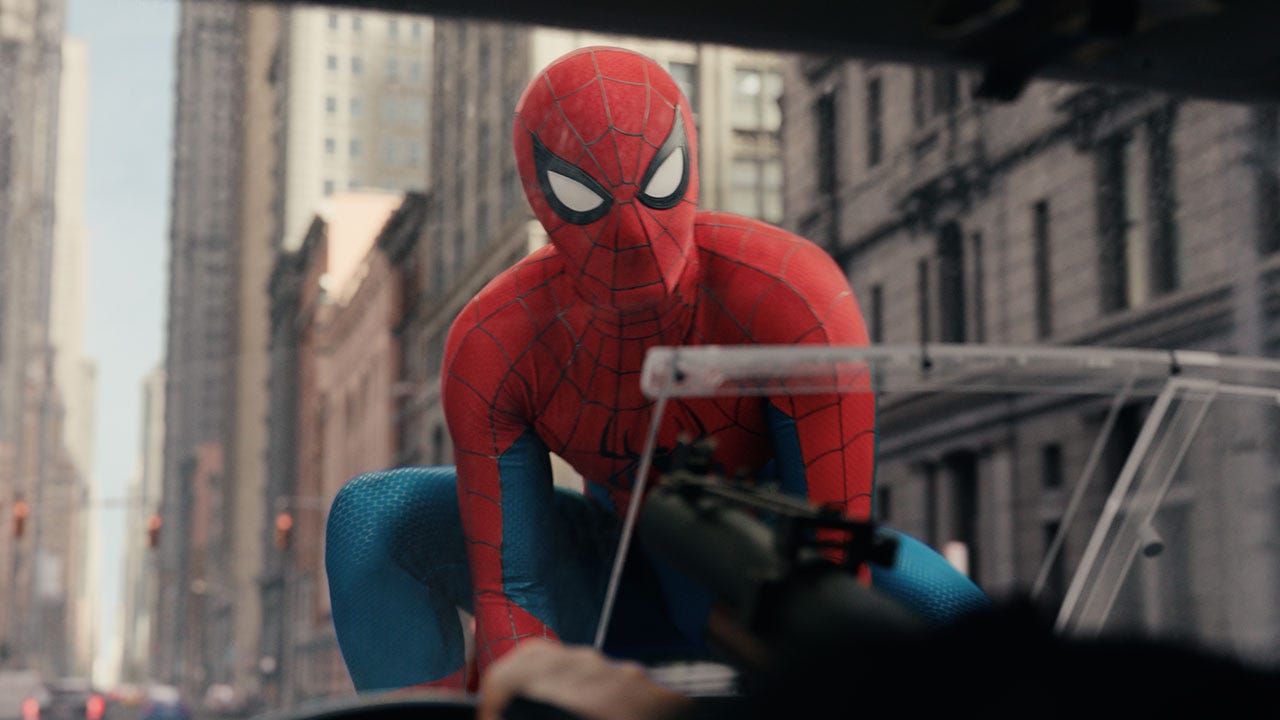
This is an IGN opinion piece from Roth Cornet, who has spent over a decade covering Hollywood, franchise filmmaking, and the business of entertainment. She’s covered superhero movies so deeply, she even made a five-part audio documentary about Superman.
Spoilers for Spider-Man: Brand New Day follow.
Bruce Banner once said the secret to controlling The Hulk is that he’s “always angry.” But in Spider-Man: Brand New Day, Banner is doing his best to bury the big green guy altogether rather than be in a constant, manageable simmer. But by the end of the movie, Peter Parker learns that it’s not about never being angry, or always being angry.
The trick is when and how we let that anger out.
On its face, Spider-Man: Brand New Day’s villainous organization, Damage Control (DODC), which was founded by Tony Stark and the government post-Avengers and later went rogue, could be construed as a disappointing cipher. For the most part, it’s a faceless entity with no emotional engine. Bill Metzger (Tramell Tillman) provides a central character to represent the agency, but he’s given little screen time or character development. We never really connect to Metzger’s felt motivations, so the stakes for the department don’t resonate for an audience. They are simply takers and evil manipulators. DODC is nominally the agency that repairs damage after superhero battles, but it’s ultimately revealed that they are also secretly running torture experiments on a child. Crucially, their primary victim in this film is Sara Grey (Olivia Booth-Ford), sister to Jean Grey (Sadie Sink). The cleanup crew is the actual monster. More to the point, they are trying to control power, which reflects what Peter Parker is attempting to do to himself. The difference is that, in DODC’s case, the power is not their own.
But the fact that Damage Control exists in the background is part of what sets Brand New Day apart from many other recent superhero movies, because this movie is actually about what lurks beneath the polite masks we put on to protect ourselves. Specifically, rage. Suppress it too much, and it comes out worse. Indulge it fully, and you stop being able to tell the difference between justice and unhinged slaughter.
The real villain in Brand New Day is internal and distributed across nearly every hero on screen. The film features some impressive fight sequences, but more importantly, all of the battles and additional characters work together thematically, telling a story about maturing, identity, letting yourself be known to and connect with others, and what happens when you push down (or unleash) the hidden parts of yourself. This isn’t about heroes vs. villains; it’s about fighting – and finding – one’s self, as told across a spectrum of too much suppression (Peter), too little (The Punisher), and rage that erases everyone else’s right to live and choose for themselves (Jean Grey). The Hulk, meanwhile, is the literal, mechanical version of that same push-pull between civility and savagery.
When the film opens, Peter Parker (Tom Holland) has sacrificed his entire identity. No one who loves him remembers who he is. He is alone, and rather than try to reconnect, he exiles himself like The Punisher/Frank Castle (Jon Bernthal). Theoretically, he’s choosing to keep those he loves safe, but underneath that is the desire to preemptively avoid again feeling the pain of loss, as he continues to grieve Aunt May (Marisa Tomei) as well as the loss of his friends thanks to Doctor Strange’s spell. He gets lonelier, more isolated, and somewhere, lurking beneath the surface, angrier. Understandably so. He’s watching his friends live out their dreams without him and the love of his life move on, none the wiser to the fact that he is swinging between physical pain, relentless work, and a truly lonely existence tucked into what looks like an undecorated supply room.
It’s like he’s jailed himself for the crime of being who he is, and is called out directly, notably by Yelena Belova (Florence Pugh), who worked through her own solitude in Thunderbolts. Yelena offers Peter a moment of actual connection, inviting him to share with her. When asked to join her in her “office” (bathhouse), he strips down to his underwear, but keeps the mask on — hiding his face, and anything real, right along with it. She notices. He’s not just avoiding people; he’s avoiding being seen, even when someone’s finally offering the thing he needs most. As he suppresses his human needs, “the spider” grows stronger. As his emotions and sensory sensitivity increase, there’s just more feeling, more of everything. Too much. In part, that plays as a metaphor for early adulthood, intensified. The fact is, Peter has legitimate reasons for all of that intensity, but he’s spent his life being told anger is “bad” and working tirelessly to be so, so good. He doesn’t know how to be himself and also be really pissed off, so his building vitriol comes out sideways and he nearly kills a cop. He’s denying his own needs, and they’re metastasizing in him.
The Punisher/Frank Castle (Jon Bernthal) is Peter’s flip side: pure rage with no desire for a governor, no internal Uncle Ben or Aunt May guiding him, and few limits. He’s also interesting in that he’s a reframe of Tony Stark’s mentorship. As flawed as he was, and as much as he gained from Peter’s inherent good-natured kindness, Tony still represented more of who Peter would like to become. Frank is the image of what could happen to Peter if he continues down the path he’s on. It’s grim but in a sense honest about an adulthood that doesn’t process pain, instead allowing it to become calcified bitterness. Frank knows this, and pushes Peter to reunite with MJ, to tell her the truth, because he doesn’t want Peter to become him: a man known as the Punisher, who is endlessly punishing himself.
After Jean is unmasked as the mysterious figure recklessly taking over citizens’ minds (even Frank’s) and brutally attacking DODC, Frank explicitly urges Peter to kill her, saying she’s “too dangerous” (powerful) to be allowed to live no matter her reasons. (A bit rich coming from The Punisher.) But Peter sees something Frank doesn’t: Jean’s anger is righteous, and she is savable. They both pay the price for the disconnect when Frank takes matters into his own hands, taking a shot at Jean — just as Peter talks her into standing down and not murdering Metzger — hitting, and nearly killing, Peter instead. Frank is the rage that never learned another mode. Peter is the anger that is acknowledged, and appropriately acted on, but not thoughtlessly obeyed. Peter ultimately relies on his empathy as his greatest strength rather than his anger.
For his part, The Hulk/Bruce Banner (Mark Ruffalo), like Jekyll and Hyde, has always represented man wrestling with his dark side and the dangers of the suppression vs. integration of our darkest thoughts and impulses. In an effort to minimize his internal struggle, Bruce built an inhibitor chip as a way for him to “manage” (ignore) the monster that lives within him so that he may spend his life as an affable professor. Yet he warns Peter that, used broadly, the inhibitor is dangerous, particularly “in the wrong hands.”

Ultimately, Peter builds his own version anyway to reduce his growing spider-abilities, and Damage Control does take and weaponize it. For both Peter and Bruce, the chip is about directing their body’s chemistry, like calibrating medication — it’s literally dialing hormonal levels. Yet, when the chip comes off, even after he is freed of Jean’s control, Hulk is more erratic, not less, theoretically because he’s been held back for so long. What the movie is saying is: over-suppress, and things come out worse.
Brand New Day’s “fakeout” villain, Jean, has an absolute right to her fury. Damage Control kidnapped, tortured, and killed her sister, the only family she had, for their own selfish gains. They wanted to own a power that was never gifted to them. They deserved to be, and ought to have been, shut down for the good of all. But in her desperation and anguish, Jean violates, endangers, and physically harms regular people, simply living their lives. She reduces people to automatons, puppets she drives to reckless and even criminal acts.
Several times, she risks bystanders or innocents like MJ (Zendaya), either assuming Spider-Man will save them or, in her all-consuming intensity and focus, not caring. She even walks an old man into traffic, a truly horrific act, which makes Frank’s point of view somewhat understandable. That is not justice; it’s not even revenge – it’s simply callous disregard. It’s hurt turned into narcissism, where no one is real but you. That works in the context of this story, because in some ways, without other people, we simply don’t know who we are. Peter is lost to himself as a result of his isolation. And what Jean needs, underneath it all (other than leveling DODC), is connection, which may be why she chooses Spider-Man to gain entry into the facility. He can “see” her, is immune to her, and as such, provides her only real interaction where she’s not in the driver’s seat. So she wants him to feel some of the fear for a loved one that she does. To force his hand, yes, but also so that someone will be where she is, feel the despair she does. Be with her.
We see this ultimately play out when she enters Peter’s mind and takes comfort in May’s memory. She gets the mothering she’s long been craving, and knows she’s not alone. As a result, she returns Peter’s act of empathy by keeping him alive as he recovers from the bullet he takes, and walks the first step on her own path to becoming a fuller person, and perhaps, eventually, a hero. She’s got a good deal to make up for. Not the most nuanced conclusion, but in the context of this story, it works and is effective. Frank is wrong that Jean needs to die. Jean isn’t wrong to want Damage Control gone. In both cases, anger and fear can be correct and still need a better outlet than indiscriminate violence.
The mechanism of Jean’s power made manifest is one of the more dynamic in recent superhero movies. Jean’s psyche jumping from body to body also visually enacts the movie’s identity theme: it’s malleable, dependent on who we’re interacting with, and can begin to consume itself in isolation. Peter reflects this in a smaller way, giving fake names throughout as he tries to reconcile his hardening adult self, his intensifying “spider” side, and the Peter Aunt May knew. He literally doesn’t know who he is, and the more he represses himself, the more vulnerable and out of control he actually becomes. A theory for how he’s able to both sense Jean and push her out of his mind lies in two overlapping changes: his heightened Spidey sense, which has radically increased his ability to detect microchanges in people (allowing him to instantly tell the difference between a person possessed by Jean and one who is not), and his shifting brain chemistry, which seems to shield him from her invasion outright. Once he starts using the inhibitor, his ability to sense her lessens. And overall, his erratic physical response to the chip endangers him. This is about what happens when someone tries to engineer away the parts of themselves they’re afraid of. Peter was warned twice, by two different people – first Bruce Banner and then MJ – and built the inhibitor anyway, to his own detriment.
Jean and Peter mirror each other; Frank and Hulk mirror each other. In each case, one is succumbing to their demons, while the other is refusing to see them altogether. Neither approach serves anyone well. Every pairing in the film is a variation on the same idea, and a direct urge to return to balance — to make your dark side part of yourself, because too much suppression and isolation breaks you while too little turns you into the monster you’ve been trying to fight. Interestingly, it isn’t just about becoming and accepting your full self; it’s also about sharing that person with others. Notably, Peter gets increasingly quippy — the Spidey we know and love — as he starts to reconnect with his friends. When Jean asks him something to the effect of, “Are you Spider-Man or are you Peter Parker?” he answers, “Both.” This is the movie (not so subtly) playing this idea out to completion. Witnessing all the other heroes as a contrast helps Peter to come back to himself.
Often, films like this risk feeling overstuffed with disconnected villains and heroes, but in Brand New Day’s case, each part supports the whole. Even the film’s MacGuffin, V-Max, seamlessly integrates. Jean searches for the mysterious substance after she heard her sister call it out in a final, urgent psychic message, only to discover that it isn’t a secret weapon or object, but the last thing Sara saw before she died: a corroded vent reading “Vent Max,” but missing letters. The reveal is emotional rather than forced, underscoring that this film’s stakes were never really about a plot device; they were always about grief, memory, and letting ourselves be known, even in our ugliest, most desperate moments. Because if you do that, you can own your rage. If not, it owns you.
What did you think of Spider-Man: Brand New Day? Let’s discuss in the comments!
