


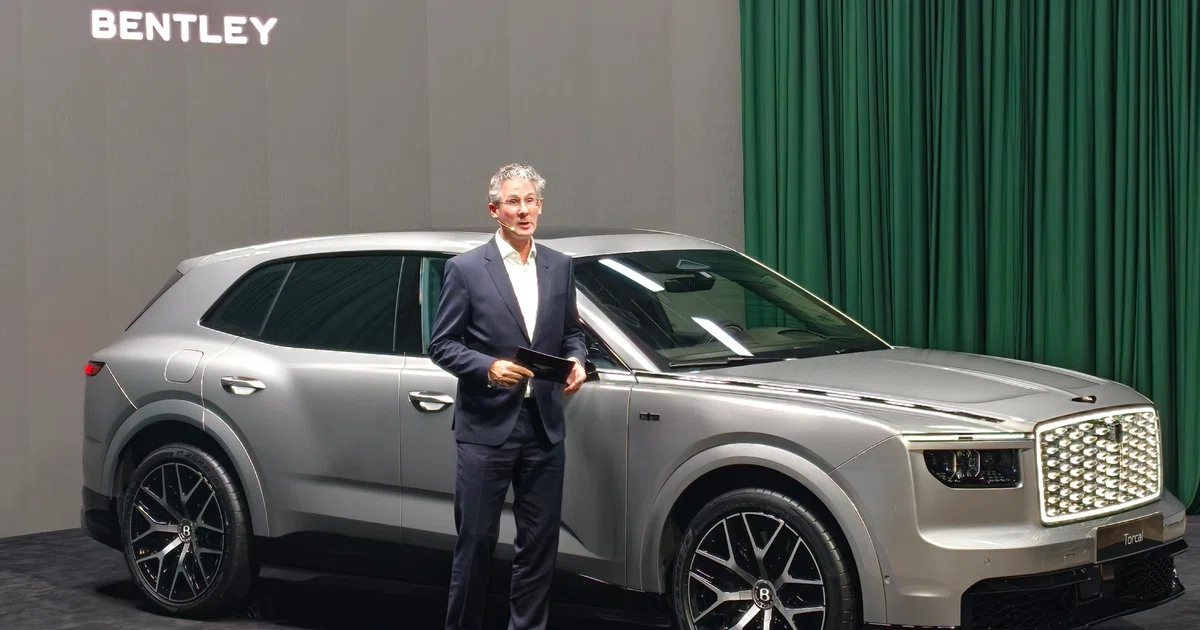
Starting at US$245,000, the Torcal is expected to bring new buyers to the British luxury marque
[SEOUL] Ultra-luxury carmaker Bentley staged the Asia-Pacific launch of its first electric vehicle, the Torcal, in Seoul on Thursday (Oct 15).
With a price starting at 330 million won (US$245,000) in South Korea and S$985,000 without a Certificate of Entitlement (COE) or options in Singapore.
Joining the British carmaker’s range as the least expensive model, the SUV is smaller and costs less than the existing Bentayga large SUV.
In contrast to competitors Ferrari and Rolls-Royce who have priced their EVs in the mid to high-end of their model ranges, the Torcal is aiming for new customers who are upgrading from mainstream luxury brands such as BMW, Mercedes-Benz and Porsche.
Bentley Motors CEO and chairman Frank-Steffen Walliser had previously told media that half of the interest in the Torcal came from existing customers, with the other half newcomers to the brand.
David Hayter, Bentley Motors’ regional director for Asia-Pacific, told The Business Times that “with the private previews we have done, we’ve seen (Torcal) has been very successful in attracting new people to the brand”. “These people who maybe haven’t considered Bentley in the past.”
The Business Times turns 50
Five decades of milestones and moments that shaped Singapore’s success story – told through our headlines.
Explore BT50
He added: “A product like this always helps to try and attract new customers, and I think with its design – and it being an EV – it changes people’s perception of Bentley.”
The company has begun accepting orders for the model in South Korea, and deliveries are expected in late 2027. Model introduction for the rest of Asia-Pacific will follow shortly.
Early pricing information for the region was not available at the time of launch, but in Europe its pricing starts at 200,000 euros (US$223,600).
SEE ALSO

For Singapore, this indicates a retail price of roughly S$1 million without COE or options.
Fast charger
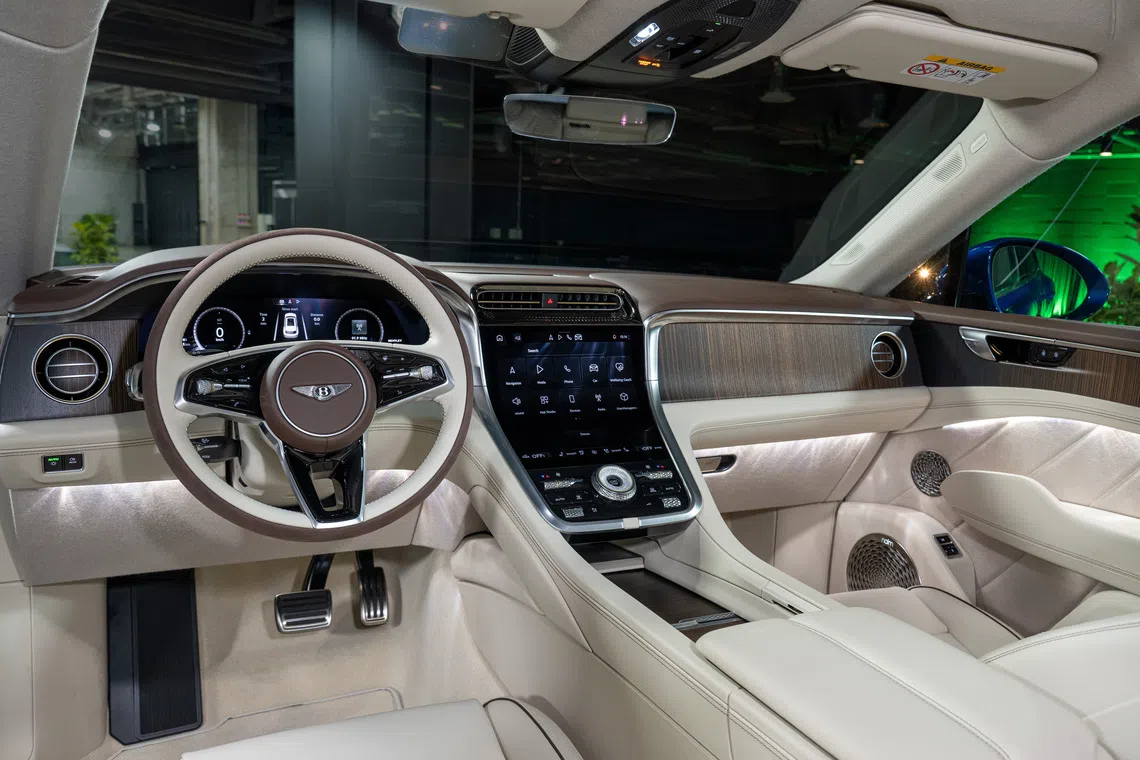
Torcal aims to draw buyers to the brand’s traditional selling points of design, performance and luxury, but mixed with sustainability and electric propulsion technology.
Hal Serudin of automotive consulting firm Lampaki Consulting said the new car follows a similar playbook to Ferrari and Rolls-Royce, handling the role of seeking out younger customers.
“It’s also a brand shaper, providing a bridge for individuals new to the brand, reflected in its ‘entry level pricing’, a step up from mainstream luxury models like those offered from BMW or Porsche,” he added. It has a 113 kilowatt hour battery allowing for a quoted 600 km of range.
The 800 volt electrical system enables charging from 10 per cent to 80 per cent charge in 16 minutes, with a high-speed direct current 400 kilowatt (kW) charger.
The Torcal is available as a standard model with 604 kW of power, and a quicker S model with 653 kW, both equipped with dual electric motors.
The standard model achieves 0 to 100 kilometres per hour (kmh) in 3.4 seconds with a 250 kmh top speed, while the S model does 0 to 100 kmh in 2.9 seconds to a 260 kmh top speed.
A synthetic “engine” sound to help driver feedback is based on the sound of Bentley’s classic V8 engine layout, incorporating musical instruments such as bass guitars, violas and drums.
The exterior design, with a prominent, square backlit grille and vertical lines, is meant to evoke Bentleys of the past. There is also attention to sustainability on the interior, with a newly developed Merino wool fabric, and veneers made of 1,000 layers of walnut wood off-cuts and recycled craft paper.
Variable voltage
Successful ultra-luxury EVs are the exception and not the rule.
While EVs have flooded the mass market and luxury segments globally, the ultra-luxury segment has been resistant to EVs as wealthy buyers still demand the sound and performance of petrol engines. European carmakers, especially ultra-luxury ones, have backtracked on earlier targets or held off the introduction of EV models as demand for such models did not materialise. Bentley itself has dropped its goal – announced in 2020 – of going fully electric by 2030.
But some carmakers are seeing pockets of demand for EVs and capitalised on it. Rolls-Royce, owned by BMW, has found early success with its Wraith electric coupe, while Ferrari’s Luce has sold out its initial production run, despite widespread criticism of the design.
Other ultra-luxury EVs have not fared as well and some brands have no plans to launch electric-only models.
EV pioneer and CEO of Bugatti Mate Rimac said that the French brand has no plans to introduce a fully electric model any time soon.
Rimac, also the head of the eponymous high-performance EV brand, noted that sales of the Nevera hypercar had not met initial expectations.
Bentley’s next EV model is likely to be introduced after 2030, as it will be based on parent Volkswagen Group’s Scalable Systems Platform, an all-new vehicle architecture that will replace current solutions across the group.
Bentley, under Audi, is part of the Volkswagen Group. Sister brand Lamborghini – also part of Audi – will not launch an EV until 2030, while UK’s McLaren said that it has no plans for an EV, both citing a lack of demand.
