


WASHINGTON :Just as Earth orbits the sun, most planets discovered beyond our solar system orbit a host star. But some are out there all by themselves, called rogue planets. While their origins are poorly understood, astronomers have now spotted a voracious one in its infancy that offers new insight into these lonely worlds.
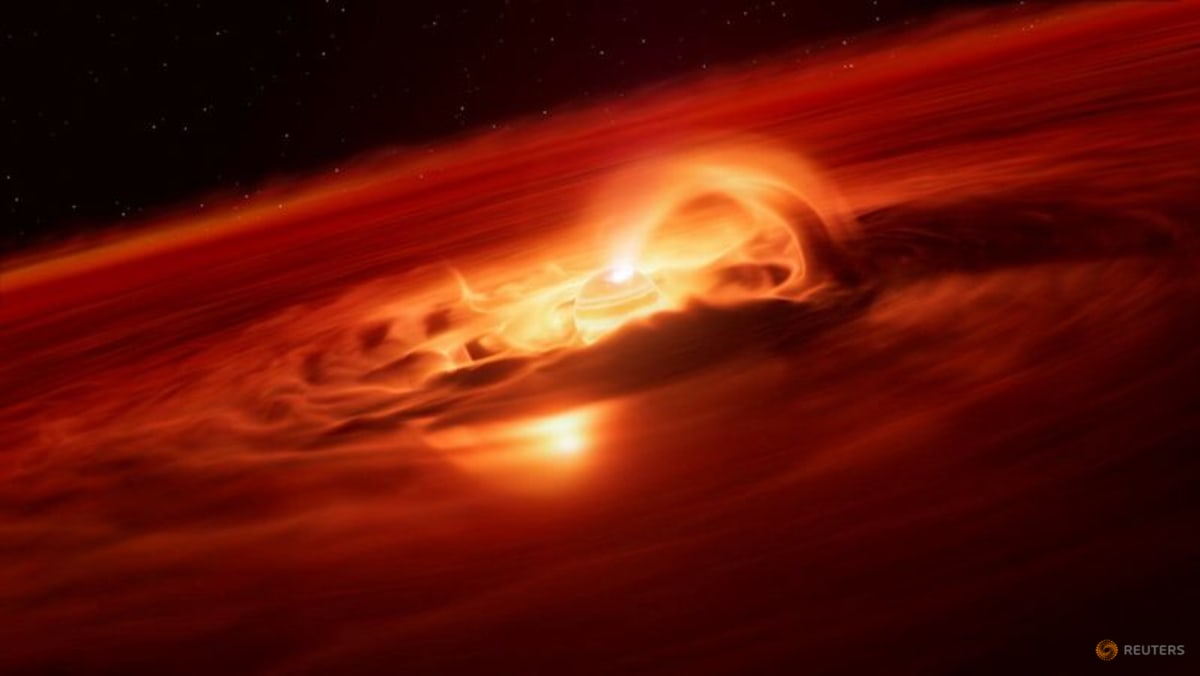
Researchers said this rogue planet, named Cha 1107-7626, is about five to 10 times more massive than Jupiter, our solar system’s largest planet. It was observed during a strong burst of growth at the center of a disk of gas and dust, forming much like a young star, as it gobbled up its surrounding material at a rate never previously seen in such an object.
At its peak, during August of this year, it was consuming this material at a rate of six billion tons per second, about eight times faster than just a few months earlier.
“The outburst we detected is extraordinary, being similar to some of the most intense phases of growth seen in young stars. It reveals that the same physical processes driving star formation can also occur on a planetary scale,” said astronomer Víctor Almendros-Abad of the INAF Astronomical Observatory of Palermo in Italy, lead author of the study published this month in the Astrophysical Journal Letters.
“This object is about one to two million years old. This is very young for astronomical standards,” Almendros-Abad said.
Almendros-Abad said the rogue planet appears to be in its final stages of formation and is not expected to gain much more mass. The researchers think it has strong magnetic fields funneling material from the swirling disk inward toward it, a phenomenon until now observed only in stars.
The researchers observed Cha 1107-7626 using the European Southern Observatory’s Chile-based Very Large Telescope. It is located in our Milky Way galaxy about 620 light-years from Earth in the constellation Chamaeleon. A light-year is the distance light travels in a year, 5.9 trillion miles (9.5 trillion km).
Rogue planets, also called free-floating planetary-mass objects, typically have a mass a few times greater than Jupiter, existing as isolated systems freely floating in space and not gravitationally bound to a host star.
“How these objects form is still an open question,” said study co-author Belinda Damian, an astronomer at the University of St Andrews in Scotland.
In theory, Damian said, they can form as stars do through the collapse of an interstellar cloud of gas and dust, known as a molecular cloud, or they can form like an ordinary planet in a disk of material spinning around a newborn star, only to get ejected somehow out of that planetary system.
While Cha 1107-7626 – a gas giant like our solar system’s largest planets, rather than a rocky world like Earth – is forming similarly to how a star does, it will not come anywhere close to reaching the mass necessary to ignite hydrogen fusion at its core like a star.
Other celestial objects called brown dwarfs also form in this manner and fall short of becoming a star. Brown dwarfs range in mass from approximately 13 to 81 times that of Jupiter, and they can burn deuterium – a form of hydrogen – at their cores for a limited amount of time.
Cha 1107-7626 may be providing a fuller understanding of how some rogue planets are born.
“This is a really exciting discovery because we usually tend to think of planets as celestial bodies that are quiet and stable, but now we see that these objects can be dynamic just like stars in their nascent stages,” Damian said. “It sort of blurs the line between stars and planets, and gives us a sneak peek into the earliest formation periods of rogue planets.”
