


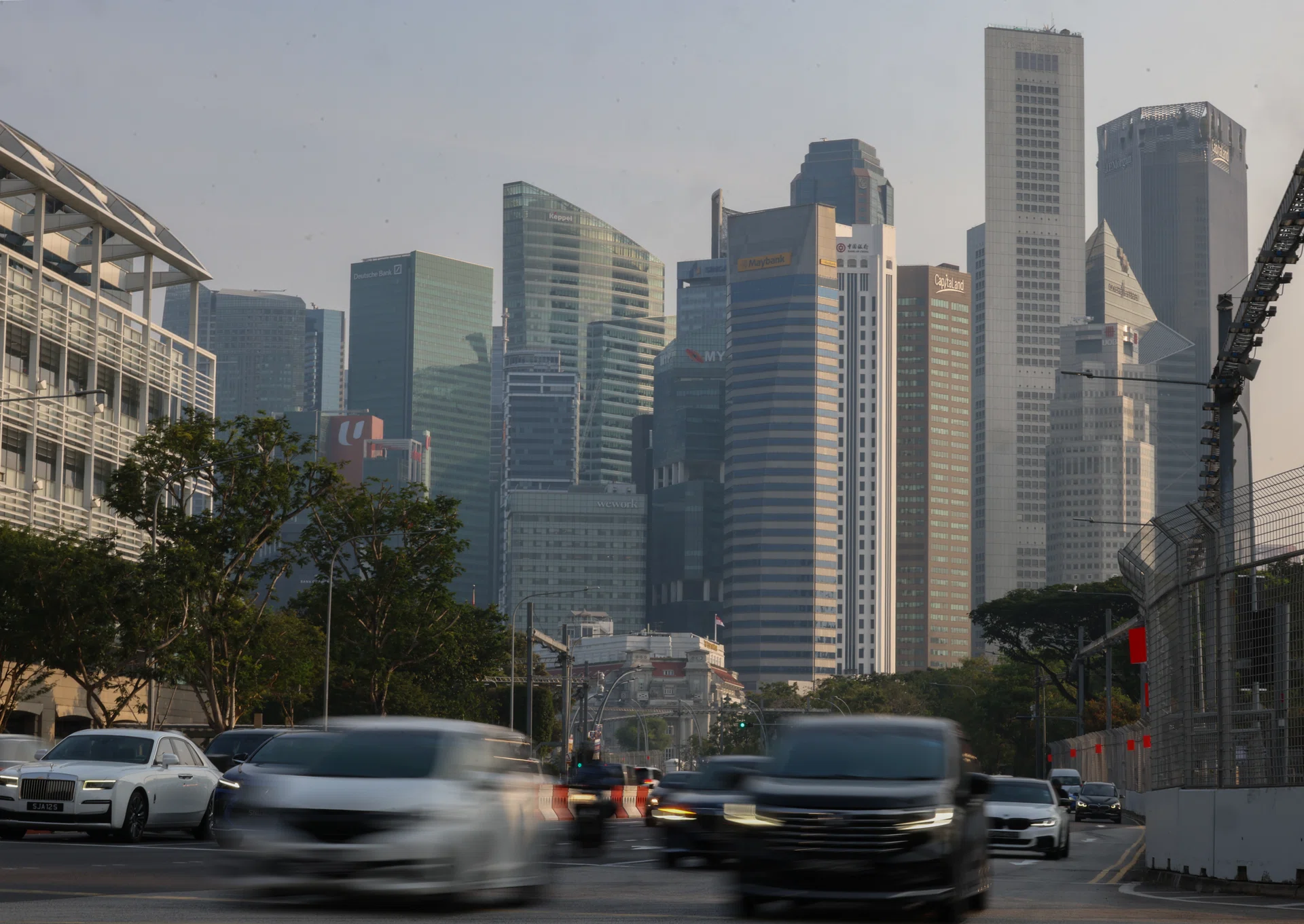
Singapore bags 64.3% of FDIs entering Asean’s 6 largest economies, but also channels some of it to its neighbours
[SINGAPORE] South-east Asia’s major economies are projected to expand by an average of 4.8 per cent annually over the next decade, but domestic hurdles may prevent most of these member states from converting global investments into broad-based growth, said a report released on Wednesday (Sep 16).
The report, jointly put together by Bain & Co, DBS and Vriens & Partners, said the 2026 to 2035 baseline growth forecast remains resilient, though it is down slightly from a previous 10-year projection of 5.1 per cent.
Of the total net foreign direct investments (FDIs) flowing into Asean’s six largest economies in 2025, Singapore absorbed 64.3 per cent, or US$151 billion. There has been a steady rise from previous five-year periods – it was 63.3 per cent between 2020 and 2024, and 57 per cent between 2015 and 2019.
Rather than starving its neighbours of capital, Singapore has increasingly functioned as the region’s central financial clearinghouse, emerging as the top source of FDIs into Malaysia, Indonesia, Thailand and Vietnam.
Still, the report warned that the surrounding economies are struggling to absorb and deploy these capital flows effectively because of binding domestic constraints such as power grid instability, tech talent shortages, high household debt and policy inconsistency.
Such factors are capping the growth ceilings of these member states.
As supply chains shift amid global volatility, high-execution markets such as Vietnam and Malaysia are capturing high-value manufacturing and semiconductor shifts.
But laggards such as Thailand and Indonesia face mounting downside risks, as institutional erosion and infrastructure delays prevent them from converting capital commitments into direct productivity gains.
Divergent regional outlook
The report said the economic trajectories in the Asean-6 are diverging because of domestic structural foundations.
SEE ALSO

Vietnam leads regional growth projections with a 6.2 per cent baseline forecast as it captures supply chain realignments from the US and China. However, power grid reliability remains a primary constraint.
The Philippines follows closely with a 5.8 per cent forecast, insulated by favourable demographics and consumer spending. Still, it is exposed to imported energy price volatility, and its business process outsourcing sector faces competition from artificial intelligence automation.
Indonesia’s baseline growth of 5.4 per cent remains anchored by the scale of its domestic market and resource downstreaming in nickel, but institutional friction and fiscal policy shifts limit its upside potential.
Malaysia is expected to expand by 4.3 per cent on the back of major semiconductor and data centre commitments, but faces immediate talent bottlenecks and a heavy concentration in lower-margin assembly operations.
At the mature end of the spectrum, Singapore’s economy is projected to grow by 2.7 per cent on the back of its hub status and its adoption of enterprise AI to offset demographic limits and a tight labour supply.
Thailand anchors the lower bound at 2.2 per cent average growth, constrained by rapid demographic ageing, elevated household debt and political fragmentation.
Core policy thrusts
To translate investor interest into sustained economic gains, the report identified three core policy imperatives for regional governments:
The first is to strengthen institutional resilience, which requires reinforcing governance, maintaining fiscal stability and deepening capital markets to lower risk premiums.
The second imperative is the fortifying of energy infrastructure by upgrading grid reliability and securing dispatchable renewable energy capacity to meet the demands of power-intensive technology hubs and manufacturing bases.
Dispatchable energy is that which can be programmed on demand at the request of power grid operators.
The third imperative is to move beyond just adopting technology to integrating enterprise-level artificial intelligence into core business workflows, driving widespread productivity gains in the broader economy.
