



With any luck, Arm’s new Lumex CPU platform may give us a hint at what to expect for upcoming Windows on Arm PCs: four tiers of CPU power, plus an improved ray-tracing engine and graphics upscaling.
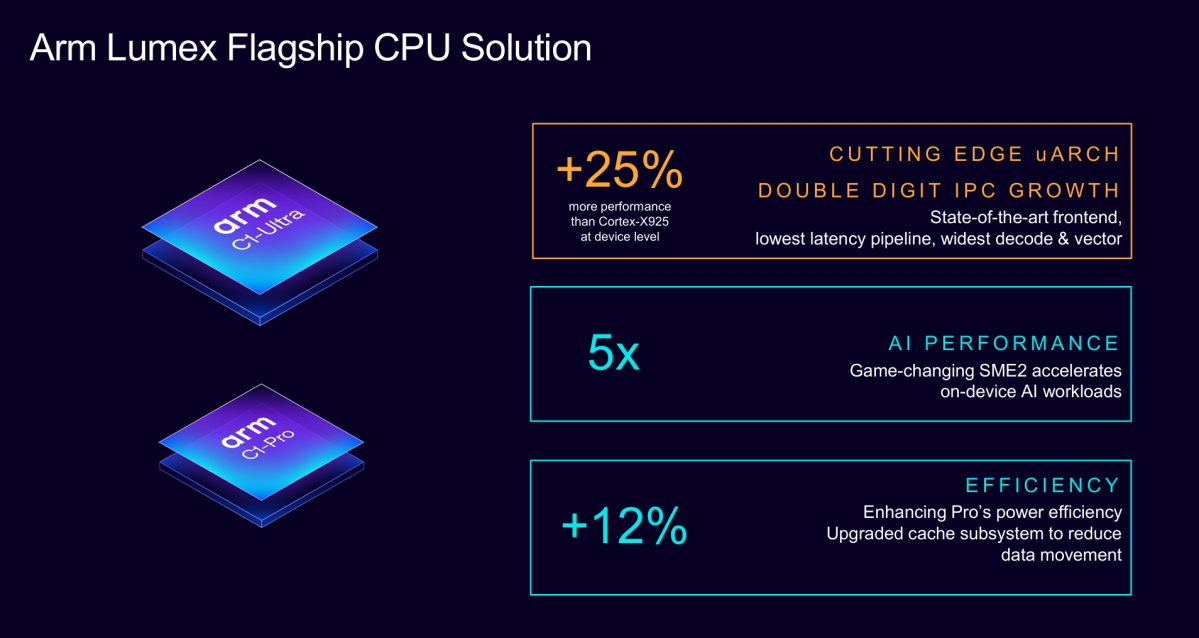
Arm says that its new Lumex C1-series chips will deliver 25 percent more performance than the Cortex X925 series of processors it launched in May 2024. Like the X925, the latest Lumex C1 cores are being optimized with 3nm process technologies in mind, with physical implementations and foundry collaborations to speed customers to market.
(While Arm has hinted at building its own physical cores for years, however, company representatives would say only that it includes “near production-ready physical implementations for partners” and is “not a chip.”)
The Lumex platform is Arm’s brand for smartphones. PC-specific Arm chips will be branded as “Niva” under Arm’s new naming scheme, though they will share some common features with the Lumex cores. Qualcomm, which actually makes the Arm processors, uses the “Snapdragon” brand, which will almost certainly continue.
Arm chips power the vast majority of the world’s smartphones, as Arm licenses its designs to customers who can choose to bring the Arm cores to market or take an architectural license and design compatible but otherwise brand new designs of their own making. That’s the approach Apple and Qualcomm have taken — who, in addition to designing smartphones, have brought Arm into the Mac OS space as well as Windows on Arm PCs. Though Qualcomm and Arm have had their legal differences over licensing Arm’s cores — which have since been settled — an Arm representative declined to comment when asked if any ongoing legal issues would prevent Qualcomm from taking a license.
Arm
And you will, apparently, see the Lumex in more than just PCs. “So the Lumex platform is going to power flagship smartphones through to PCs and tablets,” said James McNiven, the vice president of product management for Arm, in a press briefing.
Smartphones, though, have their own demands: low power, which Arm’s RISC architecture was designed for; and maximizing local AI. The Cortex C1 series includes what Arm calls Scalable Matrix Extension 2 (SME2), using the Arm v9.3 instruction set.
Arm doesn’t use a dedicated NPU. Instead, it uses a technology called KleidiAI that essentially uses software libraries to address AI-specific functions inside the CPU, no matter which version of the Arm architecture is present. In the C1 CPU cluster, Arm says, you’ll see a 5X uplift in AI performance.
Arm says that will increase performance on apps that always have some form of AI technology running, such as audio generation, camera inferencing, or computer vision. Specifically, Arm is claiming over 4.7 times improvement in latency, speech recognition, and classical large language model tasks, and about 2.8 times faster audio generation.
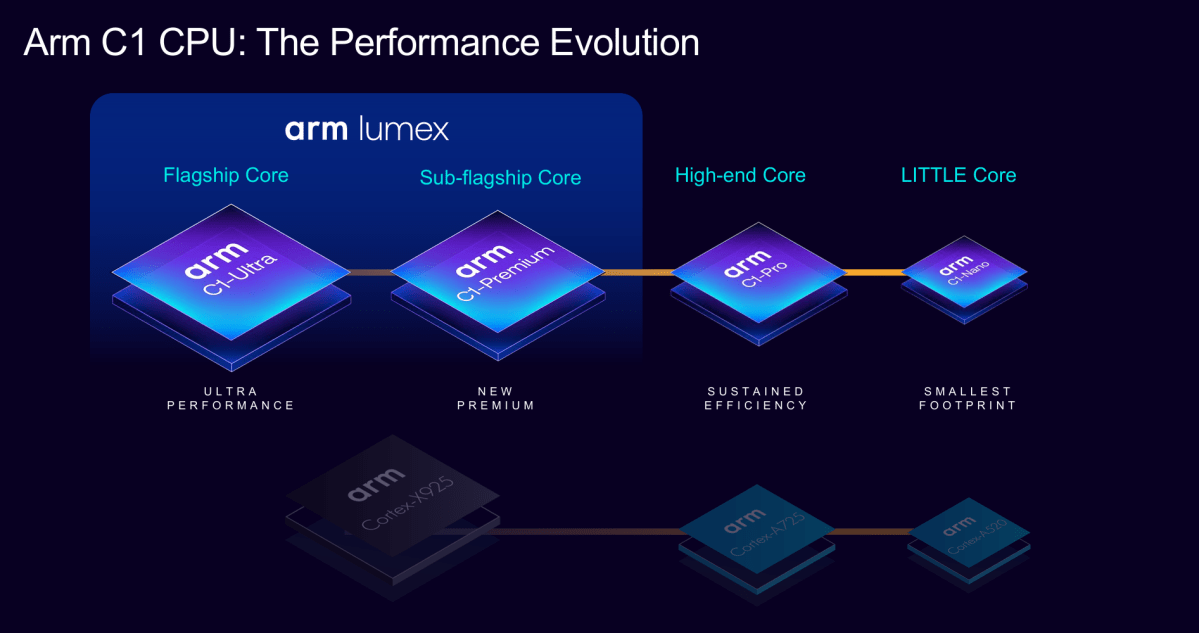
The other thing Arm has been known for is that it basically pioneered the concept of performance and efficiency cores, a strategy known as “Big-Little.” But with the Lumex, that’s been taken to a new level with the addition of a new “premium” core. Now, there are four different tiers of CPU cores: the C1-Ultra, the C1-Premium, the C1-Pro, and the C1-Nano.
Arm
Nothing’s really changed all that much: The Ultra and Premium cores are simply two tiers of “performance” cores, while the Pro and Nano deliver different levels of efficiency. Arm executives said that the Premium core could stand in for the Ultra cores on non-flagship, cheaper devices, as it offers similar performance to the Ultra, but in a 35 percent smaller area. The C1 Pro “improves” upon the Cortex A75 in terms of performance and efficiency, McNiven said, while the Nano has the “smallest footprint” and will play a role in both flagship and entry-level devices, he said. Overall, Arm executives said that the on-device AI is three times more power efficient than the previous implementations, and the Pro is 12 percent more power efficient at the same frequency.
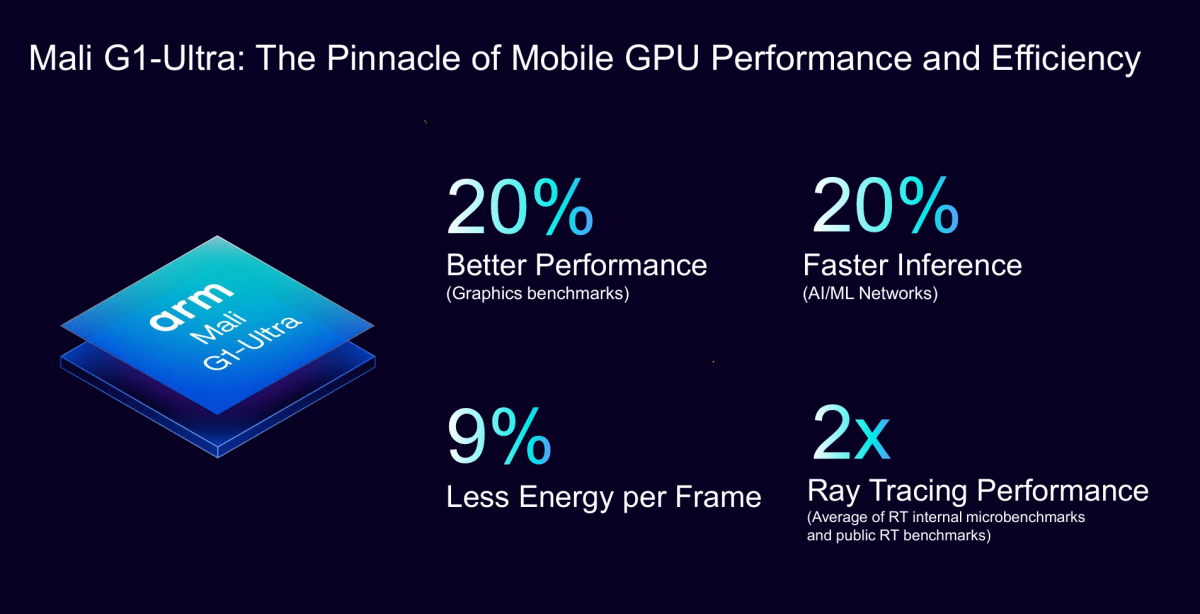
Arm is also introducing a new GPU, the Mali G1-Ultra, which will promise 20 percent better graphics performance, twice the ray-tracing performance, and 20 percent faster inferencing for AI processing than the earlier Immortalis-G925. The Mali G1-Ultra will also consume less power, as the block is on its own power island with less leakage when idle.
Specifically, Arm is claiming that frame rates on ray-traced games will be 40 percent higher than its predecessor, part of moving to a “single-ray” model for improved efficiency and more realistic lighting,” McNiven said. The new Mali core also includes upscaling — quickly rendering at a lower resolution for improved frame rate, then upscaling it for better visual quality — but it does not use the AI-generated frames of some desktop GPUs.
Arm
“One of the examples that we have been seeing recently was some of the new ray tracing benchmarks like [UL’s 3DMark] Solar Bay Extreme, and I think that we see there up to a doubling in performance, because it is so ray tracing heavy. So it really does depend on just the amount of ray-tracing content,” McNiven said.
One idea behind the Lumex platform, executives said, was to move certain cloud-based AI functions on to the device. Specifically, a large language model in the world of Krafton’s Inzoi (a spiritual successor to The Sims) was run on-device at the GDC conference, they said, as well as a “coach” that watched you play in Tencent’s Honor of Kings and offered advice. A major online payment provider is also working to put agentic AI on device to handle payment processing during peak times, instead of committing to expensive, back-end cloud servers, said Chris Bergey, the senior vice president of the client line of business at Arm.
“If your device is capable of running a large language model, you have an extra means of interacting with the game that augments your experience,” McNiven said. “But if you don’t have it, the game is still playable.”
