


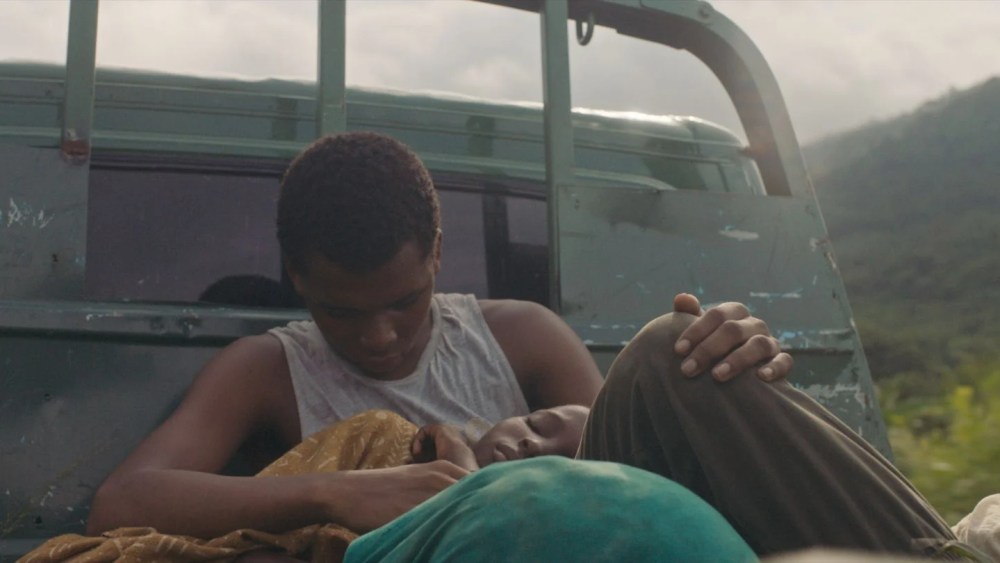
Elements of “Oliver Twist” are given a West African update in “Our Time Will Come,” an atmospheric and emotionally absorbing feature debut from writer-director Amartei Armar, who thankfully cares too much for his orphaned characters to torture them (and us) with unending miserabilism. Beginning as a road trip, then shifting to a punishing vision of hardscrabble life in Accra, the film blossoms into a story of irrevocable bonds forged out of shared adversity. Handsomely shot by John Kwame Markin and anchored by an adult-sized performance from teen Idrissu Tontie Jr., “Our Time Will Come” (presented in Marrakech’s 2025 Atlas Workshops as “Vagabonds”) plays with certain narrative conventions in such distinctive ways that it’s likely to find a welcoming home wherever it travels following its Locarno premiere.
Armar’s Ghana is one where family ties have been eroded and ethnic identity precludes any notion of national solidarity. Within the vacuum left by rural flight and grinding poverty, people’s instincts are to rebuff anyone resembling the outsider they used to be themselves, making for a dog-eat-dog world where protection is possible only if a self-described family welcomes the newcomer into their midst. Oblivion is just one step away, and kinship, whether by blood or affinity, is redefined for a modern world in which traditional safety nets have been rent asunder.
The bond between 15-year-old Owusu (Tontie Jr.) and seven-year-old Adobea (Dorothy Adobea Tandoh) is that of brother and sister: Owusu’s mother left him in the care of a friend and disappeared, but that friend died when giving birth to Adobea. We don’t know why the two kids decide to flee their orphanage, but Owusu’s selfless protection of his young charge has such potent resonance that the wisdom of their escape is never questioned, despite learning that Adobea suffers from the same blood disease as her mother.
Their goal is to reach Accra and locate Owusu’s long-lost mother: “If we can find her in Accra, we can be a family again,” he tells Adobea, though the only physical evidence he has is an old photograph. Owusu keeps them moving as if compelled by instinct, driven to find water, a place to sleep, and a kind person willing to give them a lift. By shooting these early scenes outside in full daylight, with plenty of space, Armar sets up a stark contrast between the light-filled openness of the countryside — not without its dangers — and the dark, crowded, disorienting city where the youngsters are heading.
An open-air market seems like the best place to show his mother’s photo and ask people if they know her, but these two weary, dirty provincials speaking a different language are clear targets for any scam, and all their stuff is nicked by Obolo (O’Bryan Nana Kwame Enyan), a scrappy street kid with an eye patch. In desperation Owusu searches for the thief, threading through the slums and finding him in an abandoned building with a small band of youths led by the charismatic Ziggy (Emmanuel Wilberforce), a sort of Artful Dodger who tests the newcomer and then, assured of his mettle, welcomes him and Adobea to the “family.”
Up until that moment, the abuse (and fear of abuse) experienced by Owusu and Adobae threatens to become relentless, but Ziggy’s protection marks a shift, not so much in their fortunes but their ability to survive without constant fear of violence. Suga (Barbara Yong-Jin), the one girl in the group, drops her insolent, mocking demeanor to become nurturing towards Adobea, and everyone contributes to the group’s survival by hawking and transporting anything that’s sellable.
The film’s pointed critique of a fractured society severely damaged by playing catch-up capitalism is unmistakable, but for those familiar with recent Ghanaian politics, Armar’s poignant assessment goes deeper. Not by chance does he include a billboard emblazoned with “#ReadTheBill,” part of a campaign among activists designed to raise awareness of a 2024 so-called “Family Values” bill crafted to criminalize the LGBTQ+ community (it passed); instead of supporting alternate families at a moment when the disconnect between traditional notions of blood ties and the actual state of kinship units has never been more cavernous, the government chose a red flag issue rather than addressing the country’s real problems. While such knowledge isn’t needed to appreciate “Our Day Will Come,” the quietly inserted political angle makes clear that Armar intends his film as much for his home country as international festival audiences.
Whatever background audiences bring to the table, there’s no mistaking the director’s deeply effective working relationship with Idrissu Tontie Jr., who also appeared in some of Armar’s previous shorts and unmistakably holds the film with his impressive shift from tense, driven protector to relaxed, swaggering urban denizen. In fact, the charismatic cast all shine, as does Kwame Markin’s camerawork, nicely attuned to the differing emotional registers demanded by location and mood. However, Armar inserts three music montages, presumably to keep the energy going, when one would have sufficed.
