


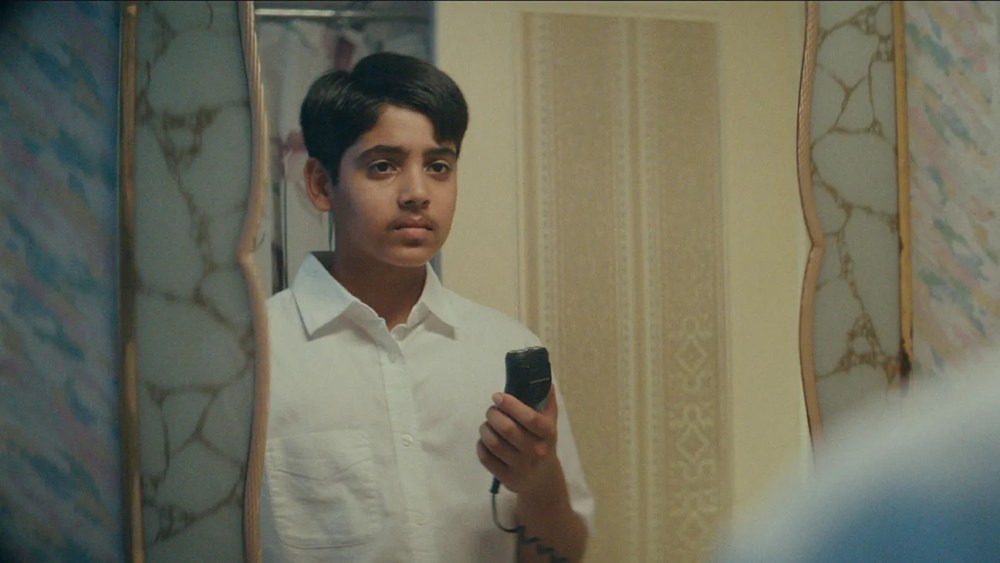
American coming-of-age comedies rarely beat with such uncomfortable verisimilitude. In the bilingual “Mustache” — the first feature from writer-director Imran J. Khan — 13-year-old Pakistani American high schooler Ilyas (Atharv Verma) undergoes an awkward adjustment from a private Islamic institution to a generic American high school. The story’s universality is born from its cultural specificity, as a mid-‘90s tale of a Bay Area outsider, who feels alien both in his social life as well as at home.
Bitingly funny in its comedy and wistful in its drama, the film rests on the delicate performance of newcomer Verma, a diminutive, age-appropriate actor who molds Ilyas in captivating ways. He seems consistently exhausted, both physically and emotionally, and he can only contextualize the world’s unspoken social contracts through careful diagrams and flowery voiceover. These narrations are descriptive, verbose, and imaginative — Ilyas may as well be a sci-fi writer, given his love of “Back to the Future” — but the character seldom has the opportunity (or the confidence) to let his spoken dialogue be as poetic.
This disconnect of mood and behavior is exacerbated when his immigrant father Hameed (Rizwan Manji), who’s struggling with his new business and has five mouths to feed, pulls Ilyas out of the relative comfort of his San Jose’s community’s Islamic school and transfers him to a local public institution. Leaving behind his classroom crush Yasmeen (Ayana Manji), though staying in touch with her through instant messenger, Ilyas embarks on a clumsy odyssey through mainstream Americana, while concocting ploys to get his parents to re-transfer him back to the relative comforts of his Quranic study. A scrawny kid with a quiet disposition, he’s still a target of bullying either way — but at least this way, he won’t feel like as much of an ethnic anomaly.
The film begins with the religious question of whether young Ilyas is allowed to shave the bristles on his upper lip, leading to a consistent self-consciousness, which appears (and re-appears) as Ilyas imagining extreme close-ups of hair and skin. This hyper-awareness rears its head in moments the otherwise invisible tween is placed under a spotlight by his peers, resulting in quick bursts of visual energy that intentionally get on your nerves.
That Ilyas is whip-smart for a kid, but extremely reserved, is the fulcrum for much of the comedy. His harebrained schemes to get his parents to believe he’s been “corrupted” by American life — like bringing home McDonald’s and sheepishly eating it in the family kitchen — might even work if they were better executed. All he needs is a partner in crime. He eventually finds one in Yasmeen, who, through numerous IM conversations, ends up writing him emails from a fake girlfriend at his new school, in the hopes that his parents will stumble upon this alleged relationship on the family computer.
Complicating matters (and turning “Mustache” into a less perverse “Dear Evan Hansen”) is the fact that these emails are based on Ilyas’s real classmate, the witty and attractive Liz Park (Melody Cao), for whom he develops actual feelings after following her to the school’s drama class, led by the kind and helpful Miss Martin (Alicia Silverstone). Soon, an entirely new social life begins to blossom, which runs counter to Ilyas’s scheme to get re-transferred.
This places Ilyas in an even more awkward situation, as the ball gets rolling on his deception. His chats with Yasmeen — which, although typed out on the internet, are depicted as playful face-to-face conversations by computer-light — become the origin for an impending avalanche of un-truths, threatening to crush whatever momentary bliss he’s able to construct, in a world where finding himself is the ultimate challenge.
The film ends up with raucously funny situations buoyed by piercing second-hand embarrassment. But all the while, Verma grounds this social chaos in a performance of genuine anxiety spirals, allowing the movie’s minor stakes to feel apocalyptic. Should Ilyas’ ploys become known — akin to Ilyas himself being known, and being completely seen — the result would be social suicide.
Although the movie eventually loses steam (a side effect of its subversions of the genre, while using Ilyas’s awkward outsidership as an aesthetic North Star), Khan traces the care with which his characters try to chart invisible social lines. He does so by employing careful reaction shots, trusting each young performer to quietly establish the stakes and consequences of simple decisions — like Ilyas leaving a similarly-ostracized South Asian peer to go hang out with the “cool kids.” This yields not only hilarious tightrope walks at every turn, but an organic rhythm, where so many other movies of this kind play like forced retrospectives attempting to conjure hazy memories long-forgotten.
“Mustache,” on the other hand, places its audience painfully front and center, to moments that are so deeply felt and lived-in, you can’t help but laugh at the honest absurdity. It’s like gazing into a mirror that reflects back at your most naked and vulnerable self.
