


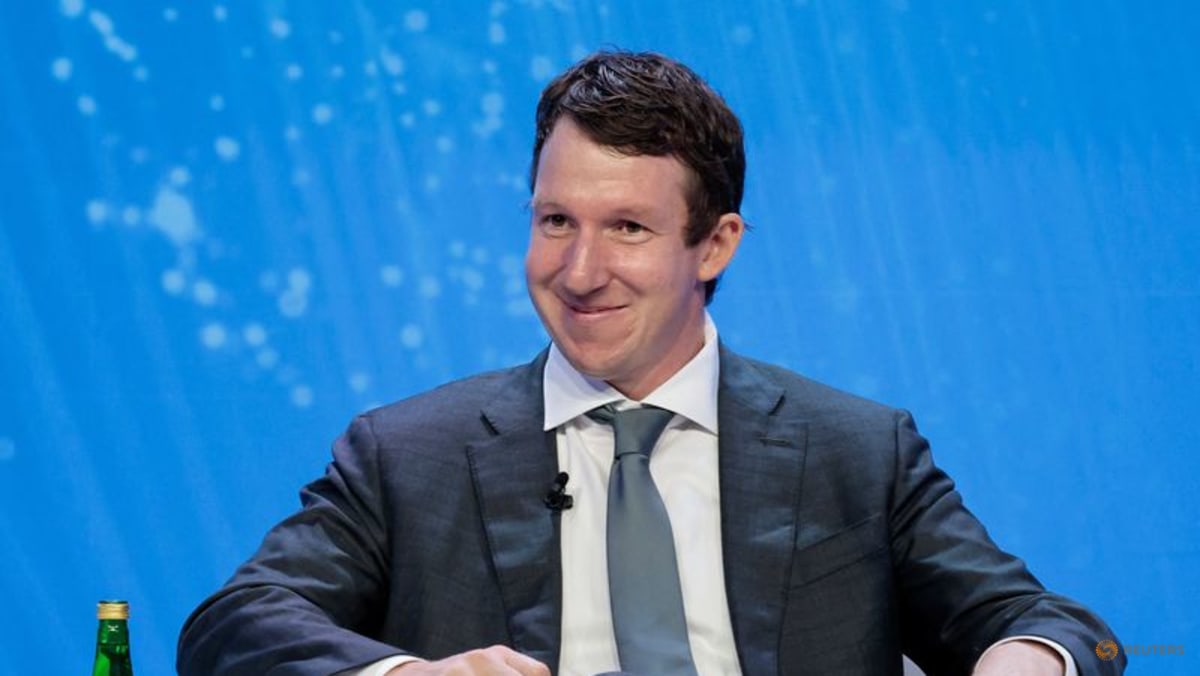
BANGKOK, Oct 17 : Rapidly improving artificial intelligence capabilities will bring far faster change across all fields, Anthropic co-founder Jack Clark said on Saturday, with one of the company’s internal models forecasting that under certain conditions it could increase US economic output by almost 50 per cent by 2030.
Clark, speaking at IMF and World Bank annual meetings in Bangkok, said that international cooperation was needed to erect “unusual and serious rules” for the transformative technology, and there was a shrinking window for policymakers to act.
Clark said that the estimated potential US GDP of $44 trillion, which compares to the current level of just over $30 trillion, “sounds very outlandish, I know.” But he added that AI was vastly increasing scientific discovery.
He said the forecast assumed “the technology continuing to get better. And if GDP were to grow this much, then economic doctrine suggests that new industries and inventions would need to have been created to power such a major economic expansion”.
Clark’s remarks come as the company prepares for an initial public offering expected in November that could value the firm at up to $2 trillion.
HUMANS IN CONTROL, FOR NOW
Clark issued a wake-up call to policymakers about the speed of AI development, saying there was growing evidence of a “singularity” where AI development outpaces human control.
“We should expect that in the coming years, the whole pace of progress of not just AI but science as a whole will speed up, and this will feel confusing and disorienting, and will bring with it great wealth and potentially great peril,” he said in a lecture to hundreds of government and finance officials.
AI was a major topic at the IMF and World Bank meetings, as both a source of growth offsetting high energy prices and a potential threat to stability if it falls short of its promise as a productivity game-changer and stock valuations crash.
Officials also expressed worries about AI destroying certain jobs and leaving some countries behind.
But Clark, a former journalist who serves as Anthropic’s “head of public benefit,” painted a picture of a rosy future where AI was a force multiplier for scientific discovery, solving mathematical, engineering and biological problems, including new drug discovery, as human researchers are supplemented by hundreds or thousands of AI assistants.
More countries can participate in the AI revolution by helping to build the data center computing capacity needed to power AI, he said.
STRICTEST CONTROLS ON BIOLOGICAL RESEARCH
Clark cautioned that global leaders need to understand how powerful AI will become and make urgent choices about how to regulate the technology.
“Being able to use AI for science opens us up to the misuses of science as well, biological and cyber weapons and things we cannot yet imagine, and we have many choices to make,” he said.
Biological research, where AI has already created new viruses, is an area “where we want the strictest human oversight and transparency to maintain safety.”
Despite some recent high-profile incidents where rogue AI systems have escaped testing environments and hacked websites and databases, he said AI was still under human control. But the window to impose safeguards was shrinking as AI became more capable and was now “a small number of years.”
Clark also acknowledged that AI was causing job losses in some fields with “high AI exposure” such as call centers and customer service personnel. But for other fields, such as scientific research, he said AI was enhancing employment and a major unknown was its potential to create jobs in completely new industries.
