



Between her experimental shorts and her two narrative features so far, Ann Oren has firmly established herself as a modern master of erotic cinema. More specifically, her work is concerned with unorthodox sexual awakenings, much of it rendering mutations of the flesh — both naturally developing or forced — with such sensuality and spellbinding craft that it could trigger something within even the most white-bread normie viewers. Sickos already banging on windows in anticipation will find much to embrace in her new “Objet a,” but even the most chaste viewers around could be captivated by Oren’s particular brand of cinematic kink.


Oren’s previous feature, “Piaffe,” followed an introverted young woman named Eva (Simone Bucio) as she covered for her unwell sister in her job as a foley artist. Her first gig involved producing sound accompaniment for a pharmaceutical commercial based around horse footage. By the end of act one, Eva had grown a horse’s tail; a lustrous appendage that she began to wear with pride. Feeling empowered by her new body part, Eva used it to lure her crush into an affair based around submissive foreplay; the hot botanist making use of both his and her specific skillsets by deep-throating Eva with a plant and later auto-erotically asphyxiating her with her own tail.
While there were intentionally comedic beats, that premise was not played for laughs. There was something joyful about its tone, but it would be reductive to say that “Piaffe” was a body-positive celebration of pleasure in all its forms. Oren’s particular calibration across all aspects of her atmosphere, design, pacing, and performances make that movie an especially fascinating film to revisit, as the reading of it differs quite wildly each time. One suspects that’s going to be the case with returning to “Objet a,” as well, which carries over most of the same features and qualities.
In the uncanny world of “Objet a,” Ingeborg (Aenne Schwarz) and Adam (Louis Hofmann) are renowned hand surgeons who share a life together; a glimpse of a magazine profile early on suggests that they manipulated a fungi to become a human skin generator. Gaia (Bucio once more) has her parasitic finger repaired by the couple, as the young woman – whose name is rooted in a personification of Earth – wants to bury what was removed from her body. Adam seems confused by the request, while Ingeborg is perfectly obliging.

Outside of their surgery, the couple have an emotional and sexual relationship that is expressed through objects. Ingeborg is regularly compelled to steal things, while Adam is fixated on becoming an object himself. “Like a doll” is how he asks to be treated, a request made during one of the many sequences in which Oren displays her deft skill with making the tactility of even the slightest touch of flesh against surfaces — of both the natural world or constructed — an utterly transfixing fusion of sight and heightened sound. Cinematographer Juan Sarmiento G. brings an appropriately sterile, less luscious color scheme than Carlos Vasquez’s red-heavy work on “Piaffe,” though heavily saturated greens become more and more prominent — shot on Super 16mm, the film is a real feast for the senses.
The couple’s sex life, at first, is devoid of more traditional human touch. Adam gets off on being asphyxiated, while Ingeborg has hypersensitive fingertips to the extent of them effectively being her erogenous zone; gracing her hands against the fabric that’s wrapped her lover during his orgasm seems to set off her own. As for penetrative sex, kissing or much in the way of regular skin-to-skin contact, that seems to be a void more gaping than some of the wounds they treat. In Adam’s subplot, there’s a suggestion this hesitance for human-to-human touch is widespread beyond just this specific relationship, as his pursuit of a fling is conducted through a trail of thirst-trap photos left around a bar, even though a proper face-to-face conversation (or kiss) with the other party was possible mere minutes earlier.
Beyond that crisis (or perhaps informed by it), the characters are also constantly fed word of ever-increasing climate catastrophes. Adam can’t seem to escape it, to the extent that whenever he’s close to climax in the bedroom, he starts listing off words connected to either extreme weather conditions (e.g. “typhoon”), diseases or wider phenomena (“pandemics”) that will only worsen as the environment collapses. But if humanity has fucked it, maybe the direct intervention of nature can at least save this couple.
After a snail gets lodged in her exhaust pipe, Ingerborg’s kleptomania screws her during a subway trip to the office. Swiping a man’s lighter as she exits the train, she badly falls while fleeing up the stairs. On the street to help her is recent patient Gaia, who Ingeborg hires as an assistant and driver while she recovers. Refusing to take proper time off, Ingeborg gets a custom leg prosthesis at a place called “Objet a.” Hey, that’s the name of the movie! But it’s also a term borrowed from French psychoanalyst and psychiatrist Jacques Lacan, standing for an unattainable object of desire; a force that induces desire towards any particular object.
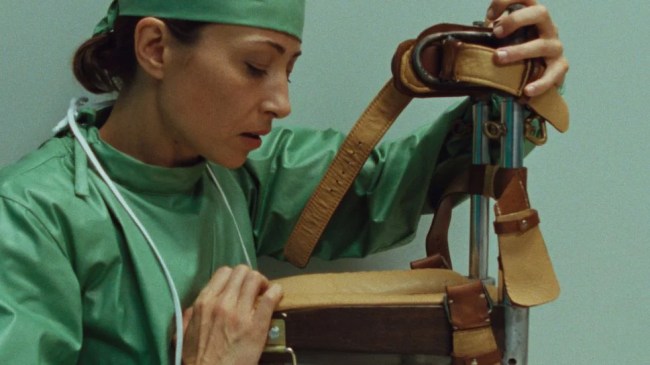
Disrupting the delicate balance of the couple’s relationship, Gaia’s enigmatic presence, personality, and physicality induce desire in Ingeborg, who’s transfixed by her obedient aide’s relationship to nature — specifically fungi — and the serotonergic sweat emitting from her mossy-haired armpits. Adam, meanwhile, seems envious of Ingeborg’s wood and leather leg prosthesis, in that it helps to make her more of an “object” like he so craves to be; Rosanna Arquette in David Cronenberg’s “Crash” now has worthy competition in the realm of kinky brace-based costumes.
As the living embodiment of a magic mushroom that is Gaia transforms the surgeons both chemically and physically, the careful choreography of the film’s (terrific) lead performances and its broader aesthetic lead to something altogether more abstract in the final stretches, with considerably different camerawork, in particular. The vibe shift, as it were, will likely polarize even those who’ve happily stuck through all the seat-licking and cum-like substances oozing out of a wooden corset.Thematically, though, the late swerve is fully all of a piece with Oren’s riveting exploration of the nature of desire, and how that can reframe our relationship to the natural world around us.
Grade: A-
“Objet a” premiered at the 2026 Locarno Film Festival. Oscilloscope will release it in the United States.
