


Growing concern over whether hyperscalers, neo-cloud operators can keep financing the infrastructure needed to deploy them
Published Sun, Oct 18, 2026 · 09:49 AM
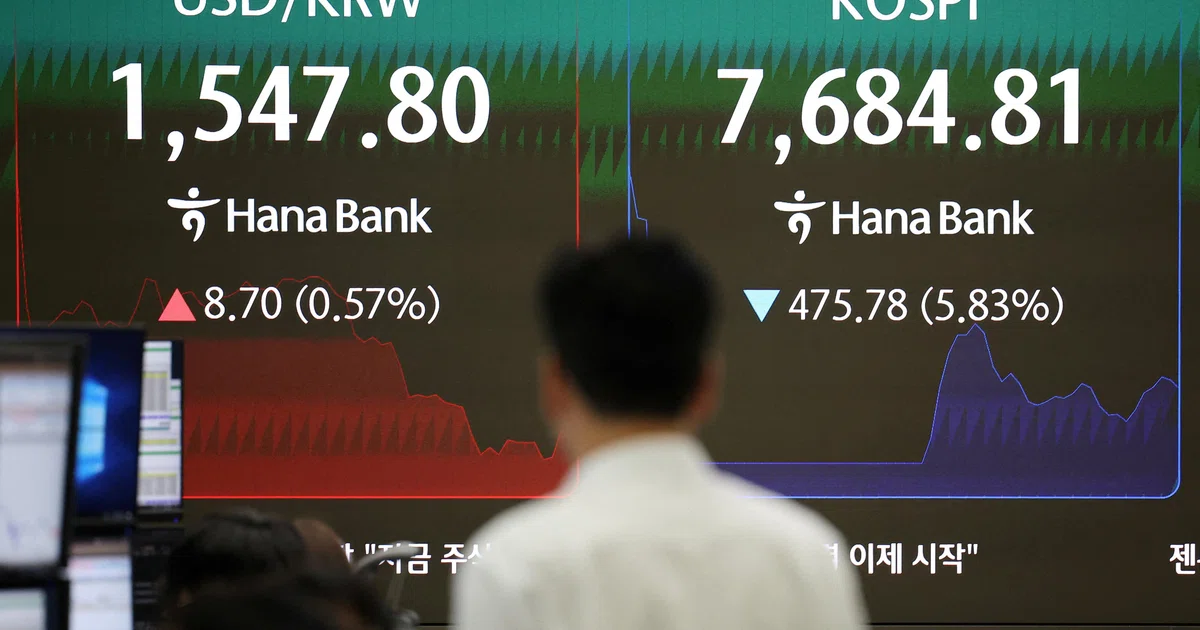
A DEEPENING sell-off in US technology stocks is exposing a new vulnerability in Asia’s artificial intelligence trade: mounting financing costs could choke off the spending needed to sustain the boom, threatening earnings across a supply chain that has powered the region’s stock market rally.
The pressure intensified last week as oil surged to US$110 a barrel for the first time since May, stoking inflation concerns, and investors turned their attention to the trillions of dollars being borrowed to build AI infrastructure.
An eight-session rout in US semiconductor shares – the longest since 2008 – wiped roughly 16 per cent off the sector’s benchmark, while the Nasdaq 100 suffered its worst week since April 2025.
For Asia, where chipmakers and the hardware suppliers that make printed circuit boards, precision components and manufacturing equipment have been among the biggest beneficiaries of the AI frenzy, the implications could be significant heading into Monday’s (Oct 19) open.
A Goldman Sachs Group basket of regional AI hardware stocks tumbled 11 per cent last week, its steepest decline since mid-July. The sell-off showed little sign of abating despite an upbeat revenue outlook from Taiwan Semiconductor Manufacturing Co (TSMC), underscoring how concerns over AI spending are spreading across the hardware supply chain.
Some of Asia’s standout performers were hit particularly hard in the maelstrom.
The Business Times turns 50
Five decades of milestones and moments that shaped Singapore’s success story – told through our headlines.
Explore BT50
Nan Ya Plastics, a maker of printed circuit board materials and the best-performing stock on the MSCI Asia-Pacific Index in 2026, tumbled 12 per cent from a record high. Rival Unimicron Technology, the index’s second-best performer, fell 14 per cent in a week, while Samsung Electro-Mechanics, which makes an array of electronic components, plunged 23 per cent.
“Financing costs are like gravity for the AI boom,” said Jian Shi Cortesi, a fund manager at GAM Investment Management in Zurich. “Rising borrowing costs could make infrastructure projects harder to finance and delay spending. Even a delay could trigger a reset in Asian suppliers’ earnings expectations and valuations.”
The concern is no longer just whether demand for AI chips will hold up. It is whether hyperscalers and neo-cloud operators can keep financing the infrastructure needed to deploy them – and whether the expected returns will justify the scale of investment.
SEE ALSO

Bonds of neo-cloud provider CoreWeave sank to levels signalling distress last week, as investors questioned whether AI demand and revenue could support the borrowing behind its expansion. Its shares slumped 12 per cent on Friday, resulting in the stock’s worst week since November 2025 with a 25 per cent drop.
The episode brought the financing risks of the boom into sharper focus, with surging oil prices adding to worries that inflation could keep borrowing costs elevated.
While TSMC, SK Hynix and Samsung Electronics supply the chips and memory needed for AI computing, their earnings ultimately depend on continued investment in the infrastructure that uses those products.
Component makers and equipment suppliers face the same underlying risk, potentially with less visibility into the timing of individual projects.
“AI funding stress is a bigger challenge for downstream beneficiaries than for the core compute ecosystem,” said Kevin Net, portfolio manager at Financiere de l’Echiquier in Paris. “Basically, the further away you get from the actual chip, the greater the risk you might see timing delays.”
Warnings about funding risks have come from industry executives, including Broadcom CEO Hock Tan, who said capital, rather than shortages of memory chips or manufacturing capacity, would become the biggest constraint on AI growth.
Gartner has warned that more than US$3.5 trillion of AI infrastructure spending could be at risk of impairment by 2030 as investment threatens to outpace the revenue needed to justify it.
“If hyperscalers and neo-clouds cannot fund their data centre investments, that would translate into lower orders for Asia enablers like TSMC, Samsung and SK Hynix,” said Ling Vey-Sern, managing director at Union Bancaire Privee. “Given how jittery the market is, the read-through would be very negative for the semi picks and shovels.”
The stakes are particularly high for Asian equities, where the AI build-out has become a dominant investment theme.
TSMC, Samsung and SK Hynix together account for nearly a third of the MSCI Asia ex-Japan Index and about a fifth of the index provider’s broader Asian gauge, with their suppliers adding to the region’s exposure to the same spending cycle, according to data compiled by Bloomberg.
Eight of the 10 best-performing companies in the MSCI Asia-Pacific Index in 2026 are component makers, each having gained at least 236 per cent. Those gains leave earnings expectations and valuations vulnerable if spending growth slows or projects are pushed back.
Still, there is little evidence so far that financing strains have translated into weaker orders, and some investors remain confident that robust demand will sustain the sector.
“We are not worried about the ongoing chip sell-off” as demand for AI remains strong, said Kunjal Gala, head of global emerging markets at Federated Hermes in London. Gala’s fund is overweight on South Korea and owns TSMC shares. BLOOMBERG
