


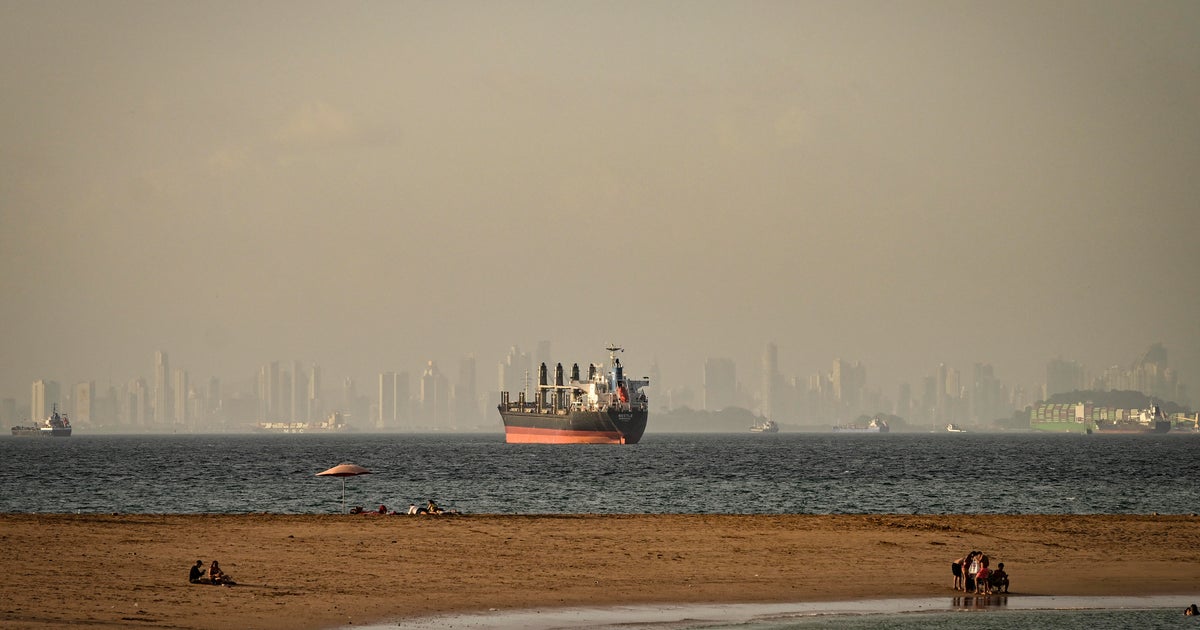
The Iran war has underscored how disruptions to a key shipping route thousands of miles away can have a material impact on what American consumers pay at home for essentials like gasoline.
The conflict, now nearing its six-month mark, has throttled traffic through the Strait of Hormuz, a key artery for global energy shipments, as strikes on commercial vessels raise concerns about the passageway’s safety. The slowdown has caused global oil prices to surge, pushing gasoline past $4 a gallon and fueling broader inflation.
The U.S. and Iran have made multiple attempts to broker a peace deal, but talks have unraveled as the two sides continue to vie for control of the Strait of Hormuz, an indication of how key waterways can become instruments of leverage during geopolitical conflicts.
A new report from Oxford Economics outlines 26 other major chokepoints with high trade volumes that could also threaten the economy if shipping were to grind to a halt.
Where is global trade concentrated?
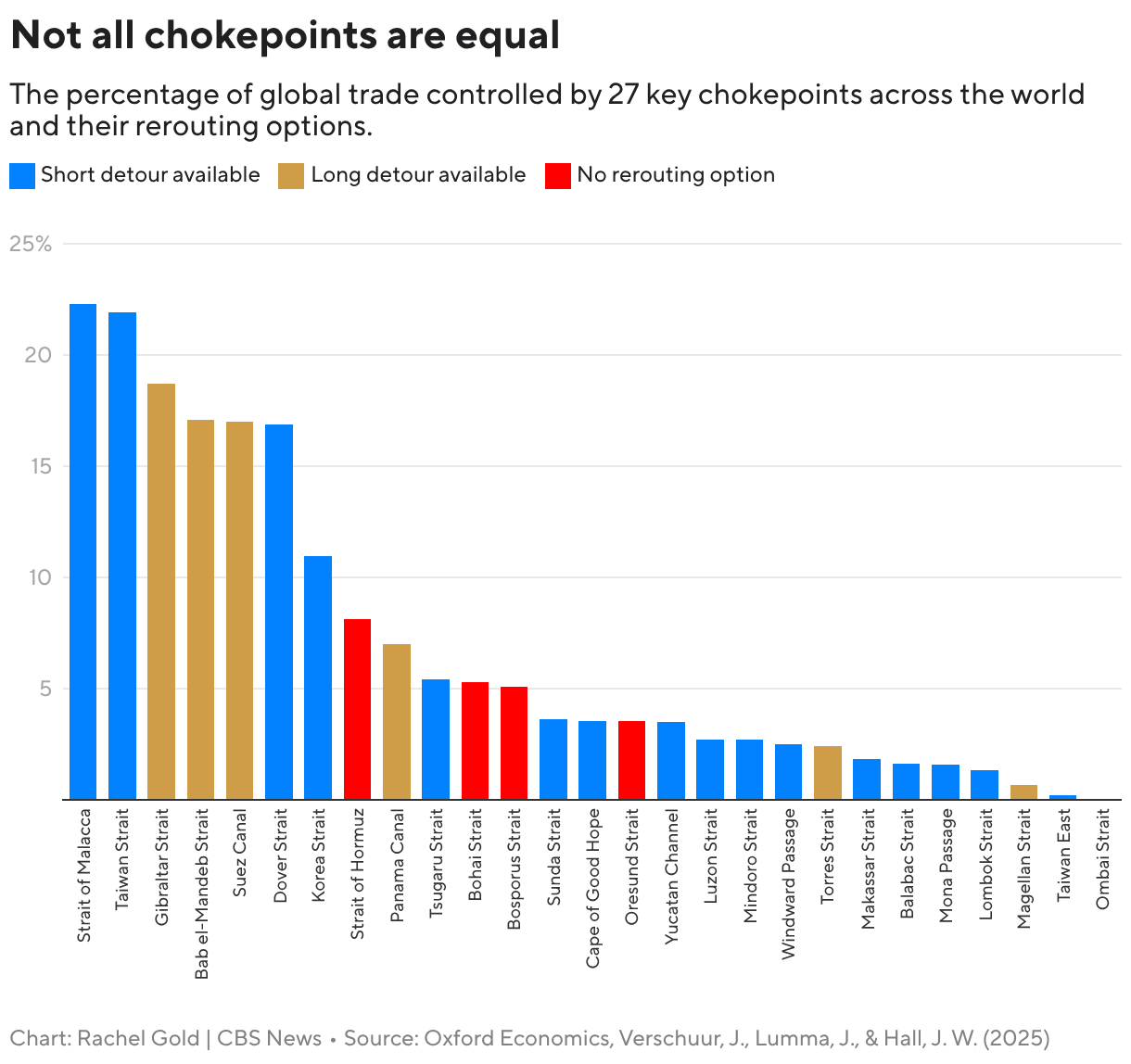
As Oxford’s report points out, Asia has the densest concentration of key global chokepoints. The region is home to several vital waterways, including the Strait of Malacca, situated between the Indonesian island of Sumatra and Malaysia, and the Taiwan Strait, through which one-fourth of global trade passes, according to Oxford.
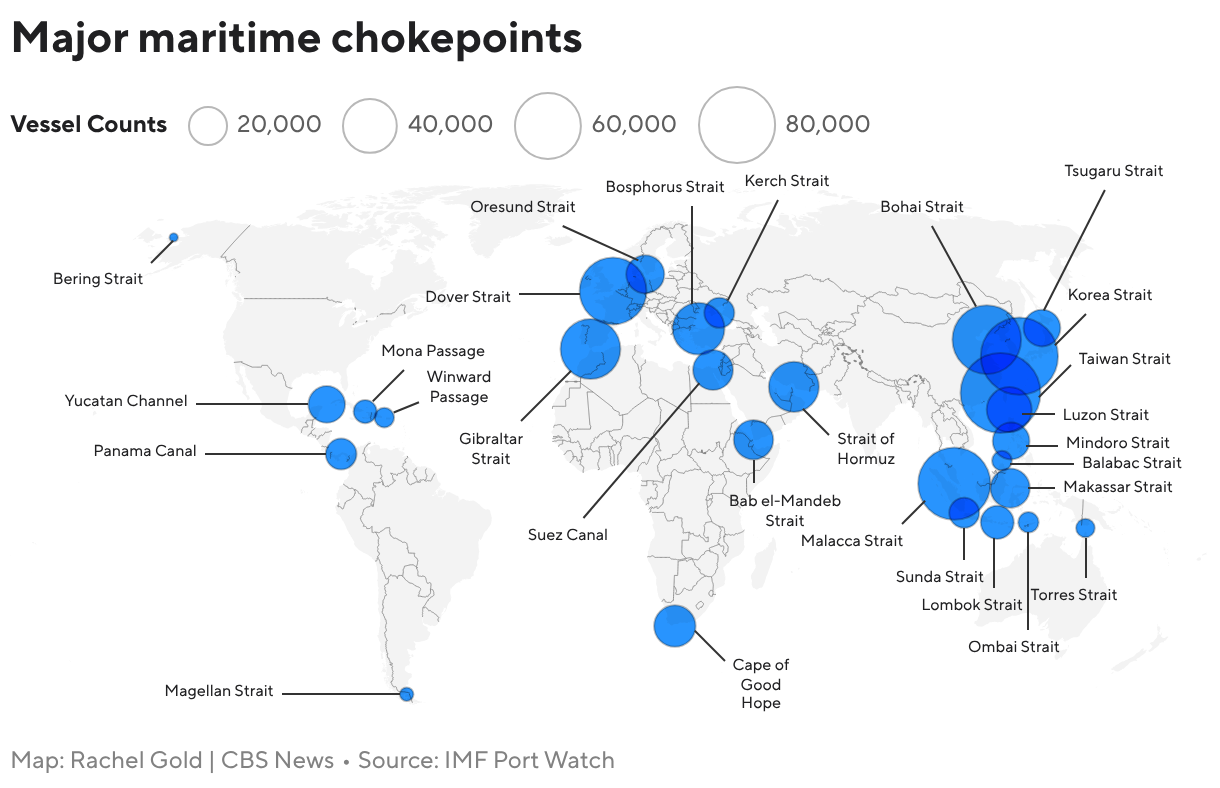
The Mediterranean Sea is also a hot spot for global trade activity. Around one-fifth of global trade transits the Strait of Gibraltar, which connects the Mediterranean Sea with the Atlantic Ocean, and the Suez Canal, an artificial waterway in northeastern Egypt, according to Oxford’s report.
While the Panama Canal is less significant to global trade, it remains an important chokepoint for the Americas. Some 40% of all U.S. container traffic traverses the artificial waterway annually, according to the Council on Foreign Relations, a nonpartisan think tank.
What are the major threats to global trade?
Geopolitical disruptions pose one of the greatest threats to global trade. That includes countries looking to use critical chokepoints for their own political or geopolitical gain, Harry Murphy Cruise, head of economic research and global trade at Oxford, told CBS News.
That’s playing out in the Strait of Hormuz, as the U.S. and Iran both try to exert control over shipping traffic.
Another, more insidious threat is climate change, which is driving more frequent and more harmful natural disasters. Just one example is the Panama Canal, where a combination of drought conditions and El Niño, a weather pattern that causes “warmer-than-average” surface temperatures in the Pacific Ocean, is lowering water levels and limiting the amount of cargo ships can carry.
Backup routes?
As Oxford’s report points out, the risks associated with each chokepoint depend on whether it can reroute traffic if and when disaster strikes.
The Strait of Hormuz, through which one-fifth of the global oil supply normally flows, is particularly vulnerable to disruptions because there isn’t another option to redirect energy supplies, according to Murphy Cruise.
“There’s no alternative path that it can take because the Strait is effectively where the oil is coming from,” he said. “If we look at some of the other chokepoints around the world, they’re slightly less tied directly to key production.”
To be sure, even chokepoints that have backup routes can still run into issues. Rerouting vessels prolongs the shipping process, which can drive up operational costs, Murphy Cruise said.
“The longer they’re out at sea, there’s higher wages, there’s higher oil prices and [other] costs,” he said.
When vessels are out at sea longer than expected, it can also limit the number of available commercial ships, creating additional cost pressures.
“That mismatch between supply and demand gets worse, and that pushes up freight costs,” Murphy Cruise added.
