Close Menu

    Subscribe to Updates

    Get the latest creative news from FooBar about art, design and business.

    What's Hot

    5/9: Saturday Morning

    Fuel shortages and high prices push adoption of EVs in Africa, led by Ethiopia

    Google settles racial discrimination lawsuit for $50 million

    Facebook X (Twitter) Instagram
    Facebook X (Twitter) Instagram Pinterest VKontakte
    Sg Latest NewsSg Latest News
    • Home
    • Politics
    • Business
    • Technology
    • Entertainment
    • Health
    • Sports
    Sg Latest NewsSg Latest News
    Home»Technology»60 years after Gemini, newly processed images reveal incredible details
    Technology

    60 years after Gemini, newly processed images reveal incredible details

    AdminBy AdminNo Comments7 Mins Read
    Facebook Twitter Pinterest LinkedIn Tumblr Email
    Share
    Facebook Twitter LinkedIn Pinterest Email


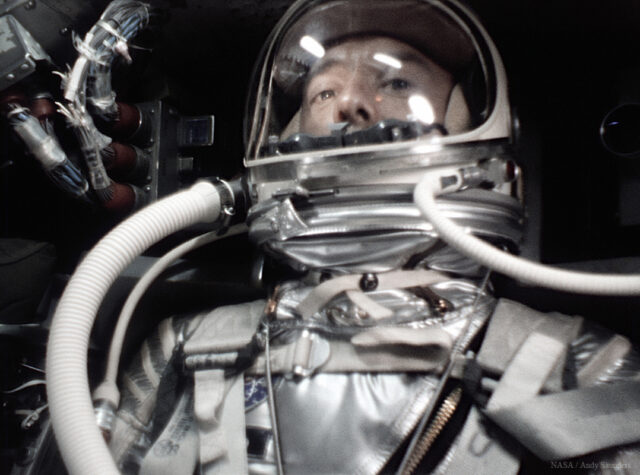
    So it was the early astronauts that kind of drove the desire to take cameras themselves, but they were quite basic. Wally Schirra (Mercury-Atlas 8) then took the first Hasselblad. He wanted medium format, better quality, but really, the photographs from Mercury aren’t as stunning as Gemini. It’s partly the windows and the way they took the photos, and they’d had little experience. Also, preservation clearly wasn’t high up on the agenda in Mercury, because the original film is evidently in a pretty bad state. The first American in space is an incredibly important moment in history. But every single frame of the original film of Alan Shepard’s flight was scribbled over with felt pen, it’s torn, and it’s fixed with like a piece of sticky tape. But it’s a reminder that these weren’t taken for their aesthetic quality. They weren’t taken for posterity. You know, they were technical information. The US was trying to catch up with the Soviets. Preservation wasn’t high up on the agenda.
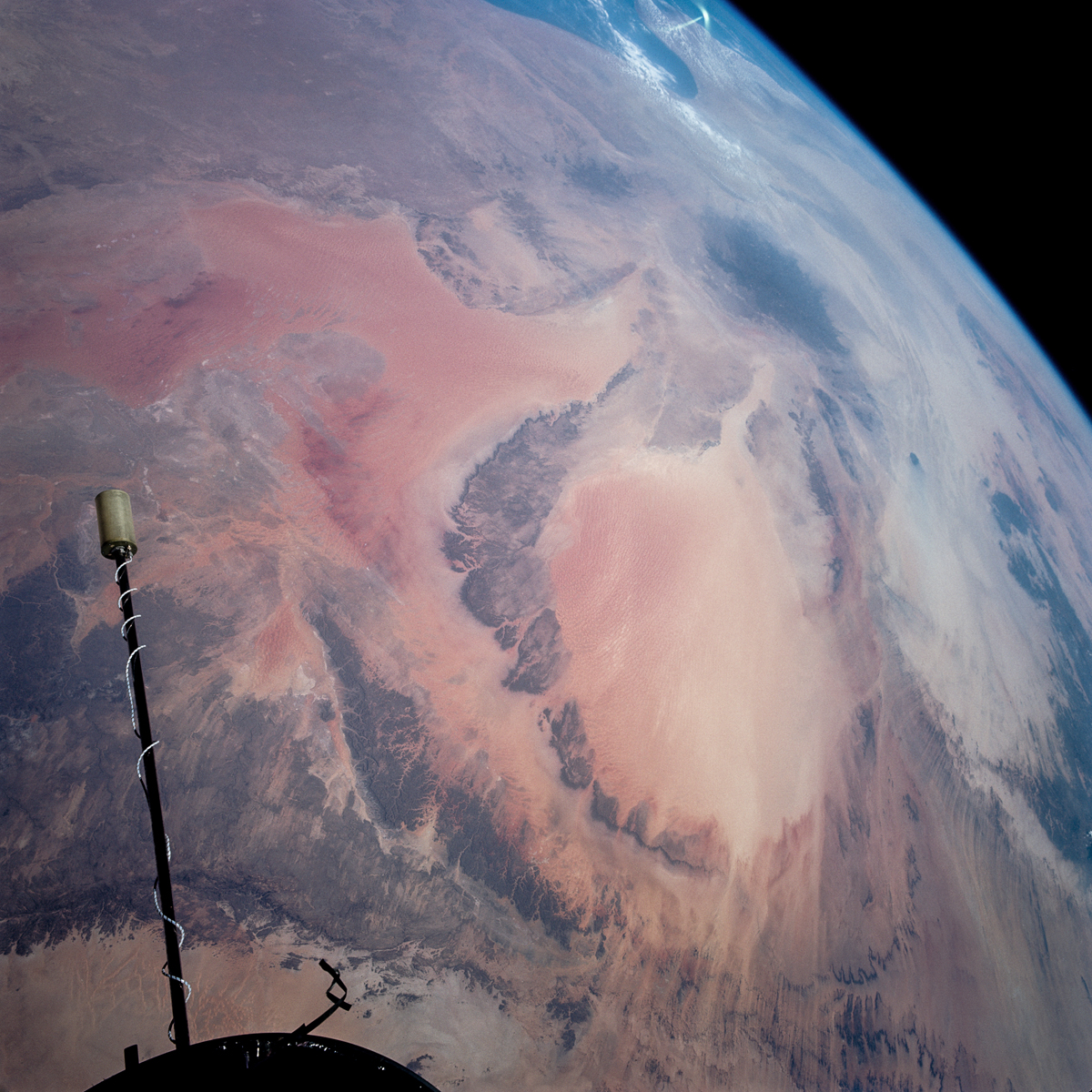
    This is not some distant planet seen in a sci-fi movie, it’s our Earth, in real life, as we explored space in the 1960s. The Sahara desert, photographed from Gemini 11, September 14, 1966. As we stand at the threshold of a new space age, heading back to the Moon, onward to Mars and beyond, the photographs taken during Mercury and Gemini will forever symbolize and document the beginning of humankind’s expansion out into the cosmos.

    NASA / ASU / Andy Saunders
    This is not some distant planet seen in a sci-fi movie, it’s our Earth, in real life, as we explored space in the 1960s. The Sahara desert, photographed from Gemini 11, September 14, 1966. As we stand at the threshold of a new space age, heading back to the Moon, onward to Mars and beyond, the photographs taken during Mercury and Gemini will forever symbolize and document the beginning of humankind’s expansion out into the cosmos.

    NASA / ASU / Andy Saunders

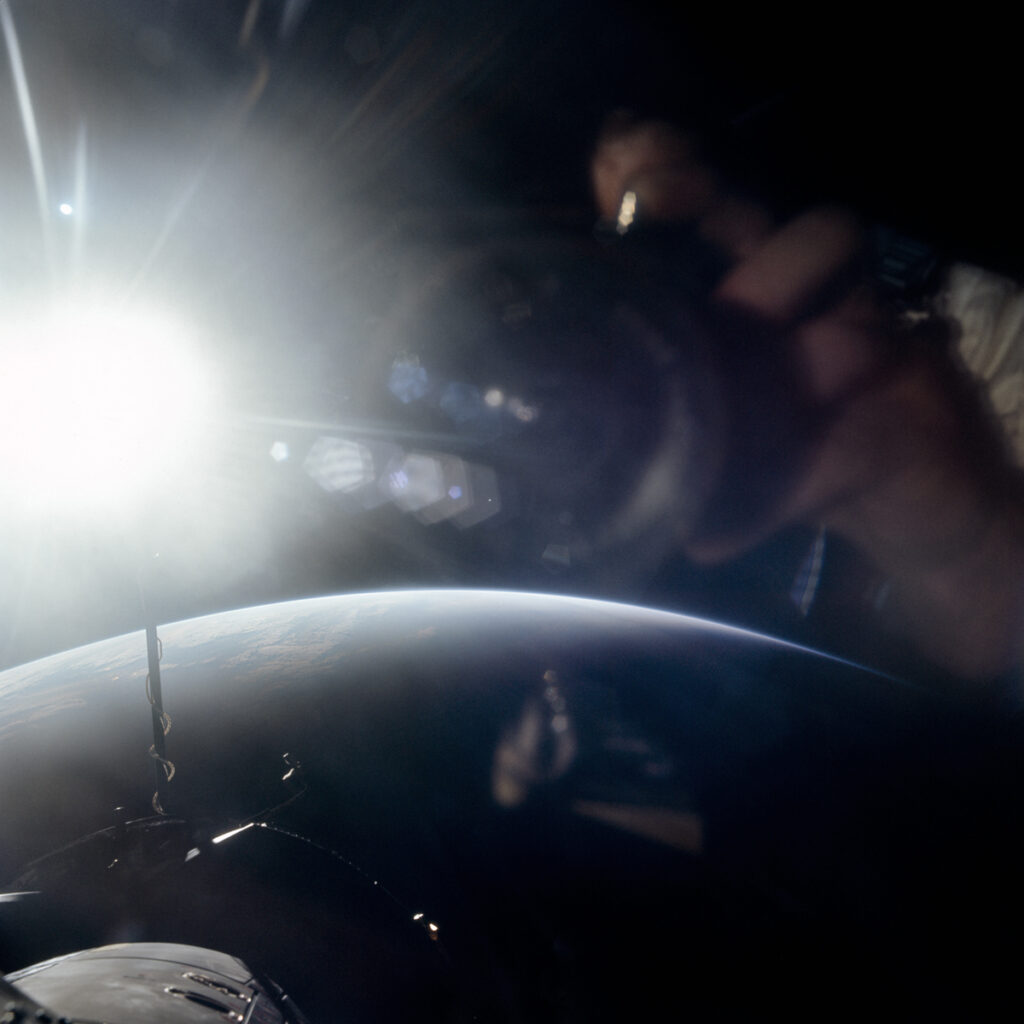
    Gemini took not only some of the first, but still some of the finest photographs of Earth ever captured on film – partly due to the high altitudes they flew to. Gemini 11’s Earth orbit altitude record held for 58 years until last year’s Polaris Dawn mission. Reflected in the window, Richard Gordon’s hand can be seen as he releases the shutter of his Hasselblad camera to capture the moment of apogee, over eastern Australia on September 14, 1966.

    NASA / ASU / Andy Saunders
    Gemini took not only some of the first, but still some of the finest photographs of Earth ever captured on film – partly due to the high altitudes they flew to. Gemini 11’s Earth orbit altitude record held for 58 years until last year’s Polaris Dawn mission. Reflected in the window, Richard Gordon’s hand can be seen as he releases the shutter of his Hasselblad camera to capture the moment of apogee, over eastern Australia on September 14, 1966.

    NASA / ASU / Andy Saunders

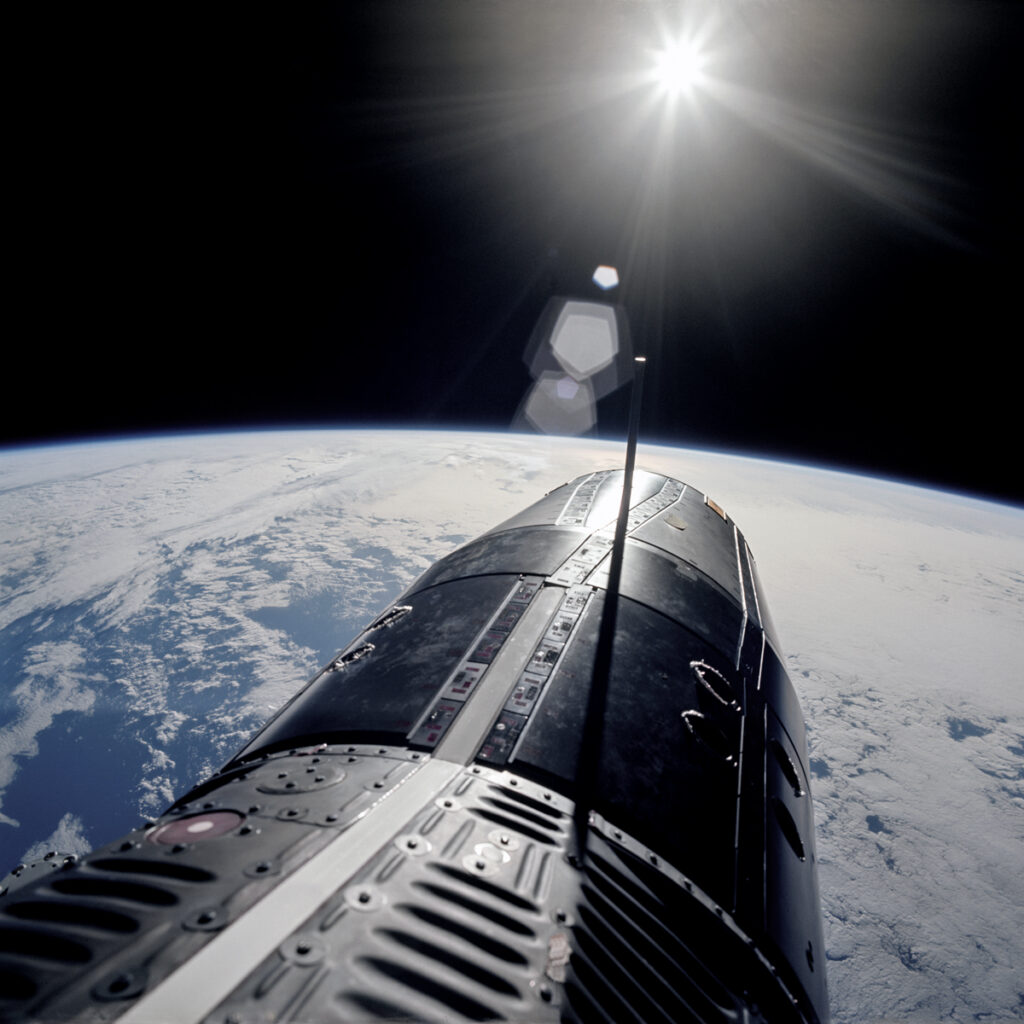
    The rudimentary-looking Gemini spacecraft, Earth, and the unfiltered, bright, white sunlight captured at the start of Gene Cernan’s “spacewalk from hell” on Gemini 9A, June 5, 1966. Effectively blinded, exhausted, overheating, and losing communications with his Command Pilot, Cernan was fortunate to make it back inside the spacecraft alive.

    NASA / ASU / Andy Saunders
    The rudimentary-looking Gemini spacecraft, Earth, and the unfiltered, bright, white sunlight captured at the start of Gene Cernan’s “spacewalk from hell” on Gemini 9A, June 5, 1966. Effectively blinded, exhausted, overheating, and losing communications with his Command Pilot, Cernan was fortunate to make it back inside the spacecraft alive.

    NASA / ASU / Andy Saunders

    Gemini took not only some of the first, but still some of the finest photographs of Earth ever captured on film – partly due to the high altitudes they flew to. Gemini 11’s Earth orbit altitude record held for 58 years until last year’s Polaris Dawn mission. Reflected in the window, Richard Gordon’s hand can be seen as he releases the shutter of his Hasselblad camera to capture the moment of apogee, over eastern Australia on September 14, 1966.

    NASA / ASU / Andy Saunders

    The rudimentary-looking Gemini spacecraft, Earth, and the unfiltered, bright, white sunlight captured at the start of Gene Cernan’s “spacewalk from hell” on Gemini 9A, June 5, 1966. Effectively blinded, exhausted, overheating, and losing communications with his Command Pilot, Cernan was fortunate to make it back inside the spacecraft alive.

    NASA / ASU / Andy Saunders

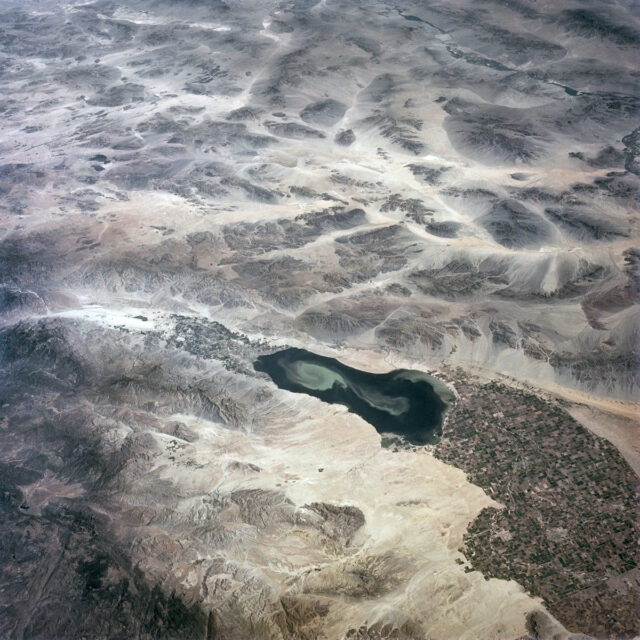
    The Salton Sea in California’s Imperial Valley, photographed 60 years ago (August 21-29, 1965), from Gemini 5. Gemini had to demonstrate all of the key concepts required to enable NASA to reach for the Moon with Apollo. At eight days, Gemini 5 was the first space mission that would be long enough for a return trip to the Moon.

    NASA / ASU / Andy Saunders

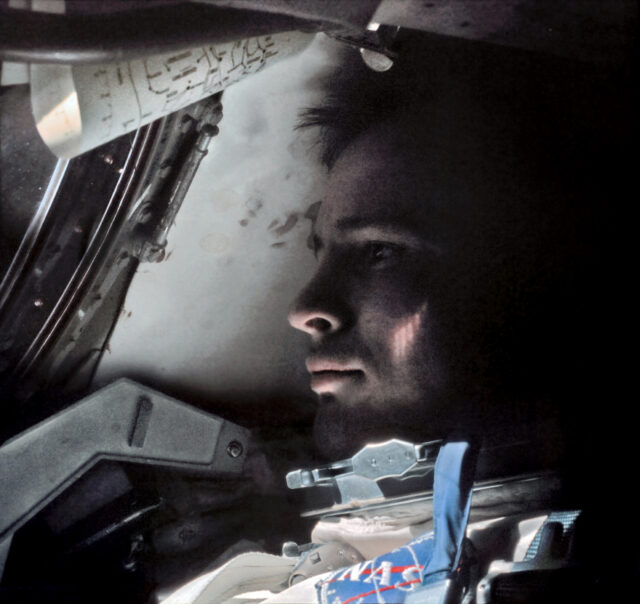
    Recovered from two separate frames of heavily underexposed film, and featured on the UK edition of Gemini And Mercury Remastered, Ed White gazes out into the heavens from inside Gemini 4, after his historic spacewalk. A star chart is seen above his head. White was later tragically killed in the Apollo 1 fire, along with Gus Grissom and Roger Chaffee.

    NASA / ASU / Andy Saunders

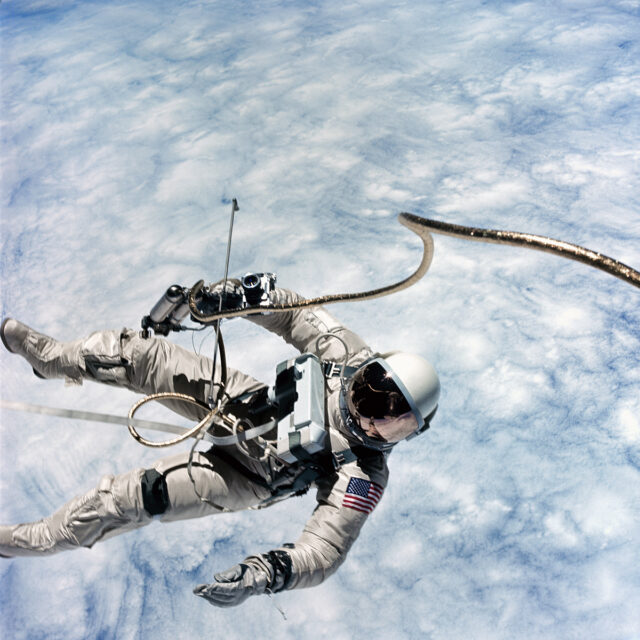
    Ed White floats in the void, during the first U.S. spacewalk on Gemini 4, June 3, 1965. These awe-inspiring photographs, of a human form against the backdrop of Earth, wowed the public and were a clear turning point in NASA’s appreciation for space photography. White is also featured on the cover of the book.

    NASA / ASU / Andy Saunders

    “Light this candle!” Alan Shepard is waiting atop his Mercury-Redstone rocket, to become the second human, and first American in space, May 5, 1961. His heart rate quickened as the hatch was bolted shut.

    NASA / Andy Saunders

    Ars: I want to understand your process. How many photos did you consider for this book?

    Saunders: With Apollo, they took about 35,000 photographs. With Mercury and Gemini, there were about 5,000. Which I was quite relieved about.  So yeah, I went through all 5,000 they took. I’m not sure how much 16 millimeter film in terms of time, because it was at various frame rates, but a lot of 16 millimeter film. So I went through every frame of film that was captured from launch to splashdown on every mission.

    Ars: Out of that material, how much did you end up processing?

    Saunders: What I would first do is have a quick look, particularly if there’s apparently nothing in them, because a lot of them are very underexposed. But with digital processing, like I did with the cover of the Apollo book, we can pull out stuff that you actually can’t see in the raw file. So it’s always worth taking a look. So do a very quick edit, and then if it’s not of interest, it’s discarded. Or it might be that clearly an important moment was happening, even if it’s not a particularly stunning photograph, I would save that one. So I was probably down from 5,000 to maybe 800, and then do a better edit on it.

    Share. Facebook Twitter Pinterest LinkedIn Tumblr Email
    Admin
    • Website

    Related Posts

    Google settles racial discrimination lawsuit for $50 million

    Access Denied

    More people are using AI for retirement planning, but how accurate is it? Here’s what experts say.

    ECB is studying defences against Mythos-powered attacks, Lagarde says

    Add A Comment
    Leave A Reply Cancel Reply

    Editors Picks

    Electrical fire to keep theater that hosts ‘The Book of Mormon’ closed through May 17

    The 2026 Grammy Award nominations are about be announced. Here’s what to know

    Disease of 1,000 faces shows how science is tackling immunity’s dark side

    Judge reverses Trump administration’s cuts of billions of dollars to Harvard University

    Top Reviews
    9.1

    Review: Mi 10 Mobile with Qualcomm Snapdragon 870 Mobile Platform

    By Admin
    8.9

    Comparison of Mobile Phone Providers: 4G Connectivity & Speed

    By Admin
    8.9

    Which LED Lights for Nail Salon Safe? Comparison of Major Brands

    By Admin
    Sg Latest News
    Facebook X (Twitter) Instagram Pinterest Vimeo YouTube
    • Get In Touch
    © 2026 SglatestNews. All rights reserved.

    Type above and press Enter to search. Press Esc to cancel.