






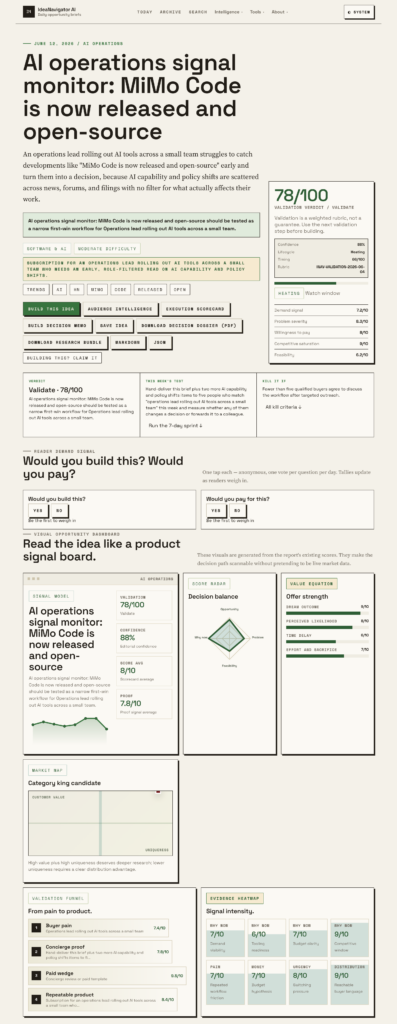
📊 Full opportunity report: Why MiMo Code Is A Game-Changer For AI Operations Teams on IdeaNavigator AI — validation score, market gap, and execution plan.
MiMo Code has been released as open-source, offering a new tool for AI operations teams to detect early signals of capability and policy shifts. This development is significant for operations leads managing small teams deploying AI tools, as it aims to streamline decision-making amid rapidly evolving AI capabilities.
The open-source release of MiMo Code was announced recently, targeting AI operations teams that need to stay ahead of capability and policy changes. The tool functions as a signal monitor, scanning feeds such as Hacker News to identify relevant updates that impact AI deployment strategies.
According to sources, this focused monitor filters news for signals that directly affect small-scale AI rollout teams, helping them respond faster than traditional weekly summaries. The initiative was driven by the recognition that AI capability and policy shifts now occur at a pace that outstrips manual tracking, and that early detection can influence deployment decisions.
At a glance
reportWhen: announced March 2024
The developmentMiMo Code’s open-source release introduces a new signal monitor designed for AI operations teams to track relevant capability and policy changes efficiently.
Enhanced Monitoring for Small AI Teams
This development matters because it addresses a critical gap for operations leads managing AI deployment in small teams. By providing role-specific, real-time alerts on capability and policy shifts, MiMo Code can help teams adapt quickly, avoid delays, and make informed decisions. Early detection of such signals can also prevent potential compliance issues or operational setbacks, making this a valuable addition to AI governance and deployment workflows.
AI monitoring tools
As an affiliate, we earn on qualifying purchases.
As an affiliate, we earn on qualifying purchases.
Rapid Pace of AI Capability and Policy Changes
The release of MiMo Code as open-source comes amid a landscape where AI capabilities and policies are shifting swiftly. Recent months have seen an increase in announcements related to new AI models, tools, and regulatory updates, often surfaced on platforms like Hacker News and industry forums. Small teams, which lack dedicated monitoring resources, struggle to keep pace with these developments, risking delayed responses or missed opportunities.
Prior efforts have relied on weekly summaries or manual news tracking, which are often too slow for the current pace of change. The need for role-filtered, timely information has become more urgent as AI deployment becomes more widespread and regulated.
“MiMo Code’s open-source release offers a targeted way for small AI teams to stay informed about relevant capability and policy shifts in real time.”
— an anonymous researcher
Unclear Scope and Adoption of MiMo Code
It is not yet clear how widely MiMo Code will be adopted by AI operations teams or how effective it will prove in real-world scenarios. Details on integration, user feedback, and performance metrics are still emerging, and the long-term impact remains to be seen.
Next Steps for Deployment and Validation
The immediate next step is for small AI teams to test MiMo Code in their operational workflows. Validation efforts will involve measuring whether the tool enables faster decision-making or prevents issues related to AI capability and policy shifts. Broader adoption and integration into existing monitoring systems are expected to follow if initial results are positive.
Key Questions
What exactly does MiMo Code do?
MiMo Code is a signal monitor that scans feeds like Hacker News for relevant updates on AI capabilities and policy changes, filtering for signals that impact small AI deployment teams.
Who is the target user for MiMo Code?
The primary users are operations leads managing small teams deploying AI tools who need early, role-filtered alerts on relevant developments.
How can teams test MiMo Code?
Teams can access the open-source code, integrate it into their monitoring workflows, and evaluate its effectiveness in providing timely signals for their specific needs.
What are the limitations of MiMo Code?
Its effectiveness depends on the quality of the signals it detects and the accuracy of filtering. Its long-term impact and user adoption are still to be evaluated.
Source: IdeaNavigator AI


