


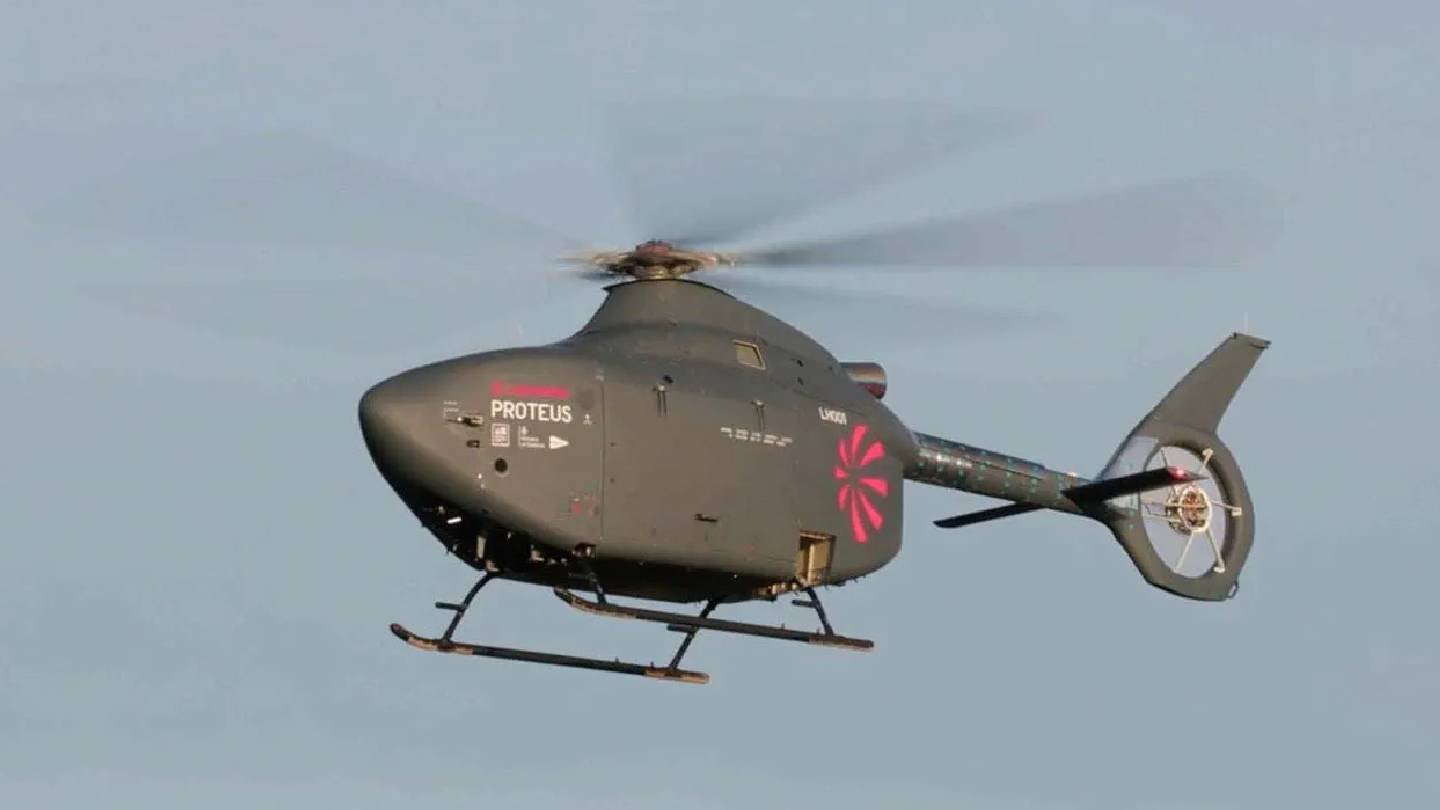

The UK has conducted the first flight of its full-size autonomous helicopter, Proteus, at Predannack airfield in Cornwall.
Leonardo built and designed the aircraft as a demonstrator for the Royal Navy.

Discover B2B Marketing That Performs
Combine business intelligence and editorial excellence to reach engaged professionals across 36 leading media platforms.
Find out more
The project aims to integrate uncrewed aerial systems alongside traditional crewed aircraft as part of the country’s future “hybrid air wing” and the Atlantic Bastion strategy.
The maiden flight comes a few weeks after a period of ground-based trials at Leonardo’s Yeovil facility, where teams assessed the vehicle’s systems, sensors and engines.
The event at Predannack was observed by engineers, technicians and representatives from Leonardo, the Royal Navy and UK Defence Innovation.
The maiden flight of Proteus delivers on commitments made in the Strategic Defence Review, which set out plans for a “New Hybrid Navy”.
The review established the importance of autonomous helicopters within hybrid air wings and in strengthening North Atlantic security through the Atlantic Bastion programme.
Proteus surpasses existing drones currently operated by the Royal Navy, such as Malloy octocopters and Peregrine, in terms of size, complexity and autonomy.
Leonardo is developing the project at Yeovil under a £60m ($80m) programme supporting 100 jobs in highly-skilled roles.
The company maintains that Proteus is among the world’s first full-sized autonomous helicopters.
The aircraft is equipped with sensors and computing systems controlled by advanced software that allows it to interpret its environment, make decisions and act without human intervention in the cockpit or cabin.
With a payload capacity exceeding one tonne, Proteus can transport various equipment and perform missions even in challenging weather conditions, including high sea states and strong winds.
During its test flight, Proteus operated its own flying controls independently from any human operator while ground-based test pilots provided supervision to maintain safety standards.
UK Defence Readiness and Industry Minister Luke Pollard said: “This maiden flight is a proud moment for British innovation. Designed and built in Yeovil, Proteus supports skilled UK jobs while helping deliver the hybrid navy outlined in our Strategic Defence Review. Autonomous systems like this will be vital in protecting our seas without putting personnel in harm’s way”.
Proteus is intended to undertake missions such as anti-submarine warfare, maritime patrols and information sharing with allied ships, helicopters, submarines and detection networks to identify underwater vessels.
The aircraft forms a core part of the Ministry of Defence’s Atlantic Bastion programme announced last month, supporting efforts to strengthen defences for the UK and NATO allies across extensive ocean areas.
Royal Navy Aviation Future Programmes deputy director commodore Steve Bolton said: “The successful first flight of Proteus is a significant step in delivering the Royal Navy’s maritime aviation transformation vision, and to demonstrating our steadfast commitment to investing in autonomy as part of a hybrid air wing.”

Sign up for our daily news round-up!
Give your business an edge with our leading industry insights.
