





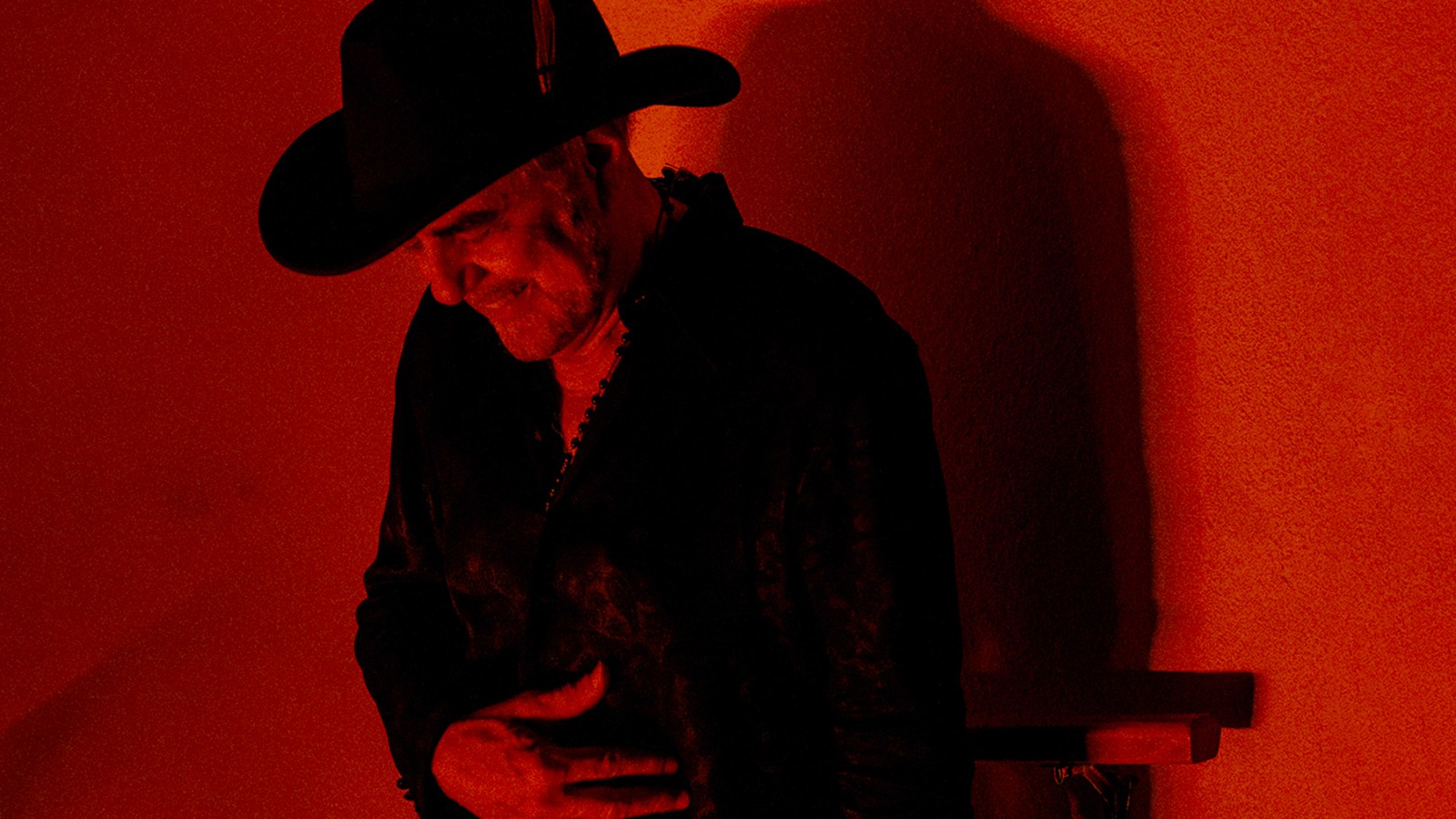
It’s easy to associate Daniel Lanois with a distinct sonic approach shared by many of the classic albums he helped birth, from Emmylou Harris‘ Wrecking Ball to Bob Dylan‘s Time Out of Mind. The Canadian producer/musician creates songs that feel like they’re haunted by their own ghosts, laced with intertwining echoes, tiny sonic fractures, and a palpable sense of place. But in the new episode of Rolling Stone Music Now, Lanois says his job is much bigger than that. “People talk about the sound, but what about the soul?” he says. “The sound of a record, well, that’s a given… But how about the soul of a record? Sound is my thing. But that’s not the main thing that I bring to the table.”
Lanois’ new solo album, Belladonna Nocturne, is a trippy collection of instrumentals that lean hard on his gift for atmosphere, from the Spanish-guitar-propelled “Inside the Walls of Puebla” to the wild, chopped-up feedback excursions of “Warp Sustain.” In our interview, he talked about creating that album and looked back on his work with U2, Peter Gabriel, Bob Dylan, D’Angelo, the Neville Brothers, and Neil Young. To hear the podcast version, check out Apple Podcasts or Spotify, or just press play above.
What are you up to right now?
I just came off of this tour in Texas with Micah Nelson, Willie’s son. We’ve made an [upcoming] album called The Ocean Floor, under the name Particle / Lanois. And we were invited to be on the bill with the Outlaw Tour people, which included Willie’s Fourth of July picnic. We had a nice time. And now, after the whirlwind of that, I’m getting ready to go to Canada to do some touring up there, which bumps into Scandinavia.

Let’s start with Belladonna Nocturne. It has a real sense of place that changes from track to track. Explain how this all came together.
I see every song as a scene. I have one, “At the Foot of the Skyway Bridge,” which is a bridge where I grew up in Hamilton, [Ontario,] which is not too far from Buffalo. It’s a steel town. And the Skyway Bridge is a place that I would ride to with my motorcycle-riding buddies, and it all had a little bit of rock & roll in it, old-timey, as if a throwback to the Fifties, let’s say. It’s a place that I like to go to, to cleanse the palate and remind myself of who I am and where I grew up. And it will likely build another picture for somebody else. We like to transport the listener to a location.

“Steel Mill” is definitely a vibe.
“Steel Mill” paints a picture of more of an urban landscape and has Jermaine Holmes on the drums, and he comes from the hip-hop world. I met him through D’Angelo. His backbeat is what we call a cross-stick. It’s not a lot of sound. It’s just a very clear striking point, and it means that it leaves more room, more air in the picture for other sounds to come through. It’s basically just three instruments. It’s bass, drums, and steel guitar. I just kept adding what I call my dubs to it, and any orchestral tones that one hears in there, l built through my electronic process of dubbing.
Your process is that you sample from the song itself and then build additional material into the song using those samples.
Yeah, that’s the process that got used on this track. I just sample from the steel guitar in this case and then expand upon it. You could call them unknown sounds, because you hear them and you wouldn’t say, “Oh yeah, that’s a flute,” and something else is a euphonium. No, they’re more mysterious than that. The reason that it works for me is I’m just drawing from already existing source material. I’m not adding a new sound. So there’s a reassurance that it’s cut from the same cloth.

You recorded “Unshaken” with D’Angelo for the soundtrack to Red Dead Redemption 2. What were the extent of your collaborations with him?
I met D’Angelo quite early on in the Red Dead Redemption music making. I met him at the Rockstar Games office in Manhattan. We hit it off nicely, and I played him a track that I had at the time. It’s a 6/8 rock song that he loved, and he said he would be happy to work on that with me. And that track did not pan out. He worked on it for a couple of days. He said, “Dan, I’m not really getting anywhere with this.” And I said, “Well, D, we’re here to have a good time and get to a special place. Give me a chance. Give me a day, and I’ll come up with another track.” And I built a new track for him. We already had one line that was used on the soundtrack. And that line, “May I stand unshaken amidst the crash of worlds,” which is something we had recorded in New Orleans — it was written by Rocco DeLuca, that line. And I took that line to D’Angelo, but I wrote then the 30 other lines to the song.
Did you guys stay in touch?
We did keep in touch. Only so much. We talked about doing some more work together and, you know, he came up as a church man, and I came up through church and worked quite a bit with church folks, including Brian Blade and his family in Shreveport, Louisiana. D was very touched by my having worked with the Neville Brothers. He was a fan of the Neville Brothers, and they always were a point of reference for him, for magnificent work done in the South by the Meters and so on. And so I think there was an underlying respect there that we were both in this for the right reasons.

I was just listening to “Ballad of Hollis Brown” that you did with the Neville Brothers. It was one of the two songs that you played to Bob Dylan right before you did Oh Mercy with him. I think it’s one of the best Dylan covers ever recorded.
Oh, yeah. Well, thank you for bringing that up. That was a little bit of a test track that we did with the Nevilles. I didn’t have a studio set up very well in New Orleans yet. I had a little apartment, and they showed up at the apartment, and we knocked out that version of “Ballad of Hollis Brown.” I just had a 12-track Akai at the time and I mixed it on a little Sony cassette machine, my little shoulder-strap Sony machine. And I never bettered the mix. I didn’t tell anybody, but we just took the cassette and mastered from that because it had the vibe on it. You never know how are you gonna get ’em, in regards to technology. Would anybody ever recommend a 12-track Akai mixed to cassette? But I never had any complaints.
To go back to Belladonna Nocturne — was this recorded in a bunch of different places? What was the process there?
It pretty much a grab-bag of beginnings, let’s call them. I have a studio in Los Angeles with a very nice piano, a nice Steinway piano, and then I have the same thing in Toronto. So wherever I happen to be, if the inspiration comes to me, then I go to the piano. It was not a sit down and let’s make an album in three weeks [situation]. It was a collection of inspirations from along the way.
Tell me about “Canadian National.”
That was recorded in Toronto on my little Steinway O. I laminated every hammer with additional felt, so the piano has a little softer touch, you might say, closer to a Fender Rhodes. Which allows me to crank up my mic pre[amp], and then I get to hear more aftereffect. We call that the harmonics. And I’m only so much of a piano player, but I’m very good with a razor blade. Having decided on a mode, let’s say, I would improvise within that mode. And if I was lucky enough to get an eight-bar section that I fall in love with, then I look to connect that eight bars to another eight bars further on down the line. Glenn Gould used to work that way, one phrase at a time, and then chop it together with a razor blade. So thanks, Glenn.
Your friend Brian Eno once showed me that he keeps all these starts to songs, little four-second sonic landscapes that sometimes become something and sometimes don’t. Do you do something similar?
We all collect our seeds, let’s call them. I have a lot of them that I love. They’re not finished works by any means, but it might be something to a melody that I wanna get back to at some point. So we keep a stockpile of our seeds. I used to call it the melody orphanage. Songs-to-be, but haven’t found a home yet. I think it’s interesting to revisit old seeds. They obviously got put in the orphanage for a reason. There’s something special about them, and they might just be looking for a family.
When I was writing the Rolling Stone cover story on U2’s No Line on the Horizon, you played me a very roiling instrumental that you said summed up your feelings about the process. How do you look back on it now?
So we went to Morocco to make that record. And we already had a great record before we went to Morocco. And I, at a lunch table in the south of France, I suggested to the band that we finish up the 10 [songs] that I recommended. Of course, we went to Morocco and didn’t work on any of that, and came up with a whole batch of new material, which makes for more fun because we keep hoping that the great track has yet to come. But in Morocco, everybody got sick. And so it became this very, very long process of record-making. I think we ended up back in Dublin. I was pretty worn out. That’s probably when you spoke with Eno. In the end, we got what we got. But there was a great record before we went to Morocco, and the adventure kept rolling along.
Eno told me a lot of the more quiet stuff had to go because they were looking for stuff that could be performed onstage.
I’ve had this conversation with many artists I’ve worked with. “Are we being responsible to the stage?” Because obviously, in a concert situation, if you’re a big band, then you’re not gonna be playing a bunch of soft material, ’cause people are looking to jump out of their skins. So there’s always that responsibility of, what will we bring to the stadium? But I’m a record-maker, you know. I don’t think so much about the stage. I think about how will we transport our listeners, and what might there be in this that will really touch somebody and cause them to think a bit differently or jump out of their skins in their own house. It doesn’t have to be in the stadium.
You performed with U2 at the Sphere a couple years ago. Any moments that stand out?
Playing at the Sphere was really special to me because it was the last show that they did. I suggested to Edge that if he needed a guitar-playing buddy, then I would join him on “One.” And he said, “Well, Danny, let me look into it,” ’cause they were filming at the time, and he said, “We’re gonna need some kinda consistency from night to night.” But as it turns out, Edge invited me to join him. There’s a mantra line that runs on through that song. It was played on guitar and with Eno on synth. So that line is the line that I decided to play with Edge. It felt the same as it did in the studio for me. I was close to my mates. And Bono said, “Just pay attention to me, and we can sing ‘One’ together,” and we did that. So what can I say? A great moment of celebration for a great song and some great friends.
Have you been involved with the new project that they’re working on at all?
I’ve had a little bit of an involvement with their new work. But I’ve not heard the album. I just saw that they released a video with the lead track. But I did do some work on some other things, so let’s see if I made the finish line. Both Eno and I did a little something in there somewhere.
Just a few songs?
Yeah, a couple or three songs. Jacknife Lee produced the album, who’s a great music man. Eno and I might be guest appearances in there somewhere.
Certainly one of the genres that I’d put your new album into is themes for an imaginary movie. It’s definitely soundtrack-ready.
I think in visual terms and sometimes I’m a little bit surprised that filmmakers don’t call me more often. Am I the only one who thinks that this music is cinematic? Maybe I need to call my filmmaker friends and network a little bit, which is not my inclination.
It certainly worked out for Sling Blade, so you would think it would happen more often.
Yeah, Sling Blade. What was special about Sling Blade was the one-on-one relationship I had with Billy [Bob Thornton]. I don’t remember there being a lot of opinions going around or music supervisors and all that kind of stuff. We were just — I’d come up with something, and Billy’d stop into the studio. I’d play him what I had, and he’d comment, “Oh, maybe that would be good here,” to repeat a theme. I really appreciated the simplicity of our communication and relationship. I just saw Billy last week in Texas, and we sat on a little porch together, and it might as well have been a Diane Arbus photograph. Couple of lost misfits on a back porch philosophizing about this and that and the other thing. It was pretty great. Time stands still with Billy. That’s what I like about him. And there’s nothing wrong with a bench on a porch, picket fence, and overgrown grass, watching the world go by. Not bad.
Shortly after No Line on the Horizon, you did Le Noise with Neil Young.
Yeah, we made Le Noise in the room that I’m speaking in right now. This is where I worked with Neil, and the invitation was to record 10 acoustic songs and film him, ’cause I was making films with my friend Adam Vollick at the time. The idea was to film with one camera, and as seen through the eyes of an individual rather than the eyes of an editing room. I think viewers really feel the vérité in that. And if we had a pretty good take from Neil, I would listen back to the take, make a mix as we listen, hand that to Adam Vollick. He’d go upstairs and lock that to his one-camera shoot, and in a matter of minutes, we were looking at a film with a great sound. I’ve explained this to my fellow filmmakers, and they say, “That’s a bit cowboy, isn’t it?” Because normally you gotta go in the editing room and fiddle around for a couple of weeks before anybody sees anything. And that tone suggested a pace, and that pace dovetailed into a more electric angle, and he pulled out his Les Paul and we went up that street. And so what can I say? Two Canadians having a pretty good time. We come from the same neck of the woods, so there was a lot — the humor was intact and a lot got left unsaid, because we were able to communicate just by looking each other in the eyes pretty good.
Did you butt heads with Neil less than you ended up doing with Dylan?
I don’t remember butting heads with Neil. It was a fabulous exchange. We had an excess of material and I was helpful to him with choosing the best ones so that we had the most concentrated record.
With Dylan ,that’s a different situation because, you know, I made two albums with him, and we go back to New Orleans on the Oh Mercy album, which was a very private record, as I like to call it. Almost as if the lens went into the secret place of Dylan. And I recognized that quite early on. I thought that we had really hit on something in the tangibility of it. I sat next to Bob. We played guitars together and had a nice microphone on him, and we cut most of the record to a Roland 808, which is just a little beatbox. And so that record had a very nighttime feeling, speaking of nocturne. And Bob recognized that pretty early on, and he said to me, “Dan, let’s only work at night on this record ’cause it seems to be where it’s going.” And I agreed with Bob on that, and we chose not to have a lot of people around. And we had Willie Green living around the corner. I kept a drum kit set up, and he would come by on my request and overdub the drums. I played the bass on the record mostly. If there was any kind of a conflict, it would’ve been that Bob was missing the presence of a band, and I didn’t want the presence of a band. I wanted all of the intention to go on the songs and his voice. And I got a very beautiful sound on his voice on that record. So I stood my ground, and we did have other musicians come by, but largely, once we sorted out our differences that way, then we embraced the more private part of the record, let’s call it.
What’s an example of that on the record?
I like to reference the song “Most of the Time.” I played four Les Paul tracks through my Vox amp up on 10, and it’s those four Les Paul tracks that sound like a string quartet in the distance. You don’t quite know what you’re hearing, but it’s almost as if a quartet is being blown in by the wind from the next town. And the depth that it creates is very much part of the mood that that song has in it. I played the bass on it. I came up with a very nice bass hook. And because I’m a guitar player and not a bass player, I was afforded the flexibility of going to a melodic place. There’s something special about that little bass line, as it’s almost like the bottom punctuation to Bob’s “Most of the Time.” And I stand by that track. The only regret I have on that album is we excluded one of my favorite tracks, which was “Series of Dreams,” which came out later on a bootleg, I believe. And if I had to go back, I would try make an effort to include that one. “Series of Dreams.”
I never understood from either of you why that particular song, which is so fantastic, didn’t make the record.
I have to take some responsibility with that. You know, I think I did say to Bob that it was reminiscent of things I had done for other people on other records. And the part of me that likes works to be completely original cast a shadow of doubt on it, and he might have listened to that, and so I should have gaffered my face, and I didn’t.
A lot of the money that supported the work you do has vanished, hasn’t it, thanks to streaming?
I think what has gone away is career building. For sure. And let’s throw back to back in the day, an artist would be signed to a label, and they would look to build a career and keep expanding. And if you’re lucky enough to get hits, then we keep rolling. But they’re fascinating times, ’cause record companies aren’t paying for records anymore. Maybe they are for some artists, but most artists are just making their records at home, and they deliver a finished record to a label or a distributor. The idea that there would be budgets coming from labels and career building and all that, I think that’s naturally just disappeared.
And it’s affected the art — artists start to think it doesn’t make business sense to put in the kind of time that so many of the great albums you worked on had.
Yeah. How are people making records? The folks I’ve been speaking with lately are thinking of getting back to putting players in a room and knocking it out in a collaborative manner. Let’s say it might be nice to get away from e-mail rock. E-mail rock is a term that we’ve been throwing around here because, maybe driven by the pandemic, you’d send a track to a faraway place, and somebody would do an overdub on it. Somebody might come up with a riff, they send it to somebody else, send it to somebody else, and then you have now 10 composers on a hip-hop track. But I had a very nice recent experience in this very house here. With my good friend Micah Nelson, Particle Kid, we assembled a little band and brought some filmmakers in, and we replayed three of the songs from the record that will come out in the new year. And there was a very nice feeling in the room, and we captured a special vibe. That might be a way of making a record in the future. Just get some people together and knock it out. A futuristic technique, even.
With Bob, one of your guiding principles on Time Out of Mind was that you were less interested in songs that were blues structures. You were trying to push him into other forms.
Well, it was definitely a blues-based record. And I knew that from the beginning. Even “Love Sick” is blues-based.
Bluesy without being a 12-bar blues, I guess.
Yeah, without being a 12-bar blues. But you know, I knew what was coming, and that’s why I made the decision to bring in Brian Blade and Jim Keltner on the drums, because if it’s gonna be the blues, I wanted Brian to be involved ’cause he’s from the South and a church drummer, and so he would have a good understanding of blues. You don’t wanna sound like a bar band, and so how will you approach the blues in an original manner in modern times when you might say that the blues had disappeared a long time ago? And so I built some beat tracks with my friend Tony Mangurian in Manhattan. Tony’s a good drummer, and I’m pretty good on percussion. So we played over top of some old blues records that Bob had recommended we listen to. I knew those records already, but it was nice to hear them again. And so with Tony, we overdubbed a bunch of drumming and percussion on top of these old-timey records that were amazing. I did not use the old-timey records in the end. I just went to listen to what we had played on top and built these — if I had a magic eight bars of a groove, then I looped that and created about a dozen different loops as an insurance policy. So the band that Bob and I had put together, if I felt that we were going to too common a place, then I would feed these beginnings, these magic loop beginnings to the drummers. I knew that if we ran into trouble, then I could reference these beginnings and direct the music into a certain direction that would make it more original.
One song that I heard entirely differently after reading your book was “Can’t Wait.” The first take was best, and you kept trying to get Bob back to it.
Well, simply put, we had a pretty good demo of “Can’t Wait” with Tony Mangurian playing the drums, and he’s more of a hip-hop drummer. So I got very excited about this ’cause I thought the song might then have a chance to hit the airwaves with more of an urban rhythm.
In the end, “Love Sick” I guess was the hit. But there is unrealized potential in “Can’t Wait.” You were right.
Yeah. But, you know, you only get so much time on a record with Bob, and so that was just a dream of mine, and I was looking to pick up from where we left off with the group of the demos. But we got something else that’s pretty nice, so everything worked out pretty good in the end.
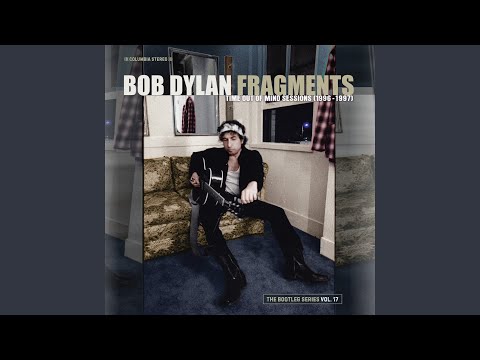
Dylan had that box set put out where they almost undid half the production on Time Out of Mind. What was your reaction?
Oh, you mean the remix of the album? Yeah. I got a call from Wim Wenders when that came out ’cause I hadn’t listened to it yet. And he said, “Daniel, I’ve gone back to listening to the original of that record because I couldn’t even listen to these remixes ’cause the feeling was not there.” I said, “All right, Wim. Well, thanks for the call, and I’ll let you know how I feel when I get around to listening to it.” So why remix records? I can only assume that this happened after Bob sold his catalog and whatnot, and those folks were probably looking to make a few bucks back and decided let’s do a remix. Let’s say Wim Wenders was right. But in my experience, people are never willing to say, “Well, we gave it a good try, but it didn’t quite work out.” Nobody ever says that. And so they released what they wanted to release, and that’s that. And what do you think, man? Did you hear it?
I heard it. I didn’t see the point of it. I thought that part of the point of Time Out of Mind was the sound. It felt a bit like a dismantling of what had been done.
Do you think he had anything to do with it?
He has had interviews where he’s suggested the album wasn’t quite what he wanted, which is pretty funny given all its success. So who knows?
Yeah, man. Have to ask him… The people who remixed that record, they might’ve done well to take a look in the mirror and say, “Well, I don’t think I bettered it.” And that might’ve been the most courageous thing to do, just to say, “Lanois got it right,” and leave well enough alone, and it’s a masterpiece, and let’s throw confetti and bust out the rum.
Bob is doing the hoodie thing onstage now, which he also did in the studio with you sometimes. What’s the hood about?
Maybe he doesn’t like his hair right now.
That was one of my guesses, to be totally honest.
You know, I’m doing the beanie, he’s doing the hoodie.
People don’t think of you as much when it comes to the huge stuff you did with Peter Gabriel on So. Nothing sounds like that album.
It was a very devoted time for me. I had already made an album with Peter before the So album. It was a soundtrack for a movie called Birdy. He invited me to work on this soundtrack with him, and we did some lovely things, very imaginative things. He said, “Well, why don’t you stay on and work on my singing record, my song record next?” I said, “OK.” And we worked together for a year almost to the day, which was apparently a fast pace for Peter. And I loved him like a brother, and it was very much a one-on-one. David Rhodes lived around the corner — Peter’s guitar player. So it was largely Peter and myself, and then we were the Three Stooges. We wore hard hats to work, and it was a very nice vibe. This place was right out in the middle of the country, and we were in a cow barn. It’s not a glamorous studio by any means, and I was OK with that. We put the glamour in the music rather than the curtains.
Something like “Red Rain” — it’s so distinct. I can’t think of another song that sounds like that.
I hit on a sound with “Red Rain.” Peter was playing a Yamaha CP70, which is an electric grand piano you could call it. And I got a really nice sound out of it, and I was very extreme in my processings and my sound manipulations at that time, and I managed to turn that piano into rainfall. These avalanches of harmonics, and I just kept at it. It’s a technique that I worked on with Brian Eno prior to working with Peter. Simply put, we print our effects, and then allowing the effects to go back through the effects, and then another print, and another generation. So to keep adding multiple generations to processing, it gets into far-out stuff where your voltage control oscillators take on a life of their own. And before you know it, it sounds like monks in the distance, and cherubs flying by, and solarizations by Man Ray personally done by hand, and so on. And that’s where I got to with “Red Rain.”
And then of course, “Sledgehammer” was very different from everything else on the record.
Yeah, we cut that to a beatbox. It was a nothing beat. It was just some little drum machine that Peter had in the house at the time. I wanted to speak on a high frequency. I wanted to have that sensation that there was somebody really delivering a great hi-hat part. Testimony. So I wanted an expressive hi-hat performance, and not done by a machine, and we were lucky enough to be introduced to Manu Katché from Paris, great drummer, and he came in and he knocked that out in one take. I said, “Please give me a hi-hat fill. I can’t find anybody to do it.” He laughed and did it. Thank you, Manu.
To go to U2’s The Joshua Tree, you talked about “Where the Streets Have No Name” in your book, conducting the band with chords written on a blackboard. Why was that needed?
Because, you know, people get in the heat of a performance and they might be learning the song still, so it’s not bad to be a science teacher with a pointer. Just point at the blackboard, then point at the next chord that’s coming up so they just look up, and they don’t have to think about following a chord chart. Thank you, Danny.
And that song started with something the Edge had recorded by himself, I believe.
Yeah, that’s correct. Edge delivered a very nice, symphonic beginning to that song. Same BPM, but a different time signature. I think it might have been in 5/4. And see, we used his home recording and transferred that to the multi-track, and essentially the band overdubbed what Edge had prepared at home. W just made sure that we built a transitional, rhythmic component for Larry [Mullen Jr.] to follow. And so by a little bit of technology, we were able to build a multi-track for the band to overdub onto. And at a certain point it went from 5/4 to 4/4.
When you get something like “Where the Streets Have No Name” or “I Still Haven’t Found What I’m Looking For,” you realize you have to make an entire album that lives up to this stuff.
Standards get set, and that’s what’s great about record-making. But the thing that is most significant is that as you’re going along, something will become the sound of the record. And that’s why albums have a certain vibe to them. Oh Mercy has that vibe to it because it was done in a private way. It was not a big orchestra or band, and so you feel that feeling — let’s get a little more snapshot from Bob’s point of view. When we got into The Joshua Tree, quite early on we found something. We found a sound to that record and it became the governor. And so this is not anything you can control ahead of time by spreadsheet or by song list or anything. It’s when you get into the thick of it, you find out what you’re dealing with.
Four years later, you did Achtung Baby. A lot of times when people do an album that completely changes the sound they were known for, they go to new people. But this was the same people deconstructing the thing that they had done.
Back to The Joshua Tree for a minute, having finished Unforgettable Fire with the lads, I said to Edge I thought we had something left to say together. I didn’t go on too much about it. I wasn’t campaigning for work. I said that because I love them, and I wanted their music to be the best for them. And I meant what I said. And after The Joshua Tree, obviously that was a very successful record, but we had such a team and we decided let’s just keep going with it. It was Bono’s idea that we would make a European rock record, and why not go to Hansa in Berlin for that? The wall had just come down. Eno had worked there with Bowie and Iggy Pop back in the day, and so there was a notion about that being far enough away from home but still Europe. So that’s what took us there.
We kept the team together. Flood kindly took on all the engineering duties, which freed me up to be in the band room with Eno. Now in regards to creativity, here we go. You got Eno, me, Flood, and all we ever cared about is soul and originality. What can we do that’s never been heard before? And then the Edge, of course, is a master guitar player, and I was very happy to work closely with him. We threw some chords around for the song “One.” We tried this arrangement, that one, and flipped it around. And luckily we’ve got Bono, and if he hears something that inspires him, he grabs the microphone and delivers a line, and so off we go from there. A very inventive time in Germany.


Nathan Brown*
What do you remember about the song “Ultraviolet”? That’s an extraordinary one.
What a great title, “Ultraviolet.” A real driving track, if I remember right. The beginning is — I love beginnings like that because they’re usually built from spontaneous little pre-song ad libs, and people are getting sounds, and it’s exciting, and the flowers are unfolding. And then Bono with a testimonial tonality and then off we go to almost go into flight. I got a flying feeling from that one. Levitation. It’s pure rock & roll. It belonged to that time. Made by those people in that room. What can you say? Wow.
“Beautiful Day” years later was more of excavating layers and messing with many versions. A very complex process.
It’s a song that we had a go at for a good few days, and it meant a lot to the band. And Eno and myself at that time were coming into the studio a little bit earlier than everybody in the morning just to get something going. And it was Eno’s idea to go a little more electro with it, and away from the band room. And he came up with a beat. Like an old rock & roll beat. And then I design a line above Edge’s line. The Bernard Herrmann to the Edge, let’s say. And Eno and I built this little track, this little beginning for the band.
What is that line played on?
It’s on guitar. I played it on guitar, and Edge is playing the melody. I forget what the treatment of it was, but the guitar is the basis of it. I mean, everything that Edge does is treated. You should see his rack.
I was at a soundcheck and watched him play the beginning of “Mysterious Ways” from close up, and he’s basically just playing a B barre chord. But there were like a million things going on.
Well, a stock B barre chord in the hands of one of the greatest rhythm guitar players on the planet named the Edge, come on. Anything you add to it will be a compliment. “Mysterious Ways.” Check out the breakdown of that. It’s like top-level. It might as well be James Brown. Thanks, Edge.
You said in your book that Dylan’s Chronicles account is accurate. There is a part in Dylan’s book where you apparently smash a Dobro. What’s that about?
It was simply about, I wanted to keep pushing for the private part of the record. And Bob was playing a great part on his guitar that I wanted him to finish. And he thought it would be better if we got somebody else. I said, “No, we’re not gonna get somebody else. We’re gonna get the man himself, Bob Dylan, to play the part.” So that’s it. By Dobro or otherwise.
Again, congrats on the new album.
Thank you. Let me say a few more things about what’s driving me. What drives me these days is I want to make music that will take people to another place beyond their understanding. And for them to feel that a record will be a reliable transporter. That you can put something on that I put my love into and to feel like you could be transported to another place emotionally. Close your eyes, maybe geographically. And what we’ve always loved about records beyond the fanfare of it and the image of it, what we’re left with ultimately is the sound of it and how it makes us feel. That’s the responsibility that I’ve decided to keep embracing and the criteria that we operate by every day. It means so much to me that somebody’s going to find something in a piece of music that might take them to a place emotionally. It might even be emotional phase cancellation, which is a term I like to use these days.
You’re feeling a little sad. Well, maybe you listen to “Most of the Time” and there’s something in the sentiment of that song that relates to something you’ve just gone through. And that song will absorb any kind of feeling that you have about your own sadness and you won’t be so sad after listening to it because it’s been canceled by phase cancellation. We’re constantly on the lookout for new forms of elevation and that’s why I stand behind my Belladonna Nocturne record. Yeah, it’s a nighttime record, but it’s got a little light in there. If you stay up long enough, you can watch the sun come up to it. And I try and make music that will cause people to be a different person than they were before they put on the album. They’re really doorways or keyholes or little specks of light at the crack of a door, and you open the door, and there it is, and a new way of looking at life, a new chapter.
Now you’re definitely drawing on Mark Rothko there.
How about that? As I understand, Mark had a lot of styles that he was operating within, and then ultimately he decided that he would be responsible to this pure form, this love of texture. And he got to that after many, many years of doing other kind of work. Sometimes it takes a while to get to that place where you admit to yourself that you don’t have to be chasing someone else’s angle on a subject matter. I feel that way about my steel guitar. You know, I’ll never be Buddy Emmons or some of those great Texas players, and I love that playing, but I could never be that. I am somebody else. And so I found something in the instrument that speaks on my behalf, and I’ve invented an original style, and I stand by it and I can continue with that. If we’re lucky enough to come upon something that belongs to us, then that’s quite a rock to stand on, and off we go to the next dimension of original work.
Rothko spoke about his signature style as being doorways and portals, which is what made me think of that.
Yeah. I see what he means. There’s no dictatorship there. You know, it’s a texture, and it’s not as if you’re looking at a portrait of somebody’s face. As colorful as it might be, it’s still a blank canvas to the viewer to a degree, because the viewer can just invent their own scene, invent their own portrait. And hopefully Belladonna Nocturne has a bit of that in it, just to lift somebody up or maybe make the car drive a little — let’s take that lane and we don’t know where it goes, and it might be nice to have no particular place to go and get away from multitasking and all of the economic pressures that we live by in modern times. Just a little escape route is not such a bad thing, or a secret passage. Let’s call it a secret passage.