








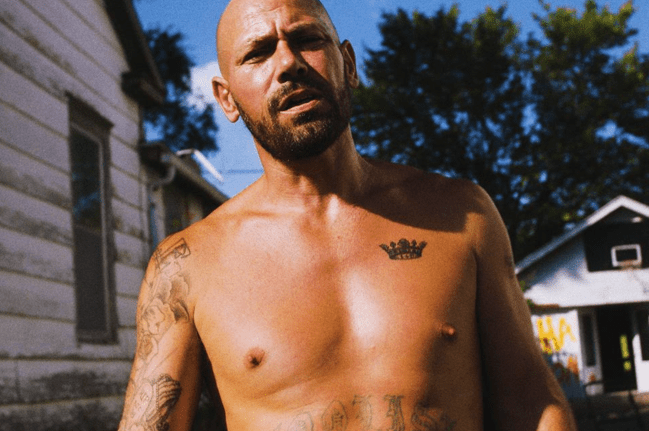


That every person is the protagonist of their own life ranks among a class of truisms whose veracity is so indisputable that it scarcely seems necessary to interrogate. But that’s just what Robert Greene does in “Too Much Sugar.” This hybrid documentary represents the director’s most audacious attempt to rethink the interplay between reality and art. His portrait of Ryan “Holli-wood” Holliger, a Missouri man using the tools of cinema to tell his own story, offers a hopeful yet honest assessment of the medium’s ability to transform the world.
The slippery line between fiction and non-fiction has always been Greene’s primary subject. His last film, 2021’s “Procession,” took a step further by concretizing a connection between art and therapy that frequently underlay the director’s work. In partnership with registered drama therapist Monica Phinney, who also participated in the production of “Too Much Sugar,” Greene set up controlled experiments to validate the healing properties of giving survivors of sexual assault the ability to reimagine their trauma as cinematic scenes.


But what structure Greene built carefully in “Procession,” he demolishes compellingly in “Too Much Sugar.” The clean demarcations between recreation and reality necessary to protect his previous subjects come crumbling down in the face of a larger-than-life figure like Ryan. This swaggering ball of machismo first came to Greene’s attention long before he ever started rolling cameras because both men had sons who played in the same youth basketball league. Greene hated Ryan when they were opponents, yet came to know and love him when the boisterous booster was on his side. Their affection and connection grew to the point where Ryan shared that he always wanted to make a grandiose movie about himself.
An early title card in “Too Much Sugar” outlines what becomes the central tension of their shared artistic endeavor. “I agreed to help him,” writes Greene, “I also asked to document his real life.” The filmmaker could indulge some of Ryan’s most self-aggrandizing cinematic fantasies, but he also had to leave space for Greene to illuminate the circumstances that inspired these visions. What begins with the seeds of a vanity project organically blossoms into something that encompasses the many people Ryan’s life touches.
The blast radius of this carpenter, fighter, and father — to use Ryan’s own chosen trio of descriptors — extends widely due to the six children he’s sired with five different women. He shares many life touchpoints, be they parenting or prison time, with his best friend Michael “AccRite” Midgyett. His stalwart partner, Amanda, becomes one of the most memorable presences in “Too Much Sugar” as a steady bedrock for the extended Holliger clan.
The more time Greene spends getting to know the community sucked into Ryan’s vortex, the clearer it becomes that each of these people is the star of a movie worth making as much as his.
Greene shares the “film by” credit with 12 others on “Too Much Sugar,” yet remarkably, the film does not collapse under the weight of all these collaborators’ voices. Some of the film’s chaos is by design to clue viewers into the demands and desires of Ryan’s life as his obligations pull him in countless competing directions.
But much of Greene’s edit boils down to two simple questions: what the movie of their own life would be and what concerns they have about letting Ryan see his own vision through. Simply juxtaposing their self-conceptions — a family horror, a therapy drama, a superhero actioner-cum-romantic comedy — with Ryan’s own broad, ’80s-style family comedy concept offers revelatory insight into the dynamics of their ecosystem.
Many participants in “Too Much Sugar” do not instantly snap into convenient genre frameworks or heroic narratives. Ryan’s oldest son, 23-year-old Wayde, struggles to conceptualize the movie of his own life because he has trouble seeing what future lies in store for him. As Greene gently prods him toward an answer, the conversation comes to represent the importance of ensuring working class Americans see themselves reflected in art — be it about themselves or merely people like them. To conceive of oneself as a protagonist is to ascribe value to a life and signal faith in a grander plan underway to reveal that person’s purpose.
AccRite, meanwhile, sees cinema not just as a tool for unlocking the future but also for rewriting the past. He remains haunted by the shooting death of his teenage son in 2023, and Ryan sees the filmmaking process as an opportunity to rewrite this tragedy. In AccRite’s movie, designed specifically with Phinney as a form of drama therapy, he delves into science fiction territory to recreate that fateful night with a time-turner device that allows him to prevent the murder. “Even if it didn’t happen in real life,” he proclaims after filming, “it happened on the inside of me.” Greene’s film makes a strong case that having such a feeling of renewal at all matters far more than whether it occurred synthetically or spontaneously.
But “Too Much Sugar” does not just depict this transformation. Greene also invites viewers into the process by making the boundaries as porous for the audience as they are for the participants. The film’s aesthetics begin with a fairly clear delineation between moviemaking magic and hardscrabble reality. Getting inside Ryan or anyone else’s personal movie leans into a more subjective cinematic language, such as intimate close-ups, more controlled frames, and a soundtrack of piano key taps that could make Jonny Greenwood blush. The documentary reality of Ryan’s life leans on observational verité techniques, with the camera often placed at an unobtrusive distance and following their freewheeling motions.
One such scene that appears captured, not composed, arises when a playful exchange about AccRite’s dead son on a job site goes too far. Cinematographer Robert Kolodny’s camera watches from afar as Ryan embraces his pal out in an open field, providing comfort and consolation in this hour of need. Greene then cuts away from the moment to their reflections on it, revealing a quality not immediately apparent: this was a staged scene for them to play out emotions that would otherwise be difficult to express in their day-to-day lives.
By breaking with the storytelling patterns established earlier in “Too Much Sugar,” Greene liberates his audience from tracking how each scene falls in the fiction/non-fiction binary. It’s a continuum for everyone making the movie, and this convention-busting move allows everyone viewing it to experience the journey with similar clarity. The film embodies its devotion to ecstatic truth being as valid as documentary truth with a full-bodied commitment.
This muddying of the narrative waters never comes at the expense of clarity. “Too Much Sugar” does not devolve into a puzzle box film meant to be solved, as text overlays often indicate when a scene comes from someone’s movie. These cues feel less like hand-holding for the audience and more of an acknowledgement of the artistry of whoever’s imagination and vulnerability lights up the screen. These moments pile up and ultimately converge, paying heartwarming tribute to how even the most monomaniacal movie projects necessitate collaboration.
As they commit to finding a collective catharsis, these participants might think they have eradicated the distinction between artificiality and authenticity. For a few brief moments in production, they do achieve a kind of singularity that allows person and persona to merge honestly. But eventually, production ceases on their movies, leaving Ryan and his orbit to determine how much they can carry the spirit of “Too Much Sugar” into their normal existences. The film’s coda surveys the aftermath ever so briefly, even though the immediate consequences of this experiment feel substantial enough to power another feature. Hollywood ending or not for his subjects, however, Greene proves his thesis once again. Films can change the world, or at the very least, the people who walk it.
Grade: B+
“Too Much Sugar” premiered at the 2026 Venice International Film Festival. It is currently seeking U.S. distribution.


