


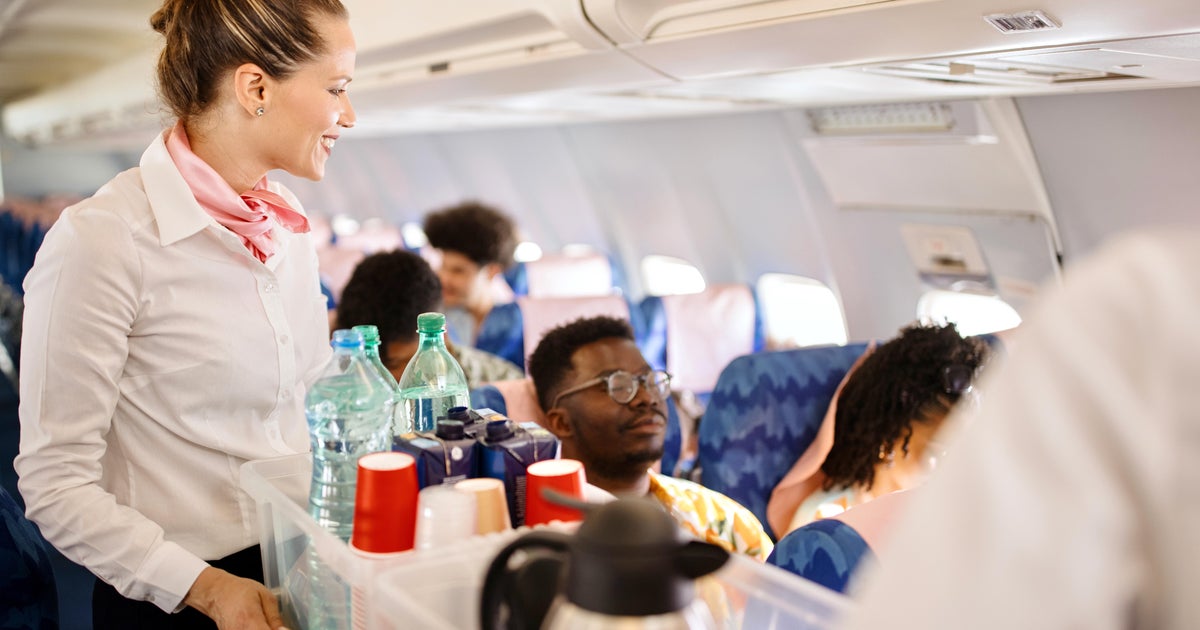
Airlines are serving “potentially unhealthy water” to passengers, according to a new study, with researchers recommending that travelers stick to bottled water and avoid drinking coffee or tea served on aircraft.
The nonprofit Center for Food as Medicine & Longevity, which examined more than 35,000 water samples served by 10 major and 11 regional airlines over three years, also urges passengers to avoid washing their hands in aircraft bathrooms and instead stick to using hand sanitizer containing at least 60% alcohol.
Among major U.S. airlines, three — American Airlines, JetBlue and Spirit — earned a “D” rating from the group, according to the analysis. Delta and Frontier were the top-ranked major carriers, both earning “A” grades for their water.
Water quality may not be a top-of-mind airline safety issue with passengers, but it’s nevertheless an “important public health consideration,” the Center for Food as Medicine & Longevity noted in its analysis. Drinking potentially contaminated aircraft water can result in issues such as gastrointestinal illness and exposure to pathogens, the group added.
What the study found
The analysis found that 2.7% of samples tested positive for total coliform, a group of bacteria that’s found in the digestive tracts of humans and animals, as well as in plants and soil.
“Testing for coliform bacteria is important because their presence in drinking water indicates that disease-causing organisms (pathogens) could be in the water system,” the Center for Food as Medicine & Longevity said in its report.
E. coli was identified 32 times across the 21 airlines, the group said.
The Environmental Protection Agency established the Aircraft Drinking Water Rule, or ADWR, in 2011, which applies to U.S. carriers with onboard drinking water systems for passengers and crew. The rule requires airlines to test for coliform bacteria and possible E. coli, as well as to disinfect and flush each aircraft’s water tank four times a year.
But the EPA rarely levies civil penalties to airlines that violate the ADWR, the study noted.
Airlines respond
American Airlines told CBS News it is “closely reviewing” the findings.
“American’s potable water program is fully in compliance with the Environmental Protection Agency’s (EPA) Aircraft Drinking Water Rule (ADWR),” the carrier told CBS News. “A recent EPA audit showed there were no significant findings with our program, and we have not received any violations for any potable water cabinets or trucks that we use.”
JetBlue said in a statement that it follows processes outlined by the EPA, the Food and Drug Administration and the Federal Aviation Administration to ensure safe water. The airline added that it serves bottled drinking water on its flights.
Spirit also said it maintains a comprehensive testing and maintenance program that complies with the EPA’s aircraft drinking water rule.
“The well-being and comfort of our guests is very important to us,” the company told CBS News in a statement. “Our data shows we have made progress in this area in recent years, and we continue to evaluate and refine our procedures as necessary.”
Southwest Airlines, which received a “C” grade, said it regularly inspects the water quality aboard its planes and that it complies with EPA standards. The company also said it only uses water from local municipal public water systems that already meet standards for residents and businesses.
On its website, the Center for Food as Medicine & Longevity describes its mission as “creating a more equitable food system that will improve health outcomes.”
Major airlines, ranked best to worst
The group’s study scored each airline on a scale of 1 to 5, with points reduced for violations such as finding a contaminant in their water samples.
- Delta Air Lines Incorporated (5.00, Grade A)
- Frontier Airlines Incorporated (4.80, Grade A)
- Alaska Airlines Incorporated (3.85, Grade B)
- Allegiant Air Limited Liability Company (3.65, Grade B)
- Southwest Airlines Company (3.30, Grade C)
- Hawaiian Airlines Incorporated (3.15, Grade C)
- United Airlines Incorporated (2.70, Grade C)
- Spirit Airlines Incorporated (2.05, Grade D)
- JetBlue Airways Corporation (1.80, Grade D)
- American Airlines Incorporated (1.75, Grade D)
Regional airlines, ranked best to worst
- GoJet Airlines Limited Liability Company (3.85, Grade B)
- Piedmont Airlines Incorporated (3.05, Grade C)
- Sun Country Airlines (3.00, Grade C)
- Endeavor Air Incorporated (2.95, Grade C)
- SkyWest Airlines Incorporated (2.40, Grade D)
- Envoy Air Incorporated (2.30, Grade D)
- PSA Airlines Incorporated (2.25, Grade D)
- Air Wisconsin Airlines Corporation (2.15, Grade D)
- Republic Airways Incorporated (2.05, Grade D)
- CommuteAir Limited Liability Company (1.60, Grade D)
- Mesa Airlines Incorporated (1.35, Grade F)
Airlines for America, a trade group that represents airlines, said its members adhere to federal guidelines for assessing the safety of drinking water.
“The top priority of the airline industry is the safety of all passengers and crew members,” the group said in a statement to CBS News. “U.S. airlines follow the guidelines of several government agencies — the Environmental Protection Agency (EPA) protocols for testing drinking water, the Federal Aviation Administration (FAA) requirements to routinely check water systems and the Food and Drug Administration (FDA) requirements applicable to water systems — to ensure the water onboard an aircraft is safe and reliable for consumption.”
