







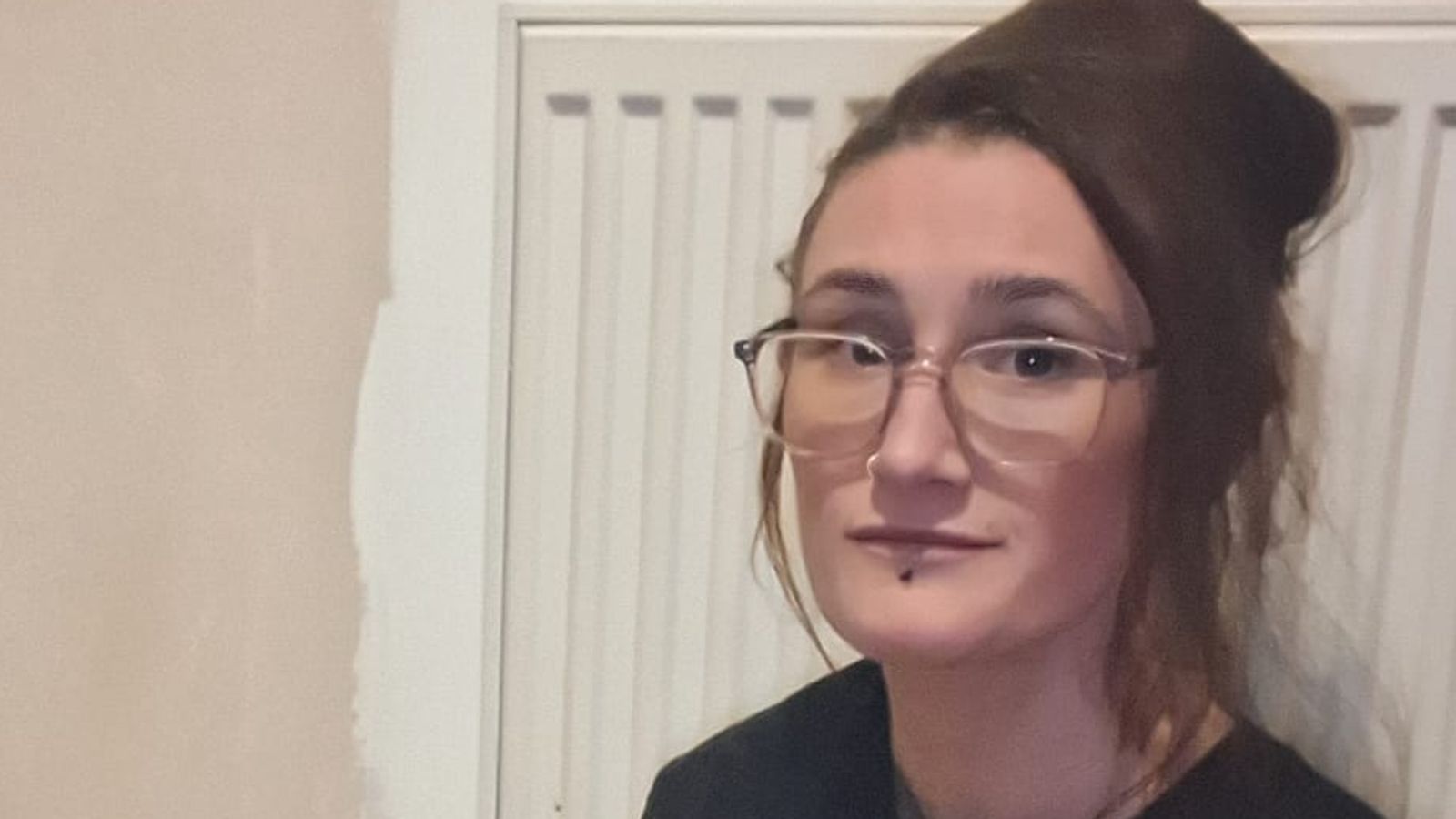
When Jane Wallbank found out she’d been awarded free upgrades to make her home warmer and cheaper to run, it sounded like “a fairytale”.
“Bills have become astronomically expensive in the last few years,” said Jane, a support worker for people with learning needs.
Then she qualified for internal wall insulation, smart radiator sensors and an extractor fan under the ECO (Energy Company Obligation) scheme, designed to upgrade homes for those in fuel poverty and make them greener.
It is paid for by energy-bill payers and overseen by a patchwork of energy companies, the government and other agencies.
“I almost felt special, like I could cut energy bills and have a bit left each month,” said Jane, a single mum of two, who works full-time but receives some universal credit.
But she ended up without heating for three weeks, a home flooded from top to bottom, mouldy floors, holes in the walls, doubled heating bills and asthma attacks.

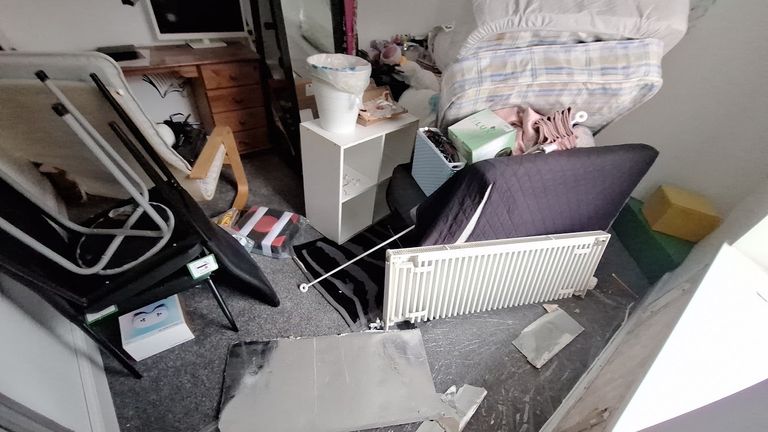
Not quite the home of a fairytale. Pic: Jane Wallbank
“It’s been the worst experience of my life, and it just feels never-ending,” Jane told Sky News.
“I’m just exhausted, truly, truly exhausted. I have spent every moment I have, between work and kids, pulling furniture around.”
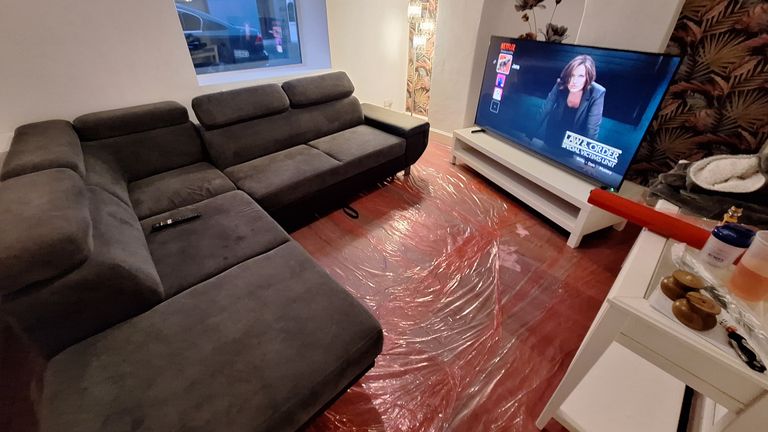
Jane now covers her floor after it turned mouldy. Pic: Jane Wallbank
Her home is one of at least 30,000 left with defects by the ECO scheme.
The technologies on offer are well evidenced to improve homes, and many installations were done well under ECO.
But experts say the poor oversight and money available incentivised “cowboy” installers to do the upgrades even in homes that weren’t suitable, or to shoddy standards.
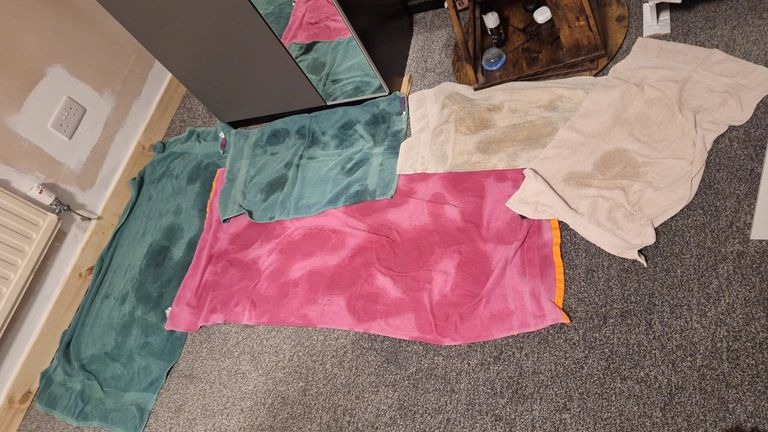
The floor suffered water damage when radiators were attached incorrectly. Pic: Jane Wallbank
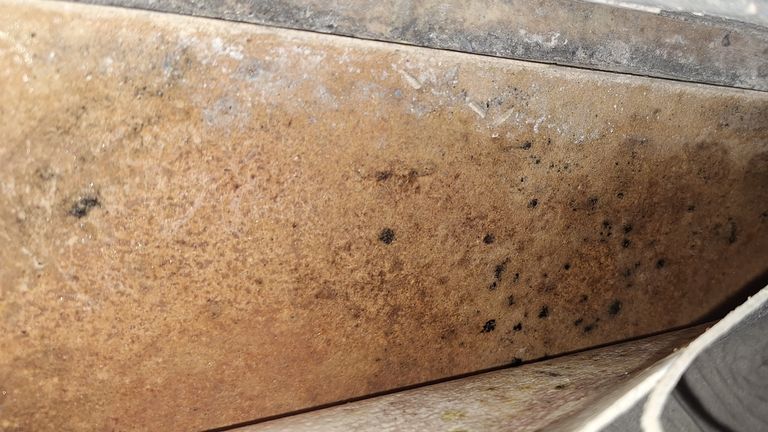
Mould under the flooring. Pic: Jane Wallbank
Damning report shines fresh light on problem
Sky News reported some of these problems previously, and the bodies involved have been working since 2024 to fix some of the issues.
But a scathing new report today revealed that fewer than 10% of the thousands of homes installed with dodgy wall insulation have been fixed.
In the meantime, further bad installations have continued to take place, such as in Jane’s rented home in south Wales last autumn.
What’s more, the remedy has so far focused only on the 30,000 homes with faulty insulation.
But Sky News has received reports of scores more issues, from roofs damaged by solar panels, heating systems that couldn’t accommodate the heat pumps, or insulation that got wet and spread mould.
The common thread is a sense of stress and helplessness.
Today’s new report found that after a year of trying to resolve the issues, the quality scheme Trustmark had only identified and remedied 3,000 of the at least 30,000 affected by poor insulation.
Fraud, failings and financial risk
In fact, the Public Account Committee (PAC) of MPs said the whole thing ought to be referred to the Serious Fraud Office for the “sheer levels of non-compliance”.
They described “a system with serious failings at every level” that has left already vulnerable recipients financially exposed.
Original installers are only liable to cover the remediation costs of up to £20,000, but some properties suffered £250,000 of damage.
PAC chair Sir Geoffrey Clifton-Brown MP said: “Potentially thousands of people are now living with health and safety risks in their homes, and despite government’s protestations we have nowhere near enough assurance that they are not financially exposed to unaffordable bills to repair the defective works.”
Read more from Sky News:
Police forces to be slashed
Zelenskyy drops truth bombs on Europe
Minister for energy consumers Martin McCluskey said “we inherited a broken system from the previous government” and “are cleaning up this mess”.
He said all homes with external wall insulation are being audited, and “no household should be asked to pay any money to put things right”.
Ministers have also decided to replace the ECO with schemes run by local authorities, which have a “significantly better record of delivery”, and to set up the new Warm Homes Agency, a single system for retrofit “to provide stronger, formal government oversight and driving up quality”.
Concerns mistakes could be repeated
The report also raises difficult questions about the government’s new Warm Homes plan, which is putting up £15bn to help more homes get onto solar panels, heat pumps and other green technology.
Ministers say this has been designed with better oversight to avoid the same mistakes and is also moving away from insulation, given the previous problems.
But Sir Geoffrey said the “public’s confidence will have rightly been shaken in retrofit schemes” and government now has a “self-inflicted job of work on its hands to restore faith in the action required to bring down bills and reduce emissions”.
Simon Francis, coordinator of the End Fuel Poverty Coalition, said: “Done properly, home upgrades and insulation are among the safest ways to bring down energy bills. Done badly, as we’ve seen, they can cause real harm.”
He added: “What’s shocking is not just the scale of the damage, but how long it was allowed to happen without effective intervention.”


