






Analysts adopt a more cautious stance in the near term, with prices expected to regain lost ground in the long term
[SINGAPORE] Gold has been a favourite among investors this year – especially when prices surged to nearly US$5,600 per troy ounce in January.
But things have since wobbled for the precious metal, as it hovers around US$4,000 per troy ounce on Tuesday (Jul 21).

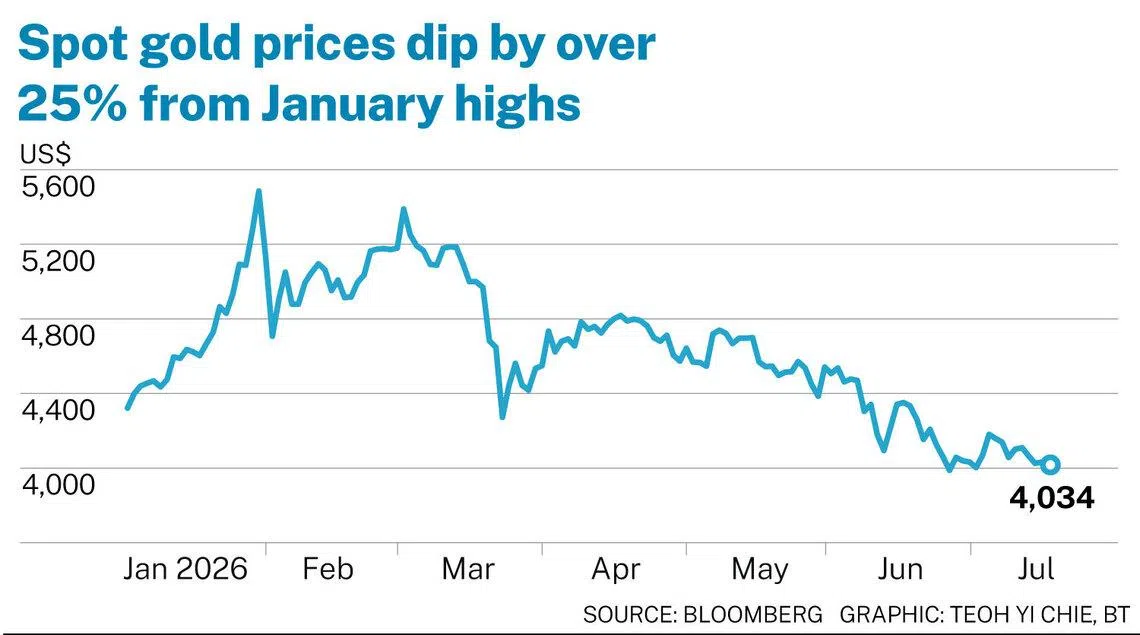
A decline of more than 20 per cent from its first-quarter highs is a stark change from when investors flocked to the safe-haven asset for security, amid the outbreak of war in the Middle East causing market volatility.
The Business Times unpacks what’s going on with the commodity now, and how investors should approach gold today.
Why gold prices have come off all-time highs now
Factors behind the yellow metal’s recent slump can be narrowed down to the following points:
- A strengthening US dollar causes gold prices to rise on a whole. It costs foreign investors more to hold the metal now, which compresses global demand.
- Prolonged war in the Middle East has caused oil and energy prices to rise again. These spikes hurt gold in the short-term, amid higher global inflation and interest rate expectations.
- Rate hike concerns are now mounting: This inevitably weighs on major commodity prices like that of gold as a non-yielding asset. If yields in fixed income assets rise, the relative case for holding the precious metal declines.
Investors have also engaged in profit-taking after market exuberance over the metal in Q1, contributing to its price decline, said Luke Browne, global head of multi-asset solutions at Manulife Investment Management.
Price targets for H2 2026
Analysts have a more cautious stance on gold in the short and medium term, with Goldman Sachs in June lowering its price target on the metal for end-2026 to US$4,900 per troy ounce, from US$5,400 previously.
This is due to how a strengthening US dollar raises the opportunity cost of holding gold now, said UBS analysts, who believe the metal will trade in a US$3,850 to 4,000 range in the near term.
Bank of America also cut its 2026 average gold price forecast by 14 per cent to US$4,360 per ounce, mainly due to persistently high real yields.
SEE ALSO



OCBC Group Research forecasts gold prices to reach US$4,360 by end-2026 as well.
This also comes amid a renewed period of rising energy prices – where some central banks may be forced to sell part of their gold reserves to stabilise their currencies, warns Ipek Ozkardeskaya, senior analyst at Swissquote.
DBS Group Research multi-asset strategist Sherilyn Chew noted that the metal’s US$4,000 level is a “relatively credible support” amid a live Middle East conflict – which could continue to weigh on gold in the near term.
“A more sustained move towards US$4,200 and beyond would likely require a broader decline in real yields,” she wrote in a Jul 15 note.
Broadly, however, the analysts are still constructive on the metal, with prices expected to regain lost ground in the long term – given how it carries an insurance value difficult to replicate via conventional financial assets.
As at June, central banks are still buying gold, which reinforces its role as a reserve asset outside the US dollar system, said a mid-year global investment outlook report by HSBC.
A variety of experts are still watching gold “closely”, with Manulife Investment Management’s Browne noting that while the safe-haven asset may not “dominate the portfolio” at present, the positions are “not zero” either.
“I can see a strong case for gold going back on a positive run,” he said. “If we see more direct fiscal and monetary (moves) while inflation goes higher, and the current geopolitical risks boil over, gold is going to be a good place to be.”
As such, JP Morgan analysts – who may have lowered their forecast on gold in the near term – still expect its price to reach US$6,000 per troy ounce in the last quarter of this year.
UBS analysts, as at June, also expect gold to move toward US$5,200 per troy ounce over the next 12 months.
The commodity remains a strong hedge for portfolio diversification and resilience in the second half of this year, a mid-year outlook report by Amundi Investment Institute noted, too.
Their analysts added that gold has historically offered stronger relative performance in an inflationary regime – compared to bonds which “depend on the source and persistence of inflation”.
Ozkardeskaya also noted that any pullback in gold prices should be viewed as an opportunity for long-term investors to strengthen their bullish positions, too.
This is particularly so for those who currently have “little or no exposure to the asset”, said Afdhal Rahman, executive director, wealth advisory at OCBC. That said, he added that investors should avoid deploying their intended capital all at once into the precious metal.
“A gradual and phased approach may be more appropriate in a volatile environment, allowing investors to capitalise on periods of price weakness,” said Rahman in a Monday note. “Gold-backed unit trusts, exchange-traded funds and paper gold are among the instruments through which investors may gain meaningful exposure, depending on their objectives, risk tolerance and preferences.”


