





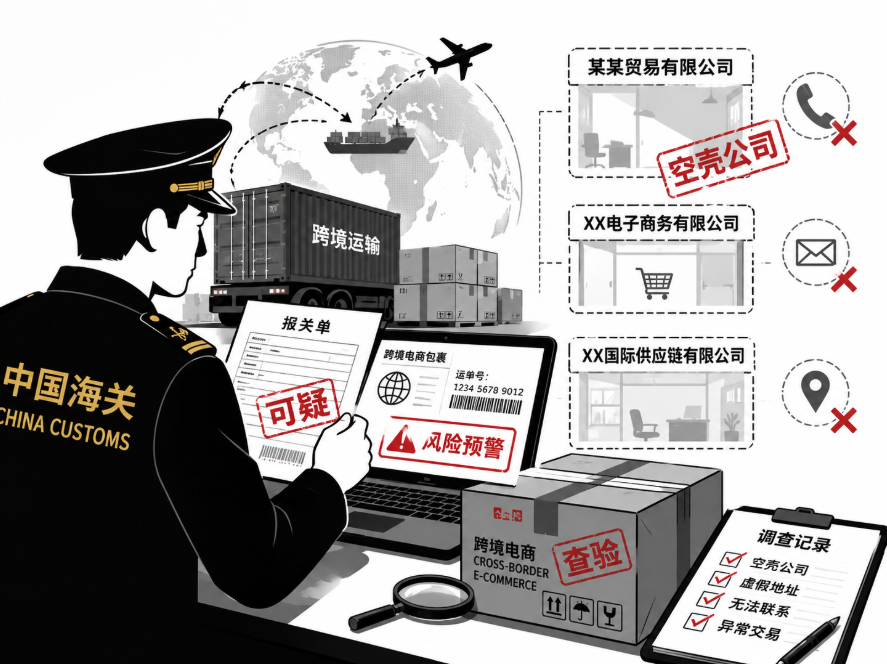
In an effort to clean up trade networks and tighten administrative oversight over fraudulent or non-compliant trade brokers, Chinese customs authorities have penalized multiple suspicious cross-border e-commerce entities in eastern China.
On July 14, 2026, the China Customs Import and Export Credit Information Disclosure Platform formally added three cross-border e-commerce firms to its official registry of anomalous and untrustworthy enterprises. All three firms, operating under the regulatory jurisdiction of Tai’an Customs in Shandong Province, were discovered to be ghost operations with no physical presence or verifiable communication channels.
The penalized companies exhibit a highly consistent pattern of behavior associated with commercial evasion and questionable trade brokering. Shandong Renren Cross-Border E-Commerce Company Limited, which was established in August 2021 with a registered capital of three million yuan, listed zero social-security-paying employees on its corporate registry. Similarly, Shandong Longliya Cross-Border E-Commerce Company Limited was founded in October 2023 with a registered capital of three million yuan and also reported zero active social-security-paying staff members. The youngest of the three, Xintai Yanghe Cross-Border E-Commerce Company Limited, was established as a micro-enterprise in March 2026 with a registered capital of just twenty thousand yuan and likewise reported zero active employees.
When Tai’an Customs attempted to audit these organizations as part of routine credit-system checks, investigators discovered that none of the phone numbers or contact channels provided during registration were functional. Furthermore, physical site inspections by customs officers confirmed that not one of these businesses actually operated out of their legally registered addresses.
The existence of zero-employee e-commerce firms operating out of unidentifiable locations poses severe structural risks to the international trade ecosystem. By placing these entities on the public anomaly list, Chinese customs authorities have effectively downgraded their corporate credit ratings. Consequently, any future shipping operations or customs clearance applications attempted by these firms will face rigorous physical inspections and exhaustive audits.
Regulatory bodies have warned global trade partners to utilize the public disclosure database to verify the credit status of Chinese digital merchants before initiating transactions to mitigate risks. In doing so, authorities hope to isolate fraudulent shell companies, protect legitimate supply chains, and force marginal operators to either maintain transparent, compliant operations or lose their commercial export credentials entirely.