






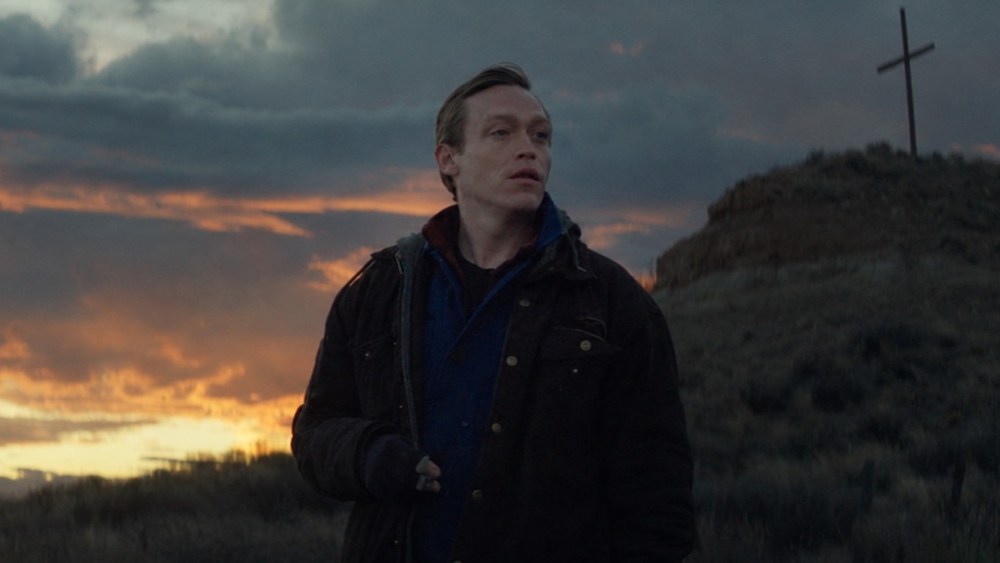
Trying to find funding for “Down the Arm of God” proved to be a difficult five-year ordeal for lead star and co-writer Caleb Landry Jones — one that brought the “Three Billboards Outside Ebbing, Missouri” and “Get Out” actor to terms with the very real-world prejudices that his film grapples with.
“Some people were worried about any kind of re-enactment of anyone’s past. We were getting a lot of folks that felt what we were trying to do was not respectful, that we were getting into possible problems of white saviorism,” Jones tells Variety of the decision to cast real homeless people in Texas. “Other things would be simply that the cast wasn’t big enough. That my name isn’t big enough. ‘We need two or three other cast members that are stars!’”
When “Leon” director Luc Besson saw how much Jones was struggling to secure funding while working with him on the 2025 horror film “Dracula,” he decided to step in with funds and, essentially, save the film under his EuropaCorp producing banner. Now, “Down the Arm of God” will have its world premiere at the Locarno Film Festival in Switzerland on Aug. 12.
Helmed by Peter Brunner, who directed Jones in 2018’s “To the Night,” Jones leads the cast as Nick, a pastor set on making a change when he arrives in a small Texas town and sees the homeless epidemic quietly happening in everyone’s backyard. However, he is swiftly met with pushback from the local community, especially after Nick invites the homeless encampment to sleep inside their church during the harsh winter.
The pushback eventually escalates to violence, leading Nick to confront his connection to God. Jones says there were times when he questioned Nick’s earnestness: “I like the ambiguity and these aspects of the character. This was Peter’s choice from the beginning.”
The film, which is based in part on true events, started simply as a story of forgiveness between father and son. The estranged father-son dynamic remains central, as Nick feels called to action after struggling to help his father, who is suffering from poverty. That framework eventually became a vehicle to work with the homeless community “without forcing any language down anybody’s throats,” Jones says.
As Brunner and Jones began digging into research over the course of five years and meeting with nonprofit organizations across Dallas, Austin and Amarillo, they kept hearing the same note: “We couldn’t make this film with actors, that we’d be doing a disservice to portray homelessness in our country,” Jones says.
That note was also echoed by the homeless people that Brunner and Jones, who penned the screenplay together, spoke to.
Over the course of five years, many of the homeless people who agreed to be part of “Down the Arm of God” died before production could begin. “The film is, in a big way, dedicated to those people as well,” Jones says.
The violence that the film builds to — with protestors in the conservative, homogeneous Texas community holding “White Lives Matter” signs directed at the people of color in the homeless encampment — is another way Jones and Brunner aimed to directly reflect reality. “Everything is there because it felt like if it wasn’t there, we were negating it,” Jones says.
Jones commends many of the homeless people who made their on-screen debut and tapped into their own personal experiences.
“The work itself wasn’t easy, but to do the work was very easy. Some of the best actors I’ve ever worked with were on this film because it really was on the line of — it wasn’t really acting sometimes, and sometimes it was rooted in a memory. It’s a real memory that the person is speaking of. Sometimes it is fabricated, especially for myself and my character. I am not a pastor, and my father is not homeless … A lot of things. I’m the outlier in the group,” Jones says. “What was difficult were the logistics and trying to get people to understand the severity of homelessness.”
As the film nears its festival debut, Jones hopes the film will make audiences across the world reckon with how close everyone is to the poverty line — especially as the homeless epidemic only gets “worse.”
“It’s something that most of us deny ourselves all the time, that we are far removed because we have this job. We have these things in our life that we see as steady,” Jones says. “I think COVID woke a lot of people up financially and seeing the repercussions of so many jobs disappearing at once, but I don’t think we really woke up to the fact that it could be us.”


