


Aperture: The paradox of choice
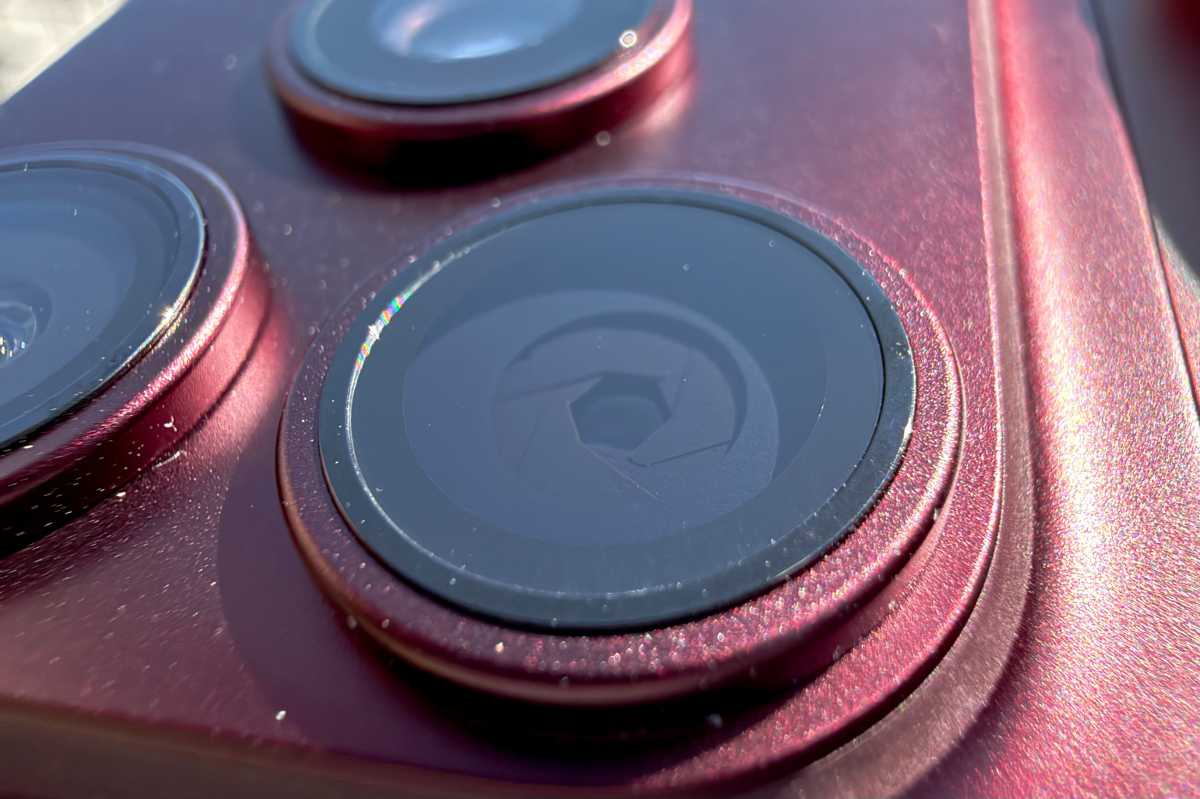
Variable aperture is the iPhone 18 Pro’s most iconic feature, letting you physically control how much light reaches the camera sensor. A wide aperture allows more light in and creates a natural bokeh effect, with a shallow depth of field. Conversely, a narrow aperture expands the depth of field to keep background elements sharp, making it ideal for well-lit group shots and landscapes. Both Apple Camera and Halide support controlling the aperture on the iPhone 18 Pro, but their approaches vary.
The iPhone’s built-in Camera app lets you manually choose between four fixed values: f/1.48, f/1.8, f/2.8, and f/4.0. Or you can opt for the automatic mode, which dynamically selects any value between f/1.48 and f/4.0—depending on what the algorithm deems best for the particular scene.
Foundry
Halide, on the other hand, gives you full control over the aperture. So you can fine-tune it and manually pick any value in the same f/1.48-4.0 range, like f/3.33, or switch to auto. As such, Halide technically provides photographers with more options than Apple’s Camera app. But more importantly, does this sort of flexibility actually impact iPhone photography?
The short answer is no. The iPhone 18 Pro’s main camera sensor is too small for such minor aperture adjustments to matter. In fact, some critics questioned Apple’s decision to bring a mechanical aperture to the device in the first place. Many Apple Camera users will barely be able to tell the difference when jumping between adjacent preset f-stops, such as f/1.48 and f/1.8. Offering users a slider with over 250 precision micro-steps in Halide is arguably overkill.
That’s not to say that Halide’s execution is completely pointless. Pro photographers working in full manual mode may lock the shutter speed and ISO (both of which impact the final exposure) at fitting values to achieve a desired look. Having complete control over the aperture can allow the exact amount of light in and perfect the overall image. Nevertheless, considering the iPhone has a small sensor, it’s not as influential as having it on a professional camera, and most users will probably be overwhelmed by its numerous options.
ISO-lated testing
Beyond the variable aperture, the iPhone 18 Pro introduces native support for advanced camera controls, like shutter speed and white balance. A slow shutter speed can create motion blur, while a fast one can help capture ultra-fast subjects as they move. Meanwhile, white balance lets you control the temperature of the light, making it cooler or warmer as needed. Halide has long supported these adjustment types, but the number of options differs.
