


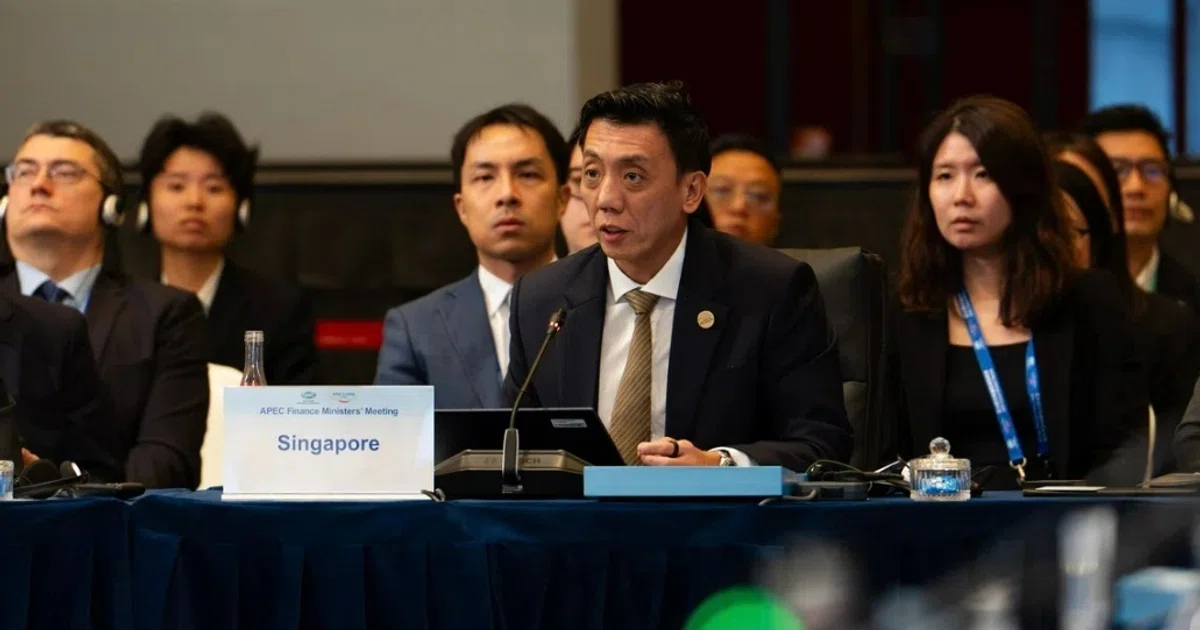
He said like-minded countries can work together to advance topical interests through plurilateral arrangements
[SINGAPORE] Countries should continue to pursue economic openness and collaboration through forums and platforms like the Asia-Pacific Economic Cooperation (Apec) grouping, even as the global consensus that has sustained openness has weakened, said Second Minister for Finance Jeffrey Siow.
Speaking at the Apec finance ministers’ meeting in Hong Kong on Oct 20, he noted that inking free trade agreements may no longer be in trend.
This comes as strategic competition is increasingly driving countries to impose trade restrictions and distribute industrial subsidies to protect their critical sectors and secure supply chains.
Against this backdrop, Siow said: “We need more forums and platforms like Apec for economies to come together, build common ground, and advance cooperation.
“Free trade agreements may have fallen out of fashion, but we can build on existing regional trade agreements such as the Regional Comprehensive Economic Partnership (RCEP), and the Comprehensive Progressive Agreement for Trans-Pacific Partnership (CPTPP).”
The Asean-led RCEP is the world’s largest free trade agreement, comprising around 30 per cent of global gross domestic product and around a third of the world’s population.
The Business Times turns 50
Five decades of milestones and moments that shaped Singapore’s success story – told through our headlines.
Explore BT50
It involves 15 countries, namely Indonesia, Singapore, Brunei, Cambodia, Laos, Malaysia, Myanmar, the Philippines, Thailand, Vietnam, Australia, China, Japan, South Korea and New Zealand.
Meanwhile, the CPTPP is a free trade agreement among 12 countries: Japan, Australia, New Zealand, Singapore, Brunei, Canada, Chile, Malaysia, Mexico, Peru, the United Kingdom and Vietnam.
Siow added that like-minded countries can work together to advance topical interests through plurilateral arrangements involving more than two parties but fewer states than multilateral agreements.
SEE ALSO
He cited digital economy agreements including Asean’s landmark Digital Economy Framework Agreement (DEFA), that is expected to be formally signed in November to lay the groundwork for closer digital integration across South-east Asia.
He also mentioned Green Economy Agreements, which Singapore has advocated to accelerate its transition towards a green and sustainable future.
Siow also named the Future of Investment and Trade Partnership, also known as FIT-P, as an example of flexible cooperation between like-minded countries.
The grouping of 20 small and medium-sized, trade-dependent economies allows some of them to move on initiatives “while the door remains open for others to join later”, he said.
For instance, 10 FIT-P members endorsed a joint declaration on strengthening the rules-based trading system on Mar 16, before three more members joined at a later date.
Siow also said that open economic cooperation must come with domestic support, as the benefits of globalisation, which have been enormous on aggregate, have not always been evenly shared.
“Workers and industries have borne the costs of rapid technological change. The advent of artificial intelligence will add to these pressures,” he added.
At a session on the global and regional outlook at the Apec meeting, Siow said that while the global economy has remained resilient amid the ongoing Middle East conflict, growth has been unevenly distributed and heavily dependent on AI investment.
He said: “If the productivity gains from AI fall short of expectations, financial markets could experience a correction, and economies could find ourselves exposed to bigger risks.”
Siow added that for growth to be sustained, AI investments must be translated into wider productivity improvements and good job opportunities.
This is a focus of Singapore’s Economic Strategy Review, Siow said, where the country is growing industries generating high-value jobs which are assisted by technology.
He said semiconductor firms like Micron and GlobalFoundries are expanding their operations in the Republic, with new roles in engineering and operations tapping AI, robotics and smart manufacturing technologies.
Singapore’s workforce is also being equipped with future-ready skills.
In accountancy, for instance, AI is being used to analyse large volumes of financial transactions, identify anomalies, and prepare detailed reports.
“But accountants must still interpret the findings, exercise professional judgement and advise businesses,” Siow said.
“Singapore has launched a programme to help accountants develop the skills to work effectively with AI. Our aim is to develop more such ‘AI-bilingual’ workers, who combine deep professional expertise with the ability to use AI effectively,” he added.
Siow also elaborated on Singapore’s fiscal policy at another session at the Apec meeting.
He said that the country’s fiscal strategy rests on three principles, including that those with greater means contribute more in taxes.
The Government also provides targeted, time-limited support to reduce the impact of economic or employment shocks, he added, while investing in infrastructure to encourage asset ownership by Singaporeans and long-term economic growth. THE STRAITS TIMES
