


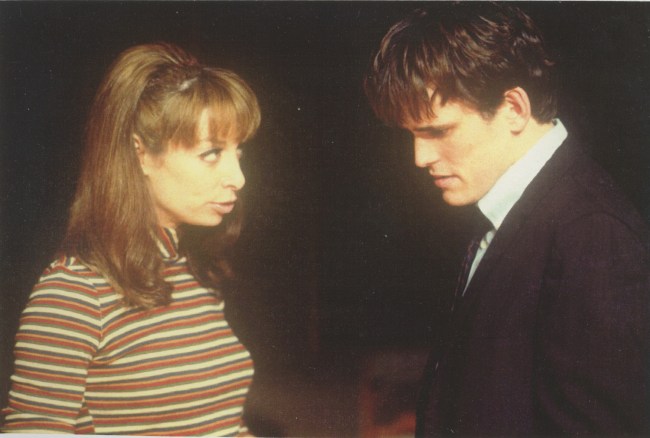
In the mid-1990s, writer/director Allison Anders was coming off two widely acclaimed independent films, “Gas Food Lodging” and “Mi Vida Loca.” She was also at an absolute low point after two crushing disappointments.
“‘Four Rooms’ [the anthology film Anders co-directed with Quentin Tarantino, Alexandre Rockwell, and Robert Rodriguez] had started out as a wonderful experience with my friends, and then it became hell because of Miramax and their interference,” Anders told IndieWire. “And ‘Paul is Dead,’ a movie I desperately wanted to make — and still want to make — fell apart because an actor fell out.”
Luckily, Anders emerged from what she described as “a personal and professional hell” to make one of the best movies of her career, “Grace of My Heart.” Released 30 years ago this month by Universal’s now-defunct specialty division Gramercy, the film represented an intersection between the indie world and Hollywood that capitalized on the strengths of both. Its tale of a singer/songwriter (Illeana Douglas) struggling to find her place in the music industry of the 1950s and 1960s was deeply personal for Anders, given scope and breadth by a major studio’s resources.


As empathetic in its perspective and precise in its rhythms as Anders’ earlier, more intimately scaled work, “Grace of My Heart” has an infectious exuberance that comes not only from Anders’ love of the subject matter but from years of thinking about it — she had wanted to do something on the songwriters of the Brill Building since film school. The original plan was to make a movie about the girl group The Shangri-Las, but as the years passed, Anders’ ambitions for the story grew, and “Grace of My Heart” would ultimately use its lead character, Denise Waverly, as a vessel to explore an entire era in pop music.
“Grace of My Heart” also examined what it meant to be a working woman artist both when the movie takes place and when Anders made it. The film began to take shape when she met actor Illeana Douglas, and the two women shared stories from their personal and professional lives. Some of those experiences made it into the movie, though Anders says just as many fictional elements in the film came true later.
“There’s a psychotic bruja energy when you dive into something personal,” Anders said. “You start to fortune-tell, basically. You end up telling stuff that’s going to happen to you that hasn’t happened yet. I don’t think that Illeana and I were talking specifically about putting what was happening in our lives into the script, but it was clear that we were going through very similar things at the time.”
Like Anders, Douglas was eager not only to find a dramatic shape for her own personal romantic tribulations, but to tell the story of the explosion of creativity that took place in the Brill Building.
“I had gotten my start in show business working in the Brill Building,” Douglas told IndieWire. “I worked for a publicist there, so I knew the building, and I loved the Burt Bacharach music and all that.” Douglas was dating Martin Scorsese at the time, and he helped set up the movie at Universal through his deal there. He also gave Anders a gift that let her make “Grace of My Heart” on her own terms, without the compromises and interference that had made “Four Rooms” such an unpleasant experience.
“Marty said, ‘Listen, they’re not going to give you final cut,’” Anders said. “‘But they’ll give it to me, and I’m going to give it to you.” Scorsese also protected Anders throughout the writing process, taking all the studio feedback and filtering it before passing it along so she wouldn’t be distracted or creatively paralyzed by what he saw as unhelpful notes. “He said, ‘I don’t want you to receive these notes, because they don’t know how to talk to artists.’” With Scorsese’s imprimatur and Universal’s financing, Anders could focus on the most ambitious aspect of “Grace of My Heart”: finding songwriters and singers to write and perform close to 30 new songs for the film.
“Allison’s brilliant idea was to pair somebody from the past to write with someone contemporary,” Douglas said. The idea was to create songs that would sound like the era but feel fresh to contemporary ears. Anders came up with a dream list of songwriters she wanted to collaborate with and enlisted the aid of Grammy-winning producer Larry Klein, who jumped at the chance to pay tribute to musicians who had inspired him.
“That period of pop music history is something I have always been avidly interested in,” Klein told IndieWire, adding that working on “Grace of My Heart” gave him the chance to work with some of his heroes — as when he paired Burt Bacharach and Elvis Costello. (That first-time pairing would lead to multiple collaborations between the two songwriters later on.) “Burt Bacharach has always been an intrinsic part of my musical vocabulary because of the era I grew up in. I heard his music from the first time I can remember hearing music.”
As pre-production raced along, Klein worked with multiple collaborators on the songs and the pre-records the actors would lip-sync to. During that process, the idea that Klein would also write the score came up. “I loved that idea, because obviously I knew certain things about the songs that I could use to inform the underscore,” Klein said. “But I had only scored some little films for friends, like AFI shorts here and there.” To get the job scoring a major studio picture, Klein needed Scorsese to sign off.
“I gave Marty some sketches, and he took them to Elmer Bernstein [Scorsese collaborator and legendary composer of ‘The Magnificent Seven’ and other classics],” Klein said. “I got approval from Elmer, and then Marty was kind enough to facilitate a dinner between Elmer and me, which was great because I was a worshipful fan of his work.” Klein not only wrote the score but co-wrote some of the songs and supervised others, bouncing ideas back and forth with Anders and music supervisor Karyn Rachtman.
“I look back on it now, and it was one of the best years of my life,” Klein said. “When you have that kind of kindred aesthetic with people, where things are just aligned, you say to yourself, this is how things are supposed to work creatively.” Klein even got a compliment from Scorsese about his acting chops when Anders gave him a small role as a music producer in the movie (he would play a bigger part in Anders’ excellent ‘Sugar Town’ a few years later). “When they screened the film for Marty, he turned around and looked at me and said, ‘You’re a good actor.’ Not a bad day.”

While Scorsese shepherded the project as an executive producer, one of the producers charged with overseeing the day-to-day production was Daniel Hassid, who had worked with Anders on “Gas Food Lodging” and “Mi Vida Loca.” Although “Grace” was Hassid’s first major studio job, like Anders, he felt protected given Scorsese’s involvement. “There were very few times where the studio told him no,” Hassid said, adding that while the budget was huge compared to what he and Anders were used to, it was minuscule by Universal’s standards.
“I think it was a $5 million film at the time, which was huge for us,” Hassid said. “From our perspective, we felt like we had all the money in the world.” The budget enabled Anders and Hassid to stage exquisitely designed musical numbers teeming with background actors in period-appropriate clothing. Yet some of the film’s best moments, such as a climactic breakdown between Denise and her manager Joel (John Turturro), are the most intimate.
That scene, an acting and writing tour de force that Anders staged in one carefully designed long take, is as emotionally powerful as anything the director ever put on film. For Douglas, it was one of the most terrifying days of shooting. “I wanted to rehearse that scene and know the parameters, and John didn’t want to rehearse it,” Douglas said. “I was very antsy, and by the time we shot it I was like a bat out of hell. It was very physical, and I didn’t tell John what I was going to do. Obviously it worked — it was very intense and explosive.”
When it came time to calibrate Denise’s emotional journey in the editing room, Anders had an incredible collaborator in Scorsese’s longtime editor Thelma Schoonmaker. “She had this beautiful combination of confidence and a bit of necessary self-doubt,” Anders said. Schoonmaker’s inventiveness produced one of the movie’s most memorable scenes, where Turturro and Eric Stoltz’s characters talk while dancing. When Anders was shooting the scene, which was heavily improvised, she had no idea whether it would cut together or work at all.
“I thought it was really funny and suited the movie, but I wasn’t sure about it,” Anders said. “The way Thelma cut it, she’s crossing the line all over the place, but you’re not thrown off of it because of the movement, and the absurdity of the scene. She made it exhilarating, and she also made it a short cut that told us a lot about the characters before getting us into something else. Suddenly, the mood changes, and they’re all in a different vibe, and it’s just beautiful how she did that.”
Although Douglas was proud of the finished film, she still misses a handful of cut scenes. “We lost two scenes that Marty and Thelma thought were making the film too top-heavy,” Douglas said. One scene involved Denise and her first husband, the other developed and deepened the relationship between Denise and her disapproving mother. “It was an improvisational scene between me and Christina Pickles. I lost the battle to keep that. There wasn’t much I could do — and it was complicated because I was in a relationship with the producer. What was happening in the movie was similar to what was happening off camera.”

Indeed, as the film progressed Douglas found aspects of her relationships with Stoltz and Matt Dillon’s characters on screen playing out in real life, and vice versa. “In all of my relationships in the movie, I fall in love with the man and start taking on characteristics of the relationship. We thought that was something women did, you know? You fall in love with a genius, but then you totally lose your personality. That was one of the things I loved about the Matt Dillon relationship, was how far afield she keeps getting from herself.”
The question of whether or not Denise could have it all — a career as a singer/songwriter and an enduring romantic relationship — was not only central to the film, but a point of contention between the filmmakers. In the original ending that Anders and Douglas envisioned, Denise ended up getting back together with one of the men she had parted ways with earlier in the film. Scorsese was adamant that Denise should end up alone, in an ending echoing his own “New York, New York” — a film Anders adores and saw as a touchstone for “Grace.”
“He said, ‘She’s gotta be alone, she’s an artist,’” Douglas said. “Allison and I were romantics and fantasized, why can’t she have both?” Although Anders pushed back against Scorsese’s notes when she felt she needed to stand her ground, in this case she began to realize that he was right. “We were standing on the beach about to shoot the scene, and I thought, ‘Oh my God, this is not the ending of this movie,’” Anders said. “I just knew that it wasn’t right.”
Indeed, the resonance in “Grace of My Heart” comes from the sweet ache that comes with knowing Denise’s beaus all genuinely love her even as there’s no way for her relationships with any of them to last. “ The ironic thing is that these men all believe in her,” Anders said. “It’s not that they’re holding her back. In fact, they want her to care about her talent as much as they do. In that sense, it’s not the traditional male/female relationship where his talent is more important than hers. They all see her as someone worth far greater than she even realizes.”
Denise’s struggle to define herself and realize her ambitions was personal for Douglas when she made the film, and it still is today. “ It’s very hard for me to watch, because it’s very autobiographical,” Douglas said. “The film has haunted me in a way, because right off the bat in the first scene with John I say, ‘Why can’t I be both? Why can’t I be a writer and a singer?’ That has sort of oddly followed me because I love acting, but I always wanted to be a writer and a director.”
Douglas thought “Grace of My Heart” would be the beginning of an ongoing partnership between her and Anders. “Little did I know that Allison and I would never really get to collaborate again,” Douglas said. “I think we did a political commercial, but we never really got to make another movie again. Over the years, the film developed sort of a cult following, which I’m thrilled about, but I had hoped that we would make more films together, and that’s just not what happened.”

That it didn’t happen largely came down to the initial response — or lack of it — to the movie’s release. Universal barely gave it any kind of marketing push, and the film came and went from theaters in a matter of days. “Marty’s deal was finished, and there wasn’t a lot of motivation from the studio side,” Hassid said, noting that on earlier films he and Anders had gotten press out of festivals that helped them get the word out. Without festival play, “Grace of My Heart” dropped onto screens with barely any advance notice. “It was a fumble.”
“That was awful,” Anders said of the movie’s release and box office failure. “It was really heartbreaking for Illeana and I. But one thing I’ve learned is that my movies have a long lead-up time for people to absorb them and accept them. I’ve learned that, as a filmmaker, it’s none of your business who the audience is. It really isn’t. You do your job, and then you’ve got to let it go. You can let people know about it, but that doesn’t mean their asses are in seats. You do your bit, and you let people know about it, and they come when they’re ready.”
Thirty years after its original release, that time seems to have finally arrived for “Grace of My Heart,” which recently had a resurgence on the Criterion Channel and will celebrate its anniversary with a November screening at Vidiots (Anders and Douglas will appear in person for a Q&A). Looking back, Anders is astonished that she got to make the film at all.
“They screened it recently at the Kentucky Theatre in Lexington, and as I was watching the credits roll with my friend Lucy Jones, who created the Harry Dean Stanton Film Festival, I said, ‘I can’t believe I got to make this movie,’” Anders said. “Look at all these great actors I got to work with, like Eric Stoltz and John Turturro and Matt Dillon. We had a very short shooting schedule and a very long editing schedule, and it was stressful, but I just felt so blessed getting to go to work every day. It was wonderful.”
“Grace of My Heart” is streaming on The Criterion Channel through September 30, and will screen at Vidiots with Allison Anders and Illeana Douglas live in person on November 11.
