


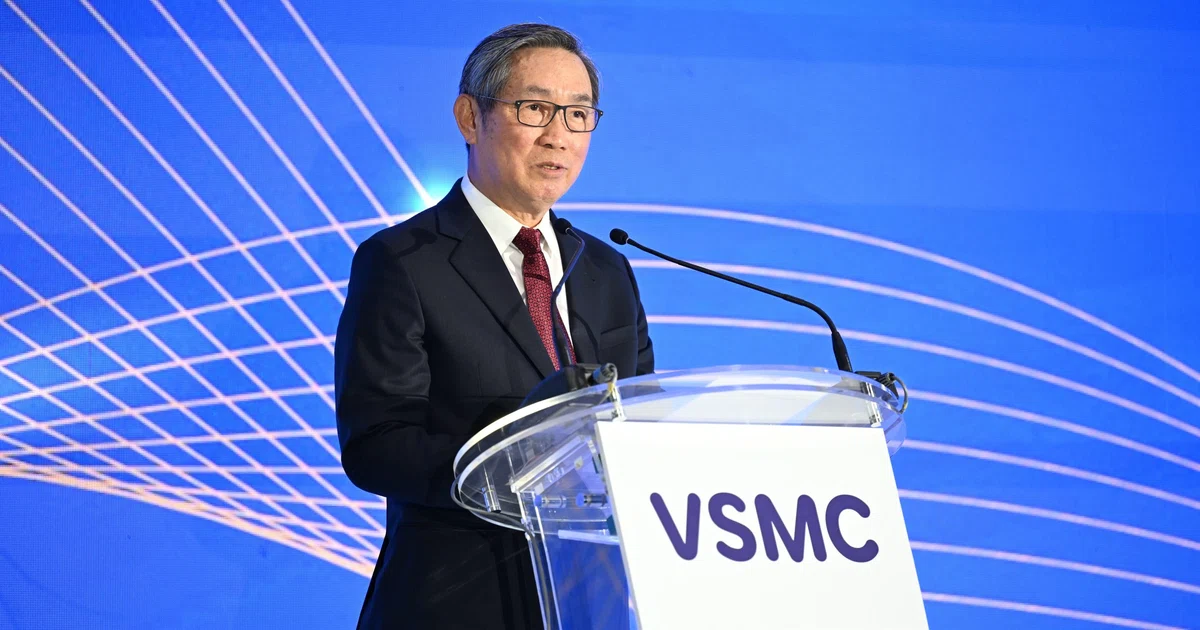
VSMC is a joint venture between NXP and TSMC-backed Vanguard International Semiconductor
[SINGAPORE] VisionPower Semiconductor Manufacturing Company (VSMC), a joint venture between TSMC-backed Taiwanese chip foundry Vanguard International Semiconductor (VIS) and Dutch chipmaker NXP Semiconductors, opened its US$7.8 billion 300 mm wafer fabrication plant on Monday (Sep 28).
The partners are betting on rising demand for chips that power “physical artificial intelligence”, in which AI moves beyond the cloud into vehicles, robots, factories and infrastructure.
The fab, located in Tampines, will support 130 nanometre (nm) to 40 nm process technologies for mixed-signal, power management, analogue and interposer applications.
These serve the high-performance computing, mobile, automotive, industrial and consumer markets. When it reaches full capacity by 2029, the facility is expected to produce about 44,000 300-mm wafers a month.
NXP president and CEO Rafael Sotomayor said engineering trust into edge devices is “the only way our society will allow physical AI to scale in the real world”.
He added that facilities such as VSMC are essential to expanding manufacturing capacity for the chips behind these systems.
With construction complete, the fab has entered risk production, and volume production is scheduled to begin in the first quarter of 2027. Its first sample lot achieved yields above 99 per cent, VSMC said.
Speciality chips in demand
Speaking at the ceremony, Minister for Trade and Industry (Energy and Industry) Tan See Leng noted that the global semiconductor industry is set to double in size to US$1.6 million by 2030.
While much of the attention is on the advanced logic chips that power AI, “speciality semiconductors are just as essential”, he said.
Such chips are optimised for specific functions, such as managing power, sensing and controlling systems in vehicles and industrial equipment. Demand for them is growing with trends such as electrification, connected devices and industrial automation.
“Singapore is well-positioned to capture these opportunities,” said Dr Tan, pointing to capabilities in speciality semiconductors that the country has built up over decades.
He added that the fab will create opportunities for local suppliers in specialty chemicals and gases, equipment services, facilities and logistics.
Why Singapore
VSMC and VIS chairman Leuh Fang said the plant was set up to strengthen global supply chain resilience, with “resilient supply chains (being) more important than ever”.
He noted that Singapore is a leading hub for technology and advanced manufacturing, backed by strong talent, infrastructure and innovation.
“For VSMC, Singapore is more than a location; it is a strategic partner for our future,” he said. “Our investment reflects our long-term confidence in Singapore’s role in the global semiconductor industry.”
NXP’s Sotomayor said the joint venture is one of the most significant milestones in the company’s decades-long history in the Republic, and its largest investment since it acquired Freescale Semiconductor in 2015.
“Singapore has built a remarkable ecosystem, supported by visionary leadership, world-class infrastructure and a highly skilled workforce,” he added.
Jobs and talent
VSMC is expected to create about 1,600 jobs, 75 per cent of which will be professional, managerial, executive and technician roles, said Dr Tan.
These include engineers, chemists and data scientists who will operate advanced manufacturing equipment and optimise processes with automation.
The company recently signed seven memorandums of understanding with polytechnics and universities, covering internships, graduate hiring, curriculum co-development and joint applied research.
VSMC is also participating in the Career Conversion Programme run by the newly formed Skills and Workforce Development Agency, and the Graduate Industry Traineeships (GRIT) Programme by the Ministry of Manpower. It plans to scale up its GRIT intake for engineering roles.
These pathways will help fresh graduates and mid-career workers enter semiconductor roles through structured training and on-the-job experience, noted Dr Tan.
