


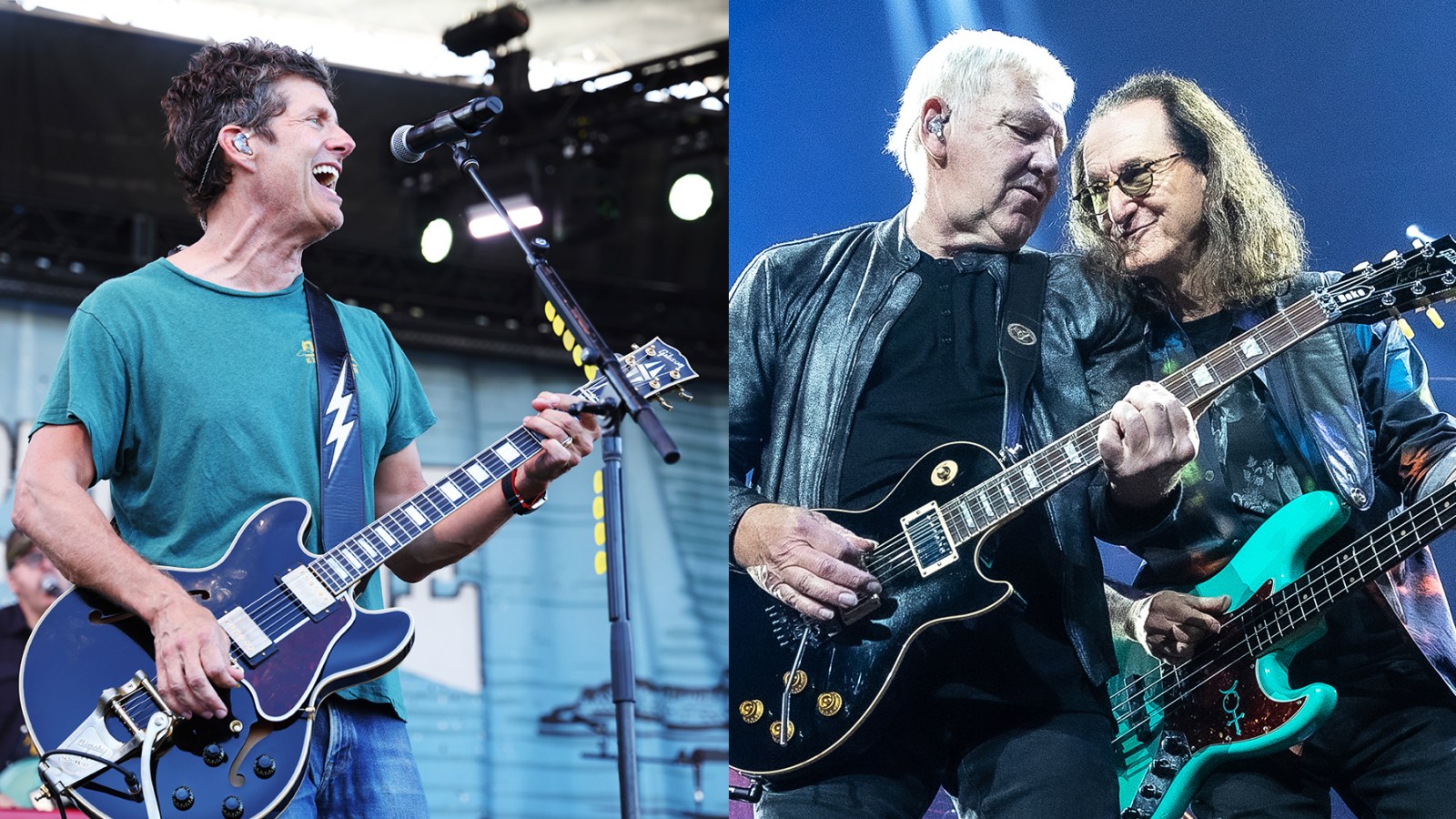
In 1982, when I was 15 years old, I spent an afternoon driving two members of the band Rush around Monroe, Louisiana, in a beat-up ’78 Honda Civic hatchback I’d proudly nicknamed the Green Barchetta. Forty years later, I managed to do it again, and it felt exactly the same.
If you grew up in a small Southern town, the bands you loved didn’t come to you — the closest they’d get would be cities like New Orleans, Dallas, or even Jackson, Miss. I had been obsessed with Rush since I was 10 years old, long before Moving Pictures made them a household name. When that album came out, with “Tom Sawyer” on the radio, suddenly everybody loved them. Part of me was thrilled, but another part felt like I’d lost hold of a tightly kept secret.
In February 1982, a year after Moving Pictures‘ release, we heard news that barely seemed possible: Rush was coming to Monroe, La. As soon as we found out, my best friend, Joel Rundell, and I came up with a crazy plan. The two of us played in bands together, got into trouble together, and shared a wild amount of self-confidence. If I suggested we could simply show up at a hotel and meet our favorite rock band in the world, Joel would just ask what time I was picking him up.
A friend’s sister who worked at the front desk of the Holiday Inn Holidome confirmed what we’d been hoping: Rush was staying there the night before the show. At sunrise on April 3, armed with several rolls of quarters, we took up residence in the hotel’s video arcade, strategically located where hotel guests entered the lobby. We played Galaga, Robotron, Joust, and Tempest, and tried to keep an eye out.
Hour after hour passed, and nothing. Then suddenly… there they were. Alex Lifeson and Geddy Lee walked past the indoor pool toward the lobby as casually as two businessmen headed to breakfast. I stood frozen, watching them walk toward us as Joel hit hyperspace on Defender, about to break the high score. I elbowed him so hard he nearly lost his game. For a few seconds, we just stared at two of the biggest rock stars in the world. By the time we gathered up enough courage to leave the arcade, Alex and Geddy were already outside.
We speed-walked out the doors and were suddenly face-to-face with our idols. They were polite, if understandably cautious, faced with two skinny, six-foot-plus teenagers with wild eyes. We soon learned they were waiting for a car service, but the car wasn’t showing up. A good 20 minutes passed with no car, and we talked about the tour, music, guitars, and, for reasons I still can’t explain, NASA. At one point, I offered them a ride, and they brushed it off. But after another 10 minutes, Geddy gave in: “So… where’s your car?”
What I neglected to mention was that my car was a tired little 1978 Honda Civic hatchback that I’d named the Green Barchetta, a joke inspired by Rush’s “Red Barchetta” that I thought was absolutely brilliant. As we walked across the parking lot, I started to panic. The Honda was filthy. There were Sonic and Captain D’s cups on the floorboards, and fast-food bags stuffed behind the seats. To their everlasting credit, Alex and Geddy didn’t hesitate, and insisted they sit in the back. Joel slid in next to me, and somehow, we pulled out of the Holiday Inn parking lot with two members of Rush sitting behind us.
They wanted to stop at a health-food store for vitamins, then a sporting goods store to buy tennis rackets. We headed toward Twin City Mall, and with every glance in the rearview mirror, I caught myself thinking, They’re actually back there.
Eventually, we made our way toward H Michael Sporting Goods on Forsythe Avenue. Walking into that place, in small-town Louisiana, with two members of Rush? It made an impression. Our friend Jim Payne was working behind the counter, and we watched his jaw drop.

Courtesy of Kevin Griffin
Alex and Geddy headed to the tennis section while the three of us followed at a respectful distance, trying to keep cool. They selected their rackets, but there was a problem: They had to be strung, and it would take a couple of hours. Alex looked over at us. “Kevin,” he said. “If you and Joel can pick these up and bring them to the venue this afternoon, we’ll get you backstage passes. Come to soundcheck.”
I don’t remember if I was able to get any words out in reply. We drove them back to the Holiday Inn, and as they climbed out Geddy leaned back into the car.
“See you at soundcheck,” he said.
“With the tennis rackets,” Alex added, wagging a finger at us with mock seriousness.
Remember, this was before cell phones, before social media, before you could immediately prove something extraordinary had happened. So, Joel and I did what 15-year-olds did before cell phones — we drove around town trying to tell everyone we knew what had happened. Nobody believed us.
By three o’clock, we were back at H Michael’s, and the tennis rackets were waiting. We sped to the Monroe Civic Center and found the loading dock, where we asked for Donovan, the tour manager. “You guys want to watch soundcheck?” he asked. We followed him to the back of the stage and up the loading ramp. I saw road cases all over the place, crew members climbing lighting rigs, techs tuning guitars. Everything that looked effortless from arena seats turned out to be the product of dozens of people quietly doing their jobs.
Rush walked onto the stage with the same lack of fanfare, just Geddy, Alex, and Neil headed to work. I looked over at Joel as they counted off a song I’d never heard before. Months later, I’d recognize it as “Subdivisions.” As I watched that soundcheck, rock stars suddenly stopped looking supernatural to me. I learned they argued over arrangements, made mistakes and laughed at themselves when they had to start over. As the mystery disappeared, I saw the craftsmanship instead, and maybe that was even more impressive.
During a break, Geddy headed to one of his keyboards, and Alex walked over to us. He asked if I played guitar, and after I nodded yes, I summoned the courage to ask: “Could you show me ‘The Spirit of Radio’?”
He picked up his guitar and played that impossible opening riff, which I’d spent countless afternoons back in my bedroom trying to decode. Now it was happening three feet away. He slowed it down, played it again and stopped. He lifted the Les Paul over his shoulder and handed it to me. I can still remember the weight of it. For the next few minutes, Alex Lifeson stood beside me, and painstakingly showed me how to play that riff. Every time I stumbled, he’d laugh, and just show me again.
I’ve been lucky enough to spend my own life making music. Whenever a young songwriter asks me for advice, or someone waits after a show hoping to meet me, I think about Alex handing me that guitar.
The following week, the local paper, The News-Star, ran a story about two Monroe kids who’d spent the day with Rush. We got a lot of mileage out of that.
Joel and I graduated high school, and went to LSU in Baton Rouge, where we started a band called Better Than Ezra. By then, we were listening to R.E.M., The Replacements, Hüsker Dü, and Pixies. We weren’t trying to sound like Rush anymore, but every once in a while, we’d sneak an odd time signature into a song like “Desperately Wanting” or “King of New Orleans.” Rush never stopped being part of our musical DNA.
In the fall of 1990, Joel died. One day, my best friend was there, and the next day, he wasn’t. For a long time, every happy memory from my teenage years led me back to my grief. Even the story about Rush, the craziest thing that ever happened to me, always ended with me wishing Joel were still around to tell it too.
Years passed, and Better Than Ezra found an audience. We made records, platinum ones. We toured the world. We had songs that found their way into people’s lives the way Rush’s songs had found their way into mine. We even became part of Norm MacDonald’s SNL legacy. And Jim Payne, the same friend who’d helped Alex and Geddy buy tennis rackets that afternoon in Monroe, eventually joined Better Than Ezra. Every time I looked across the stage at him, I couldn’t help but think how strange and wonderful life is.
In the summer of 2022, my wife, Erica, walked into the kitchen and asked, “Who’s Alex Lifeson?”
I looked up from whatever I was doing. “The guitarist in Rush. Why?”
“Oh,” she said, “I’ve been emailing with him.”
Erica was running the Gibson Gives foundation for Gibson guitars, and Alex was coming to Nashville to announce that royalties from one of his signature Epiphone guitars would benefit Vanderbilt Children’s Hospital and Room In The Inn. Somewhere in the planning process, they’d become email acquaintances. I tried to sound calm.
“When he comes… any chance I could just say hello?”
A few weeks later I found myself at the Gibson Garage in downtown Nashville. Alex finished the press conference and arrived in the green room. People gathered around him, but I stayed back. Finally, the Gibson CEO, Cesar Gueikian, brought me over. “Kevin has a story he’d like to tell you,” he said.
I began talking. 1982. Monroe. The Holidome. The Green Barchetta. The health-food store. . When I got to H Michael’s sports, he interrupted me. “Wait,” he said. “The tennis rackets. I remember! I remember you guys!” For just a second, 40 years disappeared, and Joel was standing beside me again. The Green Barchetta was parked outside.
Alex and I talked for another few minutes. He remembered showing me the guitar part to “The Spirit of Radio.” Somebody snapped a picture of us talking together. As other people drifted over to say hello, I stepped away, thinking there was no way this day could become any more surreal. Erica walked over.“Alex needs a ride back to his hotel,” she said.
I laughed. “Now you guys are fucking with me.”
“No, really, I’m serious.”
Apparently, his car service or Uber had driven off. He needed a ride, and somehow, as improbable as it was, I was his driver. I went out the side entrance of the Garage toward my Tahoe parked down the street, which, again, was an absolute mess, with golden retriever hair, water bottles, and Starbucks cups everywhere. I made a hopeless attempt to clean up before pulling around to the front of the Gibson Garage. Alex climbed into the back seat, the same spot he’d occupied forty years earlier.
We pulled into traffic, and for a minute, I couldn’t think of anything to say. Suddenly, I wasn’t the singer of Better Than Ezra. I wasn’t a hit songwriter whose songs had been performed by Taylor Swift, Morgan Wallen, and Train. I wasn’t a husband and a father. I was 15 years old again.
Then Alex yelled.
“Watch out!”
Lost in 40 years of memories, I’d drifted into an intersection and nearly gotten us T-boned by a truck. I winced and glanced back at Alex, who looked understandably, uh, concerned. The hotel was only a few blocks away, and too soon we were there. We shook hands. He thanked me for the ride, and just like that, it was over. Driving home, I found myself thinking less about Alex than about Joel. About a friend who always said yes before he asked why. About all the years that had passed between those two rides.
This summer, Rush, with their new touring drummer, Anika Nilles, are again walking onto stages in front of thousands of people. And the moment the first chords of “Xanadu” ring out, every person in those arenas will travel backward in time. I know where I’ll end up in that moment, back one more time with two skinny 15-year-olds in a hotel arcade in Monroe, LA, feeding quarters into Galaga. One of those boys never got to grow old, and the other still sees him laughing every time he looks in the rearview mirror.
Back then, we were always waiting for some magic to arrive, for the impossible to happen. On that one day in April 1982, against every reasonable expectation, it did.
