


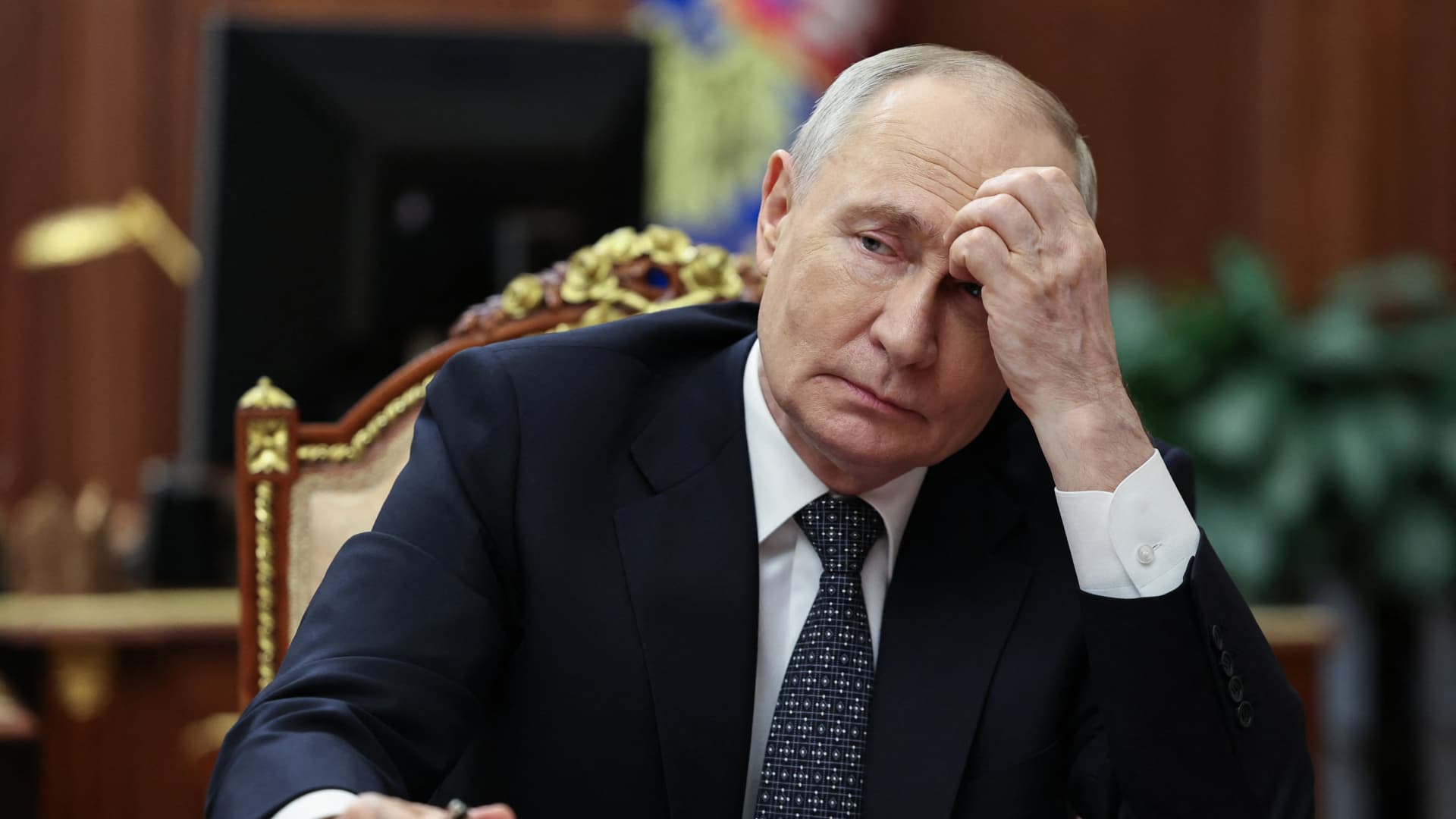
In this pool photograph distributed by the Russian state agency Sputnik, Russia’s President Vladimir Putin meets with Moscow-installed leader of the Russian-controlled parts of the Zaporizhzhia region, at the Kremlin in Moscow on July 20, 2026.
Alexander Kazakov | Afp | Getty Images
After four-and-a-half years of full-scale war with Ukraine, Russia has become a two-tier economy.
“If you are lucky and you’re employed by a tank production company, then everything’s good. Otherwise, you are probably facing problems,” Alex Kolyandr, director for Europe at consulting firm Eurasia Group, told CNBC.
Russia’s wartime economy has been brought into sharper focus in recent weeks by Ukraine’s long-range drone attacks on oil refineries and delivery warehouses.
Though it has defied expectations and is even growing slowly, according to recent data, analysts say this masks problems, such as the Kremlin’s reliance on military spending, higher taxes and subsidized bank lending.
But they question whether this will drive Russia to give up its war. Indeed, Kolyandr warned the worsening economy could incentivize President Vladimir Putin to escalate the conflict.
“If I were Putin, God forbid, I would probably decide that it is in my interest to escalate now and try to finish the war on my terms, than wait until the money ends sometime in the future,” Kolyandr said.
The Russian Embassy in London and Russia’s Foreign Ministry did not immediately respond to CNBC’s request for comment.
Kolyandr said the Kremlin could balance the books with some “bookkeeping acrobatics,” but its economic problems “will not go away and are still mounting.”
He added: “It has already started, through inflation, through the slowdown in the non-military economy, through higher interest rates.”
Two standout metrics for Russia’s economy
For the first time since 2023, Russia’s economy returned to growth in the April to June period. The country’s gross domestic product grew 1.3% year-on-year in the second quarter, according to official data published this week, while GDP expanded by 0.6% through the first half of the year. The second-quarter figures surpassed government and central bank forecasts.
The data suggest that government spending on its industrial-military complex and a recent boost in oil and gas prices have helped prop up Russia’s wartime economy.
But Charles Lichfield, director of economic foresight and analysis at the Atlantic Council’s GeoEconomics Center, said the best metrics for understanding what’s going on are the deficit and inflation.
The logo of Alfa Bank, Russia’s privately-held lender is seen atop of a building behind revolutionary militiamen – a fragment of a huge monument to Vladimir Lenin, the founder of the USSR, in Moscow on June 5, 2026.
Alexander Nemenov | Afp | Getty Images
“They are on course to double the deficit they had in 2025 and that was already double what they had in 2024,” Lichfield said, highlighting the country’s depressed energy revenues, despite higher fossil fuel prices in recent months.
In the first half of 2026, oil and gas revenues were 64% of their level in the same period two years ago. Sustained Ukrainian drone strikes have hit Russia’s refineries, and tougher Western sanctions have started to bite, like the lower European Union oil price cap and measures targeting Russia’s shadow-fleet enablers.
“On inflation, they managed to bring it down to basically the target of 4% late last year, which was a big achievement given all the internal and external inflationary pressures, but it looks like that will not last,” Lichfield said.
What Russians’ cookie buying says about the economy
Earlier in the year, the country’s largest retailer said citizens were increasingly switching to low-cost and store-brand food products.
“We recently noticed that cookie consumption has risen — almost two and a half times,” X5 Group President Yekaterina Lobacheva told RBC News in April, according to a translation by The Moscow Times. “It’s something sweet, a small indulgence, but cheaper than chocolate and other confectionery.”
Asked what levers the Kremlin can pull to mitigate the situation, Lichfield said the Russian government could tax oil and gas companies more than the current tax code suggests, try to borrow money internationally, or potentially mobilize the half of the central bank’s reserves that remain beyond Western sanctions.
Alongside roughly $300 billion frozen after the war began, Russia’s central bank is estimated to have around $300 billion in reserves, either in Russia or in jurisdictions not under sanctions. The money could technically be used to plug some fiscal gaps, Lichfield said, although this could undermine confidence in the central bank’s commitment to fighting inflation.
Lichfield said he doesn’t expect Russia to end the war for economic reasons, despite the pressure it faces.
Russia’s economy unlikely to determine Ukraine war
Elina Ribakova, senior fellow at Peterson Institute for International Economics, also said Russia’s economy was unlikely to force it to end the war when it was getting a boost from higher oil prices.
“It has to get much more dire,” Ribakova told CNBC in a phone interview. “If you tell me that we will have oil prices at $35 or $40 for the next year, then it might decide. But at the moment, especially given the war between Israel, the U.S. and Iran, it is unlikely.”
People queue to refuel their cars at a Lukoil petrol station in Moscow on June 30, 2026.
Igor Ivanko | Afp | Getty Images
Ribakova said the conversation was different when oil prices were much lower in January and February and the Russian government was talking about revising its 2026 budget, even though the year had only just begun, suggesting serious trouble.
She added that Putin had “staked so much” on the war “that he almost feels as like he has to keep on going.”
