



If you’ve ever looked at vitamin D supplements, you’ve probably noticed that some contain vitamin D2 and others D3. They are both forms of vitamin D, but they are not quite the same. Both can raise vitamin D levels and help prevent or correct deficiency, although research shows that D3 generally does a better job of raising and maintaining vitamin D levels in the blood.
So which one should you choose? In this guide, I’ll explain the main differences between vitamin D2 and D3 and when those differences actually matter.
Vitamin D2 vs D3 at a glance
Here’s the quick version of how vitamin D2 and D3 compare:
| Vitamin D2 | Vitamin D3 | |
|---|---|---|
| Scientific name | Ergocalciferol | Cholecalciferol |
| Main sources | Fungi, UV-exposed mushrooms and some fortified foods | Sunlight, animal foods and supplements; vegan D3 can be made from lichen |
| Raises vitamin D levels? | Yes | Yes |
| Which raises levels better? | Works, but generally less effectively | Usually more effective |
| Absorption from the gut | Well absorbed | Well absorbed |
| Is it the active form? | No | No |
| Can it be vegan? | Yes | Yes, if D3 is made from lichen |
Both forms are well absorbed and both can improve vitamin D levels. The main difference is that D3 generally raises vitamin D levels more and helps keep them higher for longer. This is supported by the NIH and by a UK government review of the evidence comparing the two forms.
Where do vitamin D2 and D3 come from?
Vitamin D2 and D3 come from different sources, although both can also be added to foods and used in supplements.
Where does vitamin D2 come from?
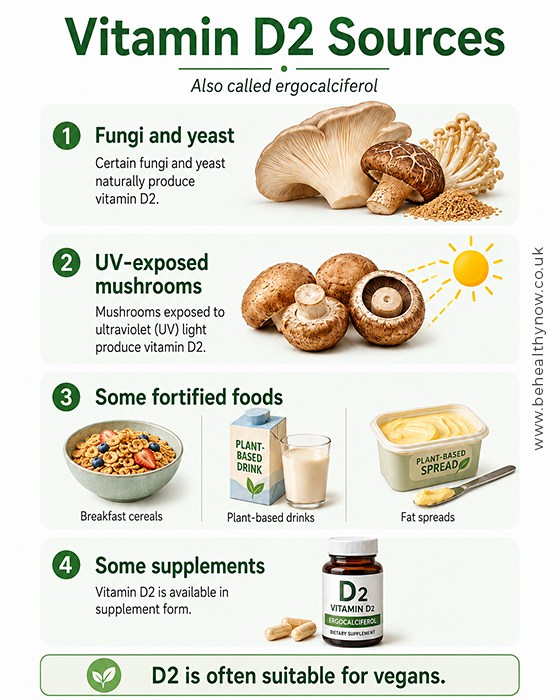
Vitamin D2, or ergocalciferol, mainly comes from fungi and yeast.
Some mushrooms also contain vitamin D2, especially when they have been exposed to ultraviolet (UV) light. This is similar to what happens when our skin makes vitamin D3 after sun exposure, although mushrooms produce D2 instead.
You may also find vitamin D2 in:
- some fortified foods (for example: breakfast cereals, plant-based drinks, fat spreads)
- vitamin D supplements
- UV-treated mushrooms
The type of vitamin D used varies, so it is worth checking the label if you specifically want to know whether a product contains D2 or D3.
Where does vitamin D3 come from?
Vitamin D3, or cholecalciferol, is the form of vitamin D our own skin produces.
When UVB rays from sunlight reach the skin, they trigger a process that allows the body to make vitamin D3. This is why sunlight can be such an important source of vitamin D.
D3 also occurs naturally in some animal foods, particularly:
- oily fish such as salmon, sardines and mackerel
- egg yolks
- liver
- some other animal foods in smaller amounts
Vitamin D3 is also widely used in fortified foods and supplements.
Most traditional D3 supplements are made from lanolin, a substance obtained from sheep’s wool. However, D3 can also be made from lichen, which means vegan vitamin D3 supplements are now available.
So D2 is not automatically the only option for someone following a vegan diet.
How does the body process vitamin D2 and D3?
Once D2 or D3 enters the body, both forms have to go through a similar process before vitamin D becomes fully active.
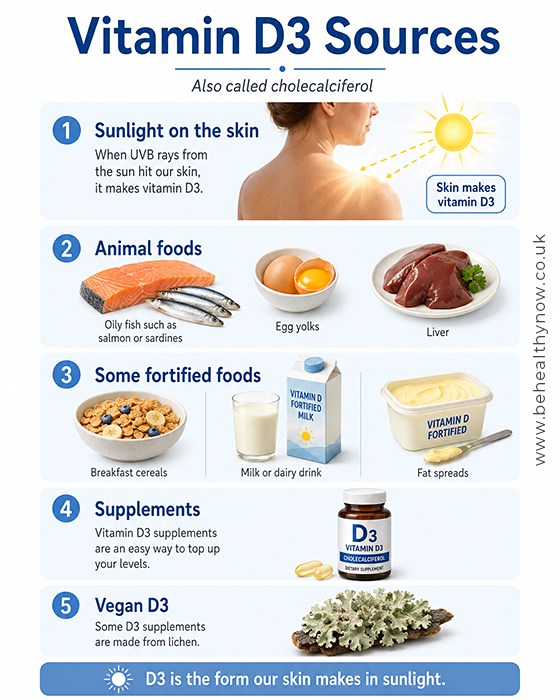
One important point is that neither D2 nor D3 is the active form of vitamin D.
First, the liver changes it
After vitamin D has been absorbed, it travels to the liver.
The liver converts it into 25-hydroxyvitamin D, usually shortened to 25(OH)D.
This sounds complicated, but it is simply the main form of vitamin D that circulates in your blood. It is also the form normally measured when you have a vitamin D blood test.
D2 becomes 25(OH)D2, while D3 becomes 25(OH)D3.
That distinction will become important later when we look at newer research comparing the two forms.
Then, the body activates it
The next step happens mainly in the kidneys.
They convert circulating vitamin D into 1,25-dihydroxyvitamin D, also called calcitriol. This is the active form of vitamin D.
In simple terms:
Vitamin D2 or D3 → liver → circulating vitamin D → mainly kidneys → active vitamin D
So although vitamin D3 is the form our skin naturally makes, it is not itself the active form of vitamin D. It still needs to be processed by the body, just like vitamin D2 does.
You can read more about this two-step activation process in the NIH Vitamin D fact sheet.
Is vitamin D3 absorbed better than vitamin D2?
You may have read that vitamin D3 is better than D2 because it is “better absorbed”. But that’s not quite the full story.
Both vitamin D2 and D3 are well absorbed in the small intestine. In fact, the NIH Vitamin D fact sheet specifically states that both forms are well absorbed.
Vitamin D is a fat-soluble vitamin, so having some fat in the digestive system can help with absorption. However, this doesn’t mean you need to take vitamin D with a very fatty meal. Some vitamin D is still absorbed without dietary fat.
A study looking at vitamin D3 absorption also found that absorption was higher when the supplement was taken with a meal containing fat rather than a fat-free meal.
The bigger difference happens after absorption
So if both D2 and D3 are absorbed well, why does D3 usually raise vitamin D levels more?
The answer seems to be what happens after the vitamin has already entered your body.
Once absorbed, D2 and D3 don’t behave in exactly the same way.
For example, a human study comparing how long 25(OH)D2 and 25(OH)D3 remain in the blood found that the form made from D2 had a shorter half-life.
Half-life sounds complicated, but it simply tells us how quickly the amount of something in the body falls over time.
In practical terms, the vitamin D produced from D3 appears to stay in the bloodstream a little longer than the vitamin D produced from D2. This may be one reason D3 tends to maintain vitamin D levels better.
What about bioavailability?
You will also sometimes see D3 described as being more bioavailable.
Bioavailability basically refers to how much of a nutrient becomes available to the body after you take it. But with vitamin D2 and D3, it is misleading to say that D3 is simply more bioavailable because more of it gets absorbed from your gut.
Both forms are absorbed well. The advantage of D3 seems to have more to do with how the body handles it after absorption.
This fits with a systematic review and meta-analysis comparing D2 and D3, which found that D3 was more effective overall at raising total vitamin D levels in the blood.
So, which is better: vitamin D2 or D3?
For most people choosing a vitamin D supplement, I would favour vitamin D3. Both forms work, but D3 generally raises vitamin D levels more effectively and is better at keeping those levels up over time.
This isn’t just based on one small study. A 2024 systematic review and meta-analysis brought together 20 comparisons of D2 and D3 and found that D3 was more effective at raising total vitamin D levels in the blood.
In simple terms, if two groups of people were given similar amounts of D2 and D3, the people taking D3 generally ended up with a bigger increase in their overall vitamin D level.
Does that mean vitamin D2 doesn’t work?
No. Vitamin D2 still raises vitamin D levels.
In fact, a separate 2024 meta-analysis of vitamin D2 supplementation found that D2 significantly increased total vitamin D levels.
So the difference isn’t between one form that works and one that doesn’t. Both work, but D3 appears to be the more reliable choice for raising and maintaining vitamin D levels.
New research: Can vitamin D2 lower D3 levels?
This sounds a little confusing at first. We’ve just seen that vitamin D2 can raise vitamin D levels, so how could it also lower D3?
A 2025 systematic review and meta-analysis found something interesting. When people took vitamin D2, the amount of vitamin D coming from D2 increased, but the amount coming from D3 tended to decrease.
To understand this, it helps to remember what happens after each form enters the body:
- Vitamin D2 is converted into 25(OH)D2
- Vitamin D3 is converted into 25(OH)D3
- Your overall vitamin D blood level can include both of these together
A simple example
Imagine a blood test shows your total vitamin D level is 50 nmol/L and almost all of it comes from D3.
You then start taking vitamin D2. Your D2-related vitamin D rises by 30, but your D3-related vitamin D falls by 9.
Your total vitamin D level would now be around 71.
So even though the D3 part has fallen, your overall vitamin D level has still increased.
These numbers are just an example to make the idea easier to understand, but this type of change is what researchers have seen across studies.
In the 2025 analysis, taking D2 was associated with a reduction in 25(OH)D3 compared with people who weren’t taking D2. When researchers looked at the change from the start of the studies, the difference was around 9 nmol/L on average.
Researchers aren’t completely sure why this happens. One possibility is that taking D2 causes the body to break down or clear D3-related vitamin D more quickly.
Does this reduction in D3 matter?
This is the part we don’t know yet.
The researchers couldn’t say whether having less 25(OH)D3 is harmful if your total vitamin D level is still adequate.
So this research doesn’t mean that D2 lowers your overall vitamin D or that taking D2 is harmful.
What it does show is that D2 and D3 don’t behave in exactly the same way inside the body, which gives us another reason not to assume that the two forms are completely interchangeable.
Are vitamin D2 and D3 doses equivalent?
On a supplement label, vitamin D2 and D3 use the same units.
1 microgram (µg) of vitamin D = 40 IU, whether the vitamin D is D2 or D3. This conversion is used by both the NIH and EFSA.
So, for example:
- 10 µg = 400 IU
- 25 µg = 1,000 IU
- 50 µg = 2,000 IU
This means that 1,000 IU of D2 and 1,000 IU of D3 are the same labelled dose.
But that doesn’t necessarily mean they will have exactly the same effect on your vitamin D level.
The same dose can produce a different response
As we’ve already seen, D3 generally raises vitamin D levels more effectively than D2.
A 2024 systematic review and meta-analysis found that this was still the case when researchers focused on studies using daily doses of D2 and D3.
So if two people took:
1,000 IU vitamin D2
and
1,000 IU vitamin D3
the doses would be equivalent on the label, but the person taking D3 may get a bigger increase in their blood vitamin D level.
There isn’t a simple conversion that tells us, for example, that a certain dose of D2 is always equal to a smaller dose of D3.
How much your vitamin D level changes can depend on several things, including your starting vitamin D level, the dose you take and your BMI. These were also important factors identified in the D2 versus D3 meta-analysis.
So I wouldn’t recommend simply taking more D2 to try to make it “equivalent” to D3. If you’re choosing between the two at the same dose, D3 is generally the more reliable option for raising vitamin D levels.
Which is better for bone health and osteoporosis?
If you are choosing between vitamin D2 and D3 for bone health, D3 is generally the better choice.
The main reason is that D3 raises and maintains vitamin D levels more reliably than D2. This matters because having adequate vitamin D helps the body absorb calcium and maintain normal bones.
However, there is an important distinction. The evidence favouring D3 is mainly about how well it raises and maintains vitamin D levels, rather than evidence that D3 prevents more fractures than D2.
For people with osteoporosis, current UK NOGG guidance recommends making sure vitamin D and calcium intake are adequate, with supplements used when needed.
So the practical answer is:
For bone health and osteoporosis, I would choose D3 over D2, but the most important thing is correcting or preventing vitamin D deficiency. Taking extra vitamin D when your levels are already adequate does not necessarily give additional bone protection.
Vitamin D2 vs D3 if you have kidney disease
The kidneys play an important role in vitamin D because they help convert it into its active form, which the body can then use.
This means vitamin D can become more complicated if you have chronic kidney disease (CKD), particularly as kidney function declines.
Is D2 or D3 better for kidney disease?
There is some evidence in favour of vitamin D3.
In a randomised trial comparing D2 and D3 in people with chronic kidney disease, D3 was more effective at raising vitamin D levels while people were taking it. However, there was no significant difference between the two forms in some other markers related to vitamin D and parathyroid hormone function.
So D3 may still be the better choice for correcting low vitamin D levels, but kidney disease is one situation where I wouldn’t recommend choosing a supplement or dose based on this comparison alone.
With more advanced CKD, the kidneys may be less able to complete the normal activation of vitamin D. Depending on the individual situation, treatment may involve carefully monitored vitamin D or, in some cases, medicines containing active vitamin D such as calcitriol or related compounds.
Current kidney guidelines do not recommend active vitamin D routinely for everyone with CKD, so this needs to be decided by a doctor.
Can vitamin D damage the kidneys?
Vitamin D at appropriate doses is not generally considered damaging to healthy kidneys.
Problems can occur with vitamin D toxicity, usually from taking excessive amounts of supplements. Too much vitamin D can cause calcium levels in the blood to become dangerously high, which can lead to kidney stones and, in severe cases, kidney damage or kidney failure. The NIH explains the risks of excessive vitamin D intake in more detail.
If you have kidney disease, kidney stones or have been told that your calcium levels are abnormal, it is best to check with your doctor before taking higher-dose vitamin D.
Which vitamin D should you take?
For most people, vitamin D3 would be my first choice.
It generally:
- raises vitamin D levels more effectively than D2
- keeps those levels up for longer
- is widely available, including vegan D3 made from lichen
Vitamin D2 still works, so there is no need to worry if that is the form you are already taking. But if you are simply choosing between the two, D3 is usually the better option.
If your doctor has prescribed vitamin D2, especially at a higher dose, don’t switch forms or add extra vitamin D without checking with them first.
FAQs
Is vitamin D3 better for the immune system?
Possibly, but this hasn’t been proven in terms of preventing infections.
A human study comparing D2 and D3 found that D3 affected some genes involved in the body’s antiviral immune response differently from D2. However, the researchers were looking at gene activity, not whether people taking D3 actually caught fewer infections.
A much larger 2025 meta-analysis also found that vitamin D supplementation did not significantly reduce the overall risk of acute respiratory infections.
So I would still choose D3 if you need a vitamin D supplement, but not because it has been proven to prevent colds or “boost” immunity.
Is vitamin D2 or D3 better for weight loss?
Neither. Vitamin D should not be taken as a weight-loss supplement.
A 2025 review of 25 clinical trials found that vitamin D supplementation did not significantly reduce body weight or waist circumference overall.
D3 may be better at raising vitamin D levels, but that doesn’t make it better for losing weight.
Can I take vitamin D2 and D3 together?
Yes, but there is usually no benefit to deliberately taking separate D2 and D3 supplements together.
Both count towards your total vitamin D intake, so make sure you don’t accidentally take too much.
If you have been prescribed a high dose of D2, check with your doctor before adding D3.
Which is better for children, vitamin D2 or D3?
Both can raise vitamin D levels in children. A trial in young infants found that the average increase in vitamin D did not differ significantly between D2 and D3.
D3 is still a sensible general choice, but getting the correct dose is more important than worrying too much about D2 versus D3.
Current UK guidance recommends:
- Breastfed babies under 1: 8.5 to 10 µg daily
- Formula-fed babies under 1: supplement if they drink less than 500 ml of formula per day
- Children aged 1 to 4: 10 µg daily
Are vitamin D sprays better absorbed than tablets?
Not necessarily.
A study comparing vitamin D3 spray with capsules found that both raised vitamin D levels effectively in healthy adults, with no significant difference between them.
Some research suggests sprays may be useful for people with absorption problems, but overall they haven’t been shown to be better for everyone.
And even if some vitamin D is absorbed through the mouth, it still needs to be processed by the liver and converted into its active form, mainly through the kidneys.
I’ve covered this in more detail in my guide to vitamin D oral spray vs tablets.
Is vitamin D2 vegan?
Yes. Vitamin D2 is vegan, as it usually comes from fungi or yeast.
But D3 can be vegan too. Traditional D3 is commonly made from lanolin from sheep’s wool, while vegan D3 is made from lichen. So if you prefer D3, look for “vegan vitamin D3” or “lichen-derived D3” on the label.
