


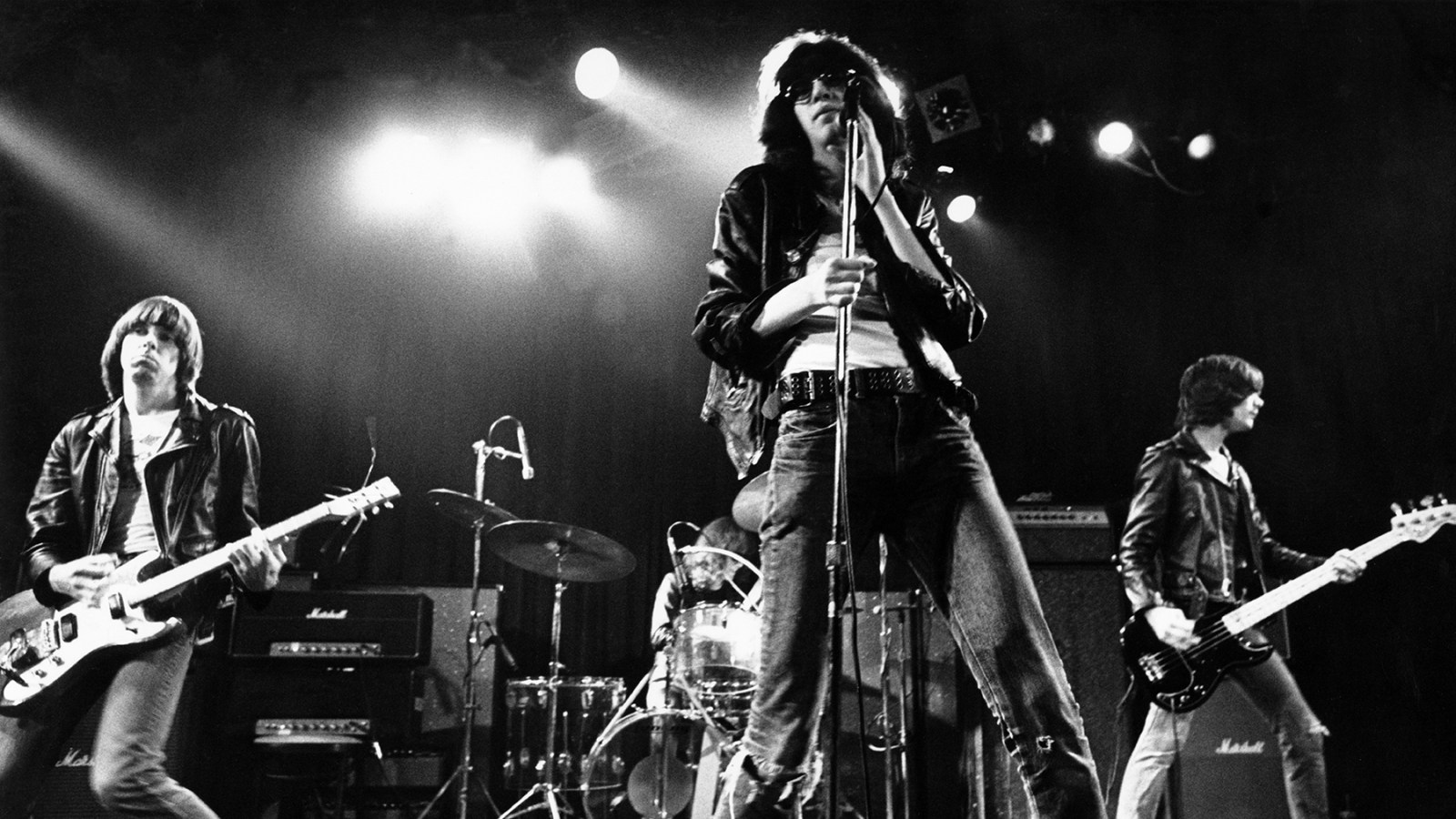
By the time the Ramones traveled to Los Angeles in August 1976 to play their very first West Coast concerts, they’d already established themselves as the vanguard act of the thriving New York City punk scene, signed a deal with Sire Records, released their groundbreaking debut album, gigged up and down the East Coast, and even played a couple of landmark gigs in London a month earlier that had a seismic impact on the burgeoning underground rock scene that had recently birthed the Clash, the Sex Pistols, the Damned, and many others.
But punk hadn’t quite made its way out to California at this point, even though the Runaways had formed, and the press was still quite skeptical of the Ramones and the entire movement they represented. “The album cover photo [of their debut] — which looks as if taken from a post office wanted poster — shows four young toughs wearing black leather jackets and old, wrinkled jeans,” wrote the noted Los Angeles Times critic Robert Hilburn on Aug. 1, 1976, just 10 days before the Ramones made their L.A. debut at the Roxy. “Two of the guys are wearing dark glasses and smirking in the slightly perverse way that would make even the sadistic gang from A Clockwork Orange consider crossing the street to avoid a confrontation.”
Hilburn continued by pointing out that their songs contain references to street hustlers, drug use, and even Nazism. “The Ramones would have faced much resistance in 1956,” he wrote. “The question facing us now is whether the group is acceptable even in 1976. If not, the reasons for rejection will be vastly different. Whereas the Ramones may have been too much of a threat to parents in the 1950s, the group may be too much of a joke now.”
He ultimately concluded they lack the “imagination” of Patti Smith, the “art” of Bruce Springsteen, the “musical affection” of Dr. Feelgood, and the “fury and growl” of Aerosmith. “As long as the group sticks so religiously to the punk-rock mold, the Ramones music (and image) is easy to like, but difficult to believe,” he writes. “And authenticity has always been a crucial fact in rock.”
In some ways, Hilburn was correct. Patti Smith, Bruce Springsteen, and Aerosmith all had much brighter futures in the world of popular music. (Dr. Feelgood are largely a tiny footnote in America.) But he was wrong, and he’d probably be the first to admit it today, when he said that the Ramones lacked authenticity. They may have given themselves fake names, but Joey, Johnny, Dee Dee, and Tommy Ramone all had a deep and genuine love for the stripped-down music they were making, and real disdain for the mainstream rock of the day. (Frampton Comes Alive! topped the Billboard 200 when the Ramones touched down in L.A., “Don’t Go Breaking My Heart” by Elton John and Kiki Dee was on top of the Hot 100, and Yes were headlining stadiums.)
The Ramones played back-to-back shows at the Roxy on Aug. 11 and 12, 1976. The Los Angeles Times listed those dates in tiny print on their calendar page near upcoming public lectures like “Practical Applications of Self-Hypnosis,” “Who Killed John Kennedy,” and “How Relationships and Sexual Enhancement Really Happen.”
On the club scene, there was Grateful Dead lyricist Robert Hunter at Golden Bear, jazz pianist Mose Allison at Lighthouse, and jazz trumpeter Freddie Hubbard at Starwood. The were all dwarfed that month by major events like Jethro Tull and Robin Trower at the L.A. Coliseum; Kiss with Ted Nugent, Montrose, and Bob Seger at Anaheim Stadium; and Aerosmith with Lynyrd Skynyrd, Jeff Beck, Rick Derringer, and Starz, also at Anaheim Stadium.
The Roxy seats about one percent as many people as the Angels’ ballpark. But it sounded pretty full when the Ramones took the stage for the Aug. 12 show and Joey Ramone blared out, “Good evening, we’re the Ramones, and if you’re a loudmouth, baby, you better shut up.” (Unlike night one, this show survives on tape.) Over the next 33 minutes, they played 13 of the 14 songs from their debut at breakneck speed, leaving out only “I Don’t Wanna Go Down to the Basement,” along with “I Remember You” and “Glad to See You Go,” from their upcoming album Leave Home.
“The New York street rockers’ extreme primitivism, posited as a love-’em-or-hate-’em proposition, is marked by a pure, authentic inanity and a genuine inescapable energy that burrows beneath the foundations of current rock’s pretensions and contrivances,” reads a review in The Los Angeles Times by Richard Cromelin. “Its deadpan, wimpy delivery is endearing, and its repetition is allayed by its incredible rapid-fire pace. Each number begins with an obsessive ‘one-two-three-fah!’ (once they got all the way up to seven), some songs, contrary to detractors’ accusations, have as many as five chords, and while there’s a bit of variation in tempo and structure, it’s not enough to mollify the relentless assault.”
Cromelin’s focus on the “pure, authentic inanity” of the Ramones seems like a direct response to Hilburn’s assertion earlier in the month that the Ramones were inauthentic. But Cromelin had the benefit of experiencing the Ramones live in the flesh at the Roxy. Hilburn was going only on the album, and the relentless hype coming out of New York, which was easy to dismiss because the New York Dolls, the most direct antecedent to the Ramones, had flamed out after just two records.
But Hilburn and other doubters would have plenty more chances to change their minds in the two decades that followed. The Roxy was the first of 180 shows the Ramones would play in California before splitting up in 1996. They filmed concert scenes for their 1979 movie Rock and Roll High School back at the Roxy, hit just about every club on the Sunset Strip several times over, performed the Greek Theater on a stacked bill in 1990 that included Debbie Harry, the Tom Tom Club, and Jerry Harrison, and even played the 2,263rd and final show of their career at L.A.’s Palace Theater on Aug. 6, 1996. It was a marathon set that included guest appearances by Eddie Vedder, Lemmy Kilmister, Chris Cornell, and Dee Dee Ramone, who had left the band seven years earlier.
It seemed odd that maybe the most quintessential New York band in rock history, rivaled only by the Velvet Underground, would wrap up their career in Los Angeles. But it was their second home by that point. Johnny Ramone moved there right after the Ramones broke up. Dee Dee Ramone died there in 2002, and is buried at Hollywood Forever Cemetery, not far from a monument to Johnny that draws fans from all over the world. (Joey is buried back east in New Jersey, and Tommy’s final resting place is on Long Island.)
To commemorate the 50-year anniversary of the first Ramones record, a one-time-only supergroup featuring Green Day’s Billie Joe Armstrong, blink-182’s Travis Barker, Rancid’s Tim Armstrong, and C.J. Ramone (Dee Dee’s replacement) are playing a concert on Aug. 30 of this year. With every member of the original lineup now dead, it’s about as close to an actual Ramones concert as we’re going to get these days. But it’s not taking place at the former CBGB site, which is now a John Varvatos store that holds occasional concerts, or anywhere else in New York City. They’re staging it at Hollywood Forever Cemetery, just four miles from the Roxy, where the entire saga of the Ramones in L.A. began.
