


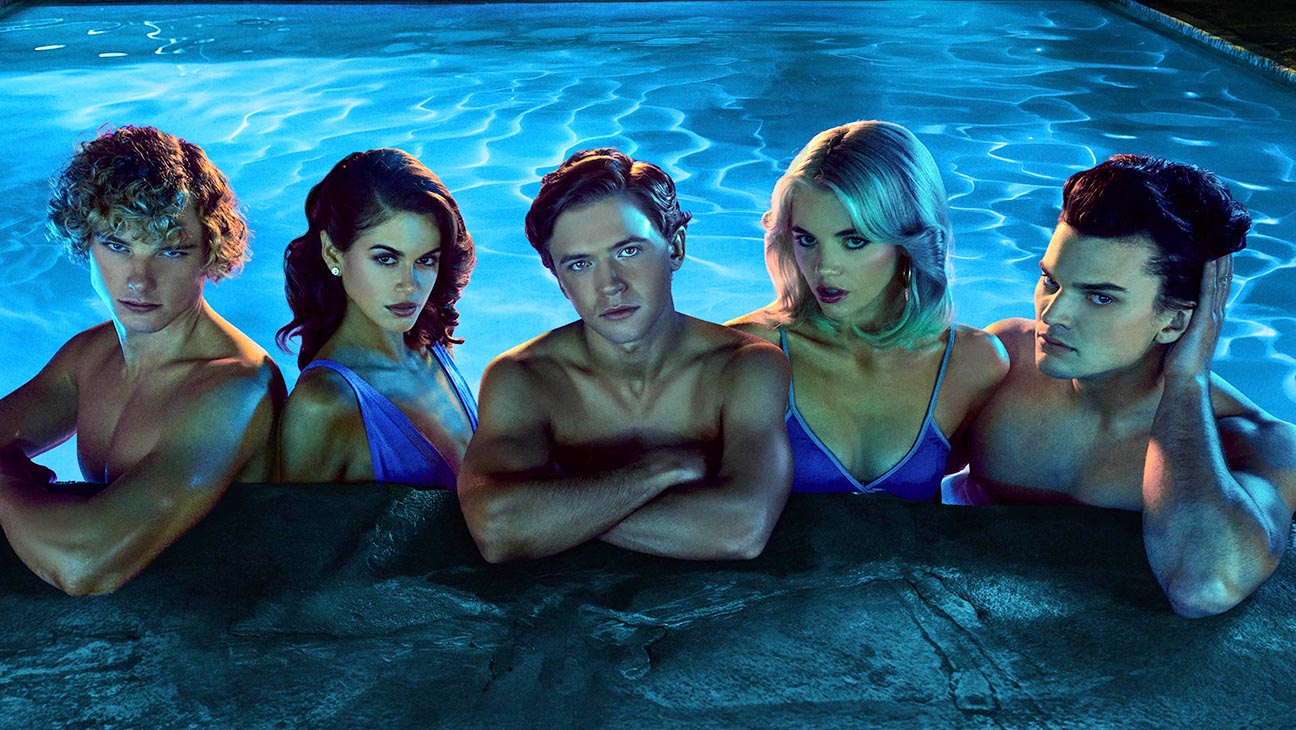
Halloween of 1981 arrives for the privileged heroes of FX/Hulu’s The Shards. Debbie (Hayes Warner), spoiled daughter of Hollywood royalty, is determined to throw a party, despite a city-wide curfew brought about by a marauding serial killer preying on affluent teens. Debbie’s best friend Susan (Kaia Gerber), the school’s queen bee, proposes the theme of Area 54 — “like Studio 54, but in space.”
“Umm. I think we need to watch the kitsch,” cautions Debbie, almost reaching through the screen to nudge viewers in the ribs.
The Shards
The Bottom Line
Nostalgic, over-the-top and unsurprisingly uneven.
Airdate: 9 p.m. Wednesday, August 5 (FX and Hulu)
Cast: Igby Rigney, Kaia Gerber, Homer Gere, Hayes Warner, Graham Campbell, Evan Rachel Wood, Wes Bentley, Jordan Roth
Creators: Ryan Murphy and Bret Easton Ellis
The Shards is very much aware that the phrase “from Ryan Murphy and Bret Easton Ellis” carries expectations or preconceptions — first and foremost, of excess.
The novel, the most acclaimed in decades for the American Psycho scribe, tops 600 pages, but could easily have dropped to 400 if you trimmed references to the main character’s masturbatory routine, meditations on the posteriors of his male friends, detailed driving instructions for navigating Los Angeles, and plugs for the fashion brands and musical artists who populate this world. That is to say, “the things that make a Bret Easton Ellis novel a Bret Easton Ellis novel.”
Murphy, working with Ellis, has expanded the already-strained novel into a nine-episode drama that reaches no conclusion by its finale. General opulence, a hit-filled soundtrack and boundary-pushing sexuality are all present and accounted for, even if the challenge of capturing early-1980s L.A. relies far more on elaborately dressed soundstages than effective location work.
The Shards is a series made for (and probably by) people who can’t always distinguish among kitsch, camp, ironic detachment and affectionate nostalgia, and, frankly, don’t care. The primary thing to know about the show and its roman à Bret approach to Ellis’ upbringing is that it’s a lot, and the pieces and tones and characterizations rarely cohere.
It is, in short, exactly what you’d expect from a team-up this eminently if joylessly compatible — at least until The Shards detours dramatically, becoming a show that’s perhaps worse but more entertaining.
Igby Rigney plays Bret Ellis. Settling in for his senior year at The Buckley School in Sherman Oaks, Bret dreams of an adulthood that entails an escape from Southern California, but in the interim he has a regular regimen that includes the aforementioned masturbation and quality time with sexually voracious girlfriend Debbie, best friend Susan, and Susan’s boyfriend Thom (Graham Campbell), the puppy-dog friendly quarterback and high school alpha. Nobody in his immediate circle knows that Bret is gay, enjoying regular dalliances with class pothead Matt (Owen Painter) and pining over Ryan (Daniel Dale).
Bret, who narrates the series with snooty affectation, is primarily parentless, with mom and dad gallivanting around Europe. It’s a world of unsupervised teens, all self-medicating with piles of cocaine and bottles of mood enhancers. Maybe that’s for the best, because the parents we do see — Debbie’s dad Terry (Wes Bentley) is a barely closeted producer preying on young men, much to the chagrin of his wife Liz (Evan Rachel Wood), a puddle of anti-depressants and unfulfilled dreams — aren’t role models; they’re incapable of functioning without assistants like Jordan Roth’s Steven, who swans in and out of scenes manipulating the action like Mrs. Danvers in Rebecca.
Two disruptions are coming that, as Bret explains, mark a transition from youth into adulthood: A new student shows up — Robert Mallory (Homer Gere), impossibly hunky and harboring secrets starting with his spell at an institution. Then there’s the Trawler, part of the nouvelle vague of Los Angeles serial killers operating in Charles Manson’s wake — peer to the Night Stalker and the Hillside Strangler — and prefacing his grotesque murders with sadistic taunting.
With his friends too busy snorting and fucking and modeling designer clothes, only Bret is paying attention to the Trawler, and only Bret connects the arrival of the Trawler and the increased proximity of his killings with the arrival of Robert. Bret is obsessed, but is his fixation on Robert the product of lust or an overactive imagination that can’t be fulfilled by his work on a novel titled Less Than Zero? Even his close friends accuse Bret of embellishing the truth for creative purposes, not incidentally an accusation both Ellis and Murphy have often faced.
The porcelain exteriors of these teenage lives are about to get shattered. Shattered into shards? Why yes!
Watching The Shards, one imagines that Ellis, credited as co-creator, executive producer and co-writer on the first two episodes, was an active participant until the end of the fourth episode — at which point he became the Trawler’s latest victim, allowing Murphy and a team of writers (Search Party co-creator Charles Rogers and Last Week Tonight vet Juli Weiner, primarily) to transform the show into something with more jagged tonal edges and long-term potential, but little continuity with what came before.
The first four episodes retain most of the novel’s key incidents and tics. I referred to the series’ porcelain exterior, but it’s much more plastic, with the early directors — starting with Murphy and then Michael Uppendahl — filming every actor like an impossibly sculpted mannequin. They’re sexy mannequins, but there’s something almost alien about Rigney, Warner and purposefully chosen nepo babies Gere and Gerber (the latter of whose physical similarity to her mother guarantees that the series’ most prominent valley is “uncanny” rather than “San Fernando”).
The young cast is supported by production designer Merje Veski and costumer Courtney Wheeler, who make sure the interior of a Hamburger Hamlet in Westwood or a garish mansion in Beverly Hills, thickly rimmed sunglasses or too-tight pants, all provide the necessary authenticity. Even more important is the soundtrack, consisting of one ’80s hit after another; it’s a bit more on-the-nose than Ellis’ pretentiously esoteric favorites, but each song is treated with reverence and many are played straight through in countless montages.
The mood is eerie, but never really scary; it’s a bloodless series despite the Trawler’s mauled victims. You won’t really like anybody — Bret’s genuine warmth for Ryan, key to building reader empathy in the book, is mostly absent here — because nobody is really human.
The fifth episode, which returns Murphy behind the camera, is wild. It pauses most of the momentum for a cheerfully preposterous public access dance competition — basically Hairspray in 1980s Los Angeles. It’s so dreamlike and disconnected from what came before that I kept expecting somebody to abruptly wake up, but it’s Murphy’s opportunity to sever ties with the novel and make overblown pronouncements about the ’80s — fluidity, pastels and pornography are explicitly mentioned as hallmarks of the decade — in garish, lively assault on the viewer. I found the episode irritating and messy, but purposeful.
Subsequent episodes almost become an unacknowledged third season of Murphy’s Fox comedy Scream Queens, which may irritate Ellis devotees but results in a show that’s funnier and odder and more willing to take wild swings, like an episode that uses a Shakespeare class as a catalyst for characters slipping in and out of fantasies inspired by Hamlet, Romeo and Juliet and Macbeth. Does it come together as anything harmonious? No. The second half of the season is chaos, but it breaks through what was stifling about the earlier chapters, and the cast benefits.
The season gradually showcases Warner, who finds the bruised psyche beneath her character’s sexpot surface and delivers cutting dialogue with a precision that calls to mind Murphy blondes including Emma Roberts, Leslie Bibb and Billie Lourd. Gerber continues to show surprising range, nailing Susan’s brittle air of perfection, even if she gets to use very little of the withering timing that worked so well in Bottoms and Overcompensating.
The Shards men, too, are Murphy types, with Rigney resembling Evan Peters and Gere frequently evoking Ashton Kutcher.
If the teens — none resembling a “teen” in any way — are, intentionally, malfunctioning automatons, the adults get to really let loose. Murphy knows how to wring the most out of Bentley’s vulpine intensity, while Wood is certain to become a Murphy regular, given how well she gets his vibe. Roth, a Broadway producer with limited acting credits, doesn’t feel like he’s acting in the same show as anybody else, but given how everybody — including the Trawler — seems to be wearing a mask, his Mephistophelian obsequiousness is pleasantly unobscured.
Though little here is naturalistic, several prominent guest stars, led by James Wolk as one victim’s shattered father and Constance Zimmer as Robert’s unraveling aunt, get to be one-scene time bombs of real emotion.
The Shards concludes its season with a huge cliffhanger, but not one that makes future seasons feel necessary. Still, given the sense of excess that defines the entire endeavor, “necessity” may not be a factor here.
