


I had never noticed jeon in my youth, not like I do now. Maybe because they were always there, at every party, holiday, Tuesday night dinner. While the mothers gathered in the kitchen to fry up brimming platters of the Korean fritters — with ingredients like meat (wanja jeon), kimchi (kimchi jeon) and cod (daegu jeon) — the fathers played cards in the dining room, drinking soju and beer, and we children ran amok upstairs playing video games. The smell in the air, fried oil, was singular.
The word jeon (pronounced JUHN) encompasses a vast category of fritters and savory pancakes. But “fritter” and “pancake” aren’t adequate words for the breadth that the Korean word, jeon, encompasses. That’s why I think of it more as a cooking style, technique or method than a single dish. The quiet practice of dipping peak-season fish, vegetables, herbs and grasses in beaten egg, then pan-frying them in hot oil is a labor of love — timeless and joy-inducing, not to mention effusively Korean.
Jeon can be traced back to at least the Joseon dynasty (1392 to 1910), where it (and many of today’s most delicious Korean dishes) featured in royal court cuisine. As with bulgogi or kimchi, many things can be jeon.
The chef Mingoo Kang’s favorite vegetable is the thin-skinned variety of Kermit-green summer squash known as aehobak, or Korean zucchini, which is slightly sweeter and more aromatic than American zucchini. When it’s “sliced to the right thickness, lightly salted, dusted with flour and coated in egg before being gently pan-fried,” said Mr. Kang, of Mingles, in Seoul, South Korea, “it becomes incredibly delicious,” a fleeting pleasure.
Depending on the base ingredient, each requires a slightly different cut, cook and dipping sauce.

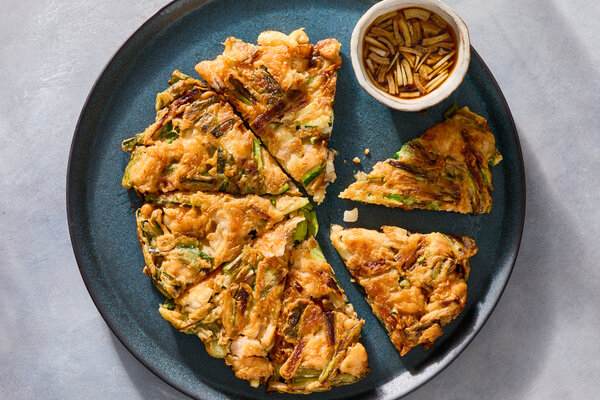
Haemul pajeon, a seafood scallion pancake, is arguably the homiest of jeon.Credit…Julia Gartland for The New York Times. Food Stylist: Monica Pierini.
Nadia Cho, the founder of Jeong Culture and Communication (and a co-author of Mr. Kang’s “Jang: The Soul of Korean Cooking”), gravitates toward the simplest forms, like napa cabbage (baechu jeon). “There is something confident about showcasing a single vegetable in its entirety,” she said, “rather than chopping it up.”
The seafood scallion pancake known as haemul pajeon, arguably the homiest of jeon, is most poetically enjoyed on rainy days indoors with the milky rice wine, makgeolli. “In Korea, we say that the sound of rain reminds us of the sound of jeon sizzling in a pan,” Ms. Cho said. Don’t forget to use plenty of oil; that’s the real secret to the staccato of pan-fried jeon.
For something different, you can change up the starch. It’s incredible the amount of satisfaction one can get from transforming a single russet into gamja jeon, Korea’s answer to the potato pancake. This nontraditional version — mostly egg, cornstarch and potato that’s been half grated and half cut into fine matchsticks — is crisp on the outside and tender-chewy on the inside. Pan-frying enhances the humble potato’s starchy flavor, like a Waffle House hash brown that came home from college with a nice, squidgy belly. As does the dipping sauce called choganjang (vinegar soy sauce), which has many iterations. Mine is a careful calibration of soy sauce, vinegar, water and sugar.
Pair it all with a nice crisp lager, for a celebration of everyday wins. When there’s jeon, life itself is the party.
