


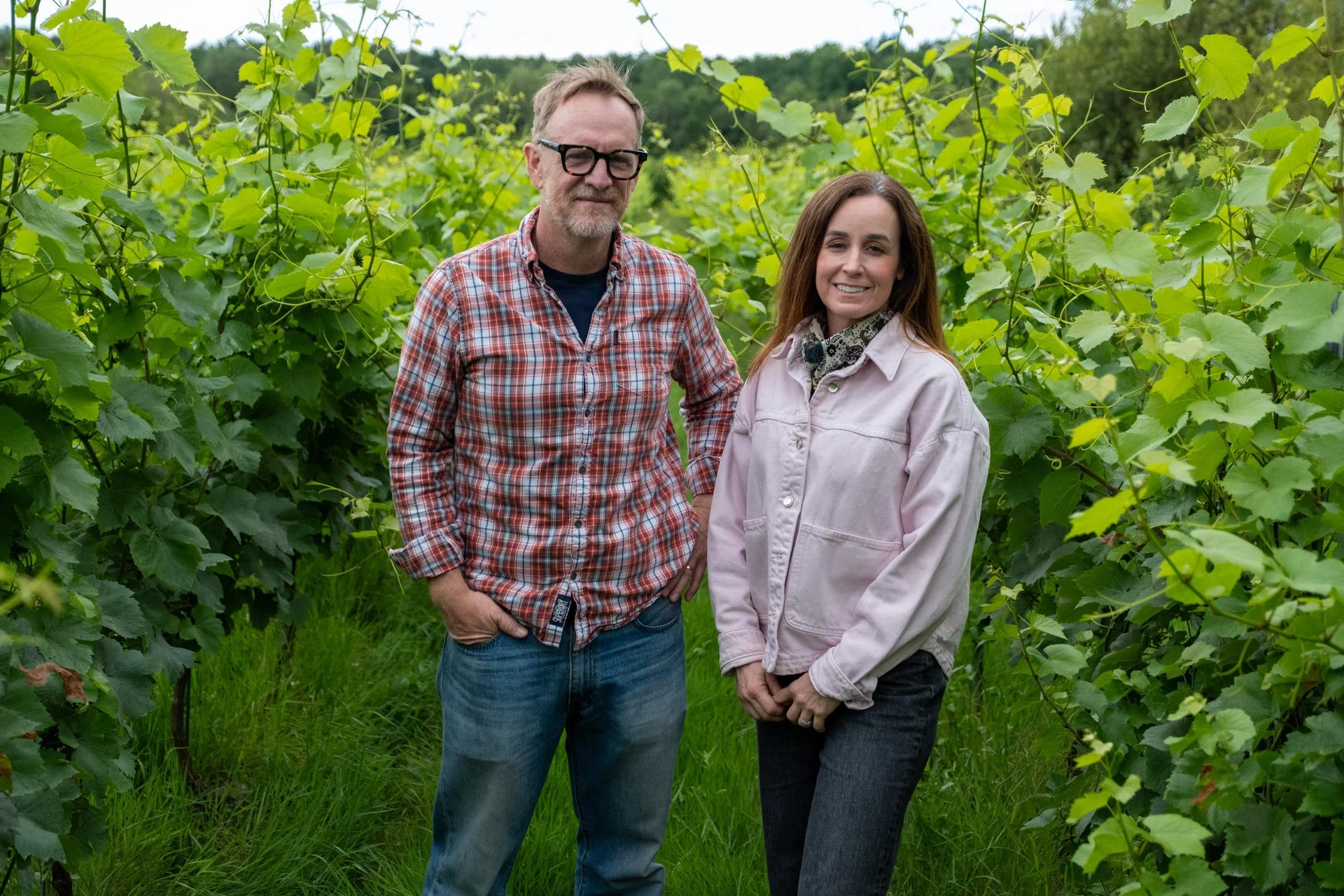
[FRANCS, FRANCE] Success often walks a tense tightrope. One misstep can bring it all crashing down. Consider the saga of what used to be known as Southold Farm & Cellar.
This small, risk-taking, family-run producer has made wonderful wines in two entirely different places, the North Fork of Long Island and then in Texas. Judging by the wines, Southold should have ensured itself a long run in either place. And yet, after encountering unforeseen obstacles, Southold twice left it all behind. Now, it has settled in France and is trying again in Bordeaux.
The Southold story illustrates the complexities of small family wine businesses. On the one hand, Southold has excelled at making distinctive artisanal wines that explore the potential of a given site. From a winemaking perspective, it’s all you can ask. Yet, it’s still a business, subject to all the pitfalls, fluctuations and naive misjudgments that can affect any small company.
When I first met the proprietors, Regan and Carey Meador, 10 years ago, they had planted a vineyard full of grapes that nobody else on the North Fork of Long Island was growing, and were making some of the freshest, most unusual wines in the region. They were countercultural groundbreakers who were making an often humdrum region far more interesting.
But local zoning authorities rejected their application to build a small winery. In response, they packed up everything and moved with their two young children, Coralai and Sawyer, to the Texas Hill Country. Before long, they were making delicious, innovative wines that differed from most other wines made in Texas.
It seemed as if the hard road they had chosen was paying off.
The Meadors planned to be there for the long run. They planted a hillside vineyard near their home in Fredericksburg, growing more than 20 kinds of grapes, including xarello, petit manseng and other unconventional varieties. They opened a tasting room, and eventually a restaurant, to showcase their wines.
“I get to make all the mistakes,” Regan Meador told me in 2019, when I visited Southold. “My kids get to fix them, and the grandkids get the benefit.”
But things took a disastrous turn after 2020. The estate vineyard fell victim to drought and Pierce’s disease, a bacterial disorder that can be controlled only by systemic insecticides, a step that Meador, who farms organically and regeneratively, did not want to take.
The restaurant business overwhelmed them, and to break even, their wine business would have had to grow well beyond what they had envisioned. They would have needed outside investors.
Instead, the Meadors decided that Texas was no longer for them. They sold almost everything they owned and, in August 2023, moved to France. There, with the proceeds they earned from selling their Texas property, they bought a small vineyard and winery on the eastern edge of the Bordeaux region, in the gentle green hills of the awkwardly named Francs-Cotes de Bordeaux appellation.
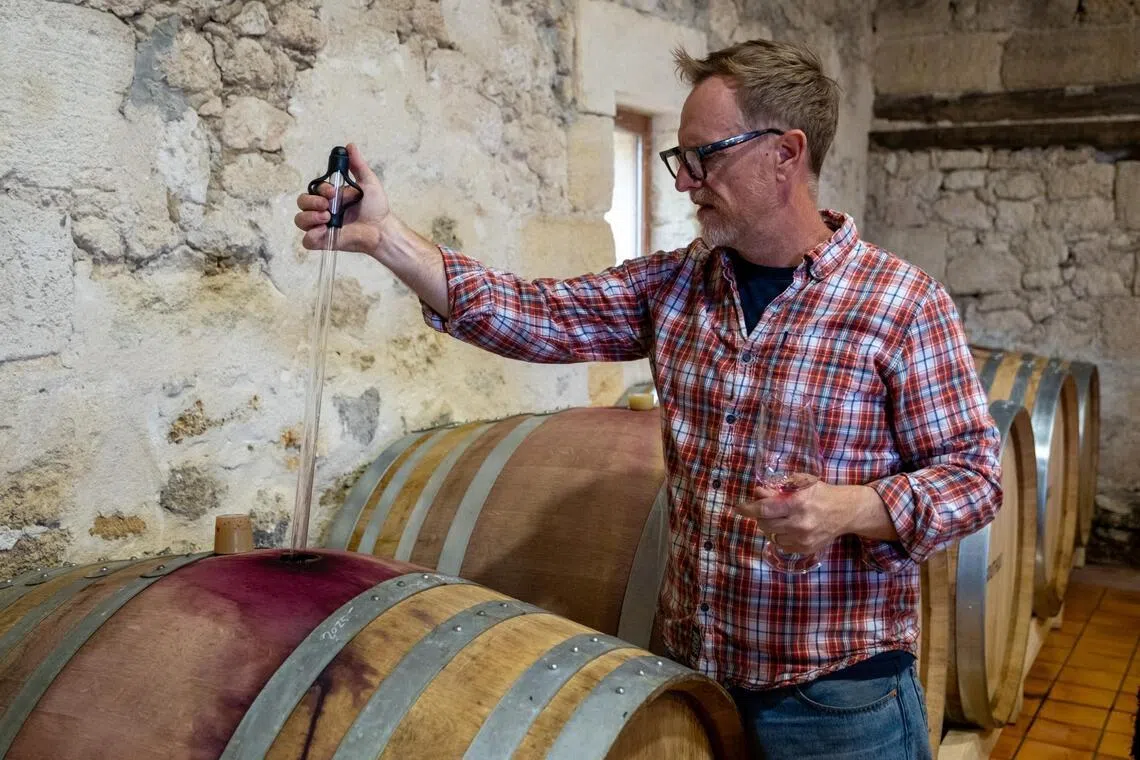
As a fan of their wines, I wondered how the Meadors would adapt to this latest dislocation. In May, I visited Regan Meador at what is now simply called Southold. I found him both excited by this new start and somewhat humbled and reflective.
“It’s been a real weird detoxification,” he said. The relocation to France caused him to miss the 2023 vintage, the first time in years he was not making or selling wine.
“That gave us time to ask what we still loved about all of this, and what we wanted to leave behind,” Regan Meador said. “For example, I will never open a restaurant again. That does not mean Texas was a mistake. It was formative and important. But leaving forced us to separate the work we love from the rest that had grown up around it.”
The property they found, with the aid of a French agency that helps people invest in rural properties, includes an old stone-and-wood barn with a simple, functional winery and roughly 6 hectares (ha) of vines. It was planted mostly with merlot, though the previous owners had gone rogue and planted a little chardonnay, not a grape native to the region.
In Bordeaux, the Meadors have traded in the unfettered frontier of American winemaking, where the grapes you grow and the wines you make are limited only by your imagination, for the laws and hidebound traditions of Bordeaux.
Still, Regan Meador is making changes to the vineyard, mostly with an eye to the warming climate and other potential calamities, like the widespread mildew attacks that devastated the 2024 vintage all over France.
He has grafted over some of the merlot to cabernet franc, both traditional Bordeaux varieties, which ripen later than merlot and will do better in hot vintages. But he is summoning more of his old inventiveness with white grapes.
“Bordeaux has a much narrower white canon, so there is more room to ask what actually makes sense here now,” he said. “What can handle a wider range of vintages, express this place, and make compelling wine without feeling experimental or novel for its own sake.”
To that end, he has used grafting to turn around 1 ha over to chenin blanc, and 0.4 ha to the Jura variety savagnin, both great grapes but with no history in Bordeaux. The hope, he said, is simply to figure out the best way to express the character of the place without ruffling too many feathers.
“There’s been a little bit of the ‘what are they doing?’ aspect,” he said. “I acknowledge the power of tradition. If the authorities are going to be on my butt, I’m not going to do it.”
Southold has now made two vintages, and only the 2024, tiny by virtue of the mildew issue, has been bottled. But the wines have all the hallmarks of the Southold style: fresh and lively, distinctive and delicious.
The 2024 Le P’tit Rouge is 100 per cent merlot – clear, pure and refreshing with a lightly bitter herbal quality that propels you on to the next sip. The 2025 chardonnay, which I tasted from a tank, was particularly interesting, with a lovely, waxy texture.
“This is kind of saying its own thing, that’s what I’m looking for,” Regan Meador said.
When the family left Texas in 2023, none of them spoke French. Yet they are adapting well. The family lives in the city of Bordeaux where Coralai, 12, and Sawyer, 10, now attend French public schools after starting in an international school.
“They love it here,” Regan Meador said. “Our lives were isolated on top of that hill in Texas. We’ve found a community here easier than in Texas.”
Regan Meador has traded in his old Texas-size pickup truck, which he often drove six hours a day visiting vineyards, for an electric Kia for the 40-minute commute to the vineyard. He is aiming to make 24,000 to 36,000 bottles a year, about the amount he can handle himself, rather than the 80,000 bottles he was making in Texas.
Bordeaux is not fashionable right now. It may not be any easier to sell Bordeaux than it was to sell Long Island or Texas wines. But a vanguard of small, conscientious producers in Bordeaux are making exciting wines and, of course, the region’s distinctive terroir has been prized for centuries.
“My hope is, my area of Francs will be known for small, thoughtful projects,” he said. “I know I have skin in the game, but I genuinely think Bordeaux could become one of the most exciting wine regions in the world over the next three to five years, not because it needs to reinvent itself completely, but because people will start noticing what has been hiding here all along.” NYTIMES
