



Courting Chinese automakers marks a pivot from US reliance toward building a stronger domestic car industry
Published Sun, Feb 8, 2026 · 06:02 PM
[OTTAWA] Canada’s government is working to land a Chinese-Canadian auto plant that will export electric vehicles globally, Industry Minister Mélanie Joly said.
She said Canadian auto parts firms such as Magna International, Linamar and Martinrea International already have operations in China, and could participate in a joint-venture assembly plant in Canada.
“We believe that these great Canadian champions can partner with Chinese EV companies to make a Canadian-Chinese car to export it around the world,” Joly said in an interview with Bloomberg News on Friday (Feb 6).
The overtures to Chinese automakers mark a turnaround for the Canadian government as it looks to reduce dependence on the US market for cars and build a stronger domestic industry. Canada had previously said China was unfairly subsidising its manufacturers, while security concerns have been raised over the vehicles’ technology.
“We can find a way to have software in the car that will address the security concerns,” she said. “We think we’re able to have labour standards that are in conformity with what we accept and expect in Canada, and that there can be local supply chains in Canada that are created out of these investments.”
Joly said there are “active conversations” on how domestic firms might complement new Chinese investment into Canada’s auto sector, including with software developer QNX, which is headquartered in Ottawa and owned by BlackBerry On a recent trip to China, Joly met with Chinese auto firms BYD, the world’s largest producer of EVs, and Chery Automobile.
Navigate Asia in
a new global order
Get the insights delivered to your inbox.
“I’ve already raised the fact with many Chinese companies that QNX is a state-of-the-art company that we could scale even more around the world,” she said.
The minister argued that a co-created EV could still be competitive globally despite the higher labour costs of building in Canada compared to China. She pointed to Honda Motor, which builds its affordably priced Civic car in Ontario, as an example. “We can find a way to square the circle,” she said.
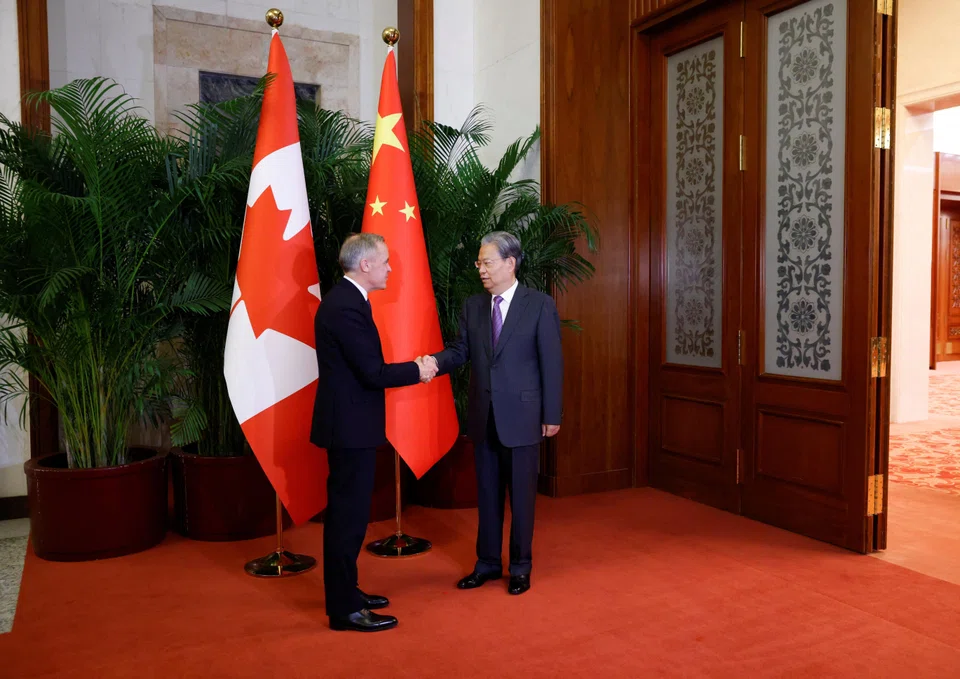
Canada’s goal of attracting Chinese auto investment is part of Prime Minister Mark Carney’s broader trade truce with Chinese President Xi Jinping. In January, China agreed to begin removing duties on Canadian agriculture products in exchange for Canada exempting as many as 49,000 Chinese-built EVs annually from a 100 per cent tariff imposed in 2024.
SEE ALSO
On Thursday, Carney and Joly unveiled an overarching strategy for Canada’s auto sector, which has been hammered by US President Donald Trump’s tariffs. General Motors recently announced layoffs at its Canadian plants and Stellantis reneged on a decision to restart a factory near Toronto to build a Jeep model.
The strategy includes revamping Canada’s counter-tariff approach to reward firms that maintain production in the country.
Canada is keeping its retaliatory tariffs on US-built autos, but is planning to implement a system of import credits. The more cars a company builds in Canada, the less it will pay in tariffs on imported US vehicles – and it would also be able to sell excess credits to other firms.
Today, the biggest beneficiaries would be the two Japanese firms, which account for three-quarters of Canada’s auto production.
“It is a way actually to compensate companies such as Honda and Toyota that are increasing their production in Canada,” Joly said. “It’s another way for them to make revenues.”
Carney’s government is also angling for auto investment from other countries, with South Korea a major target because Hyundai Motor and Kia sell hundreds of thousands of cars in Canada but make none of them locally. The two governments recently signed a non-binding agreement “to cooperate on advancing a Korean automotive industrial footprint in Canada.”
“We’re definitely looking at car assembly plants,” Joly said. “Quebec is the biggest Kia market in the world. So we’re having conversations. Our goal is to create jobs and attract investment in the auto sector, so I think we are willing to look at different scenarios.” BLOOMBERG
Decoding Asia newsletter: your guide to navigating Asia in a new global order. Sign up here to get Decoding Asia newsletter. Delivered to your inbox. Free.
