


📊 Full opportunity report: Siemens Invests Big In AI To Optimize Factory Operations on ThorstenMeyerAI.com — validation score, market gap, and execution plan.
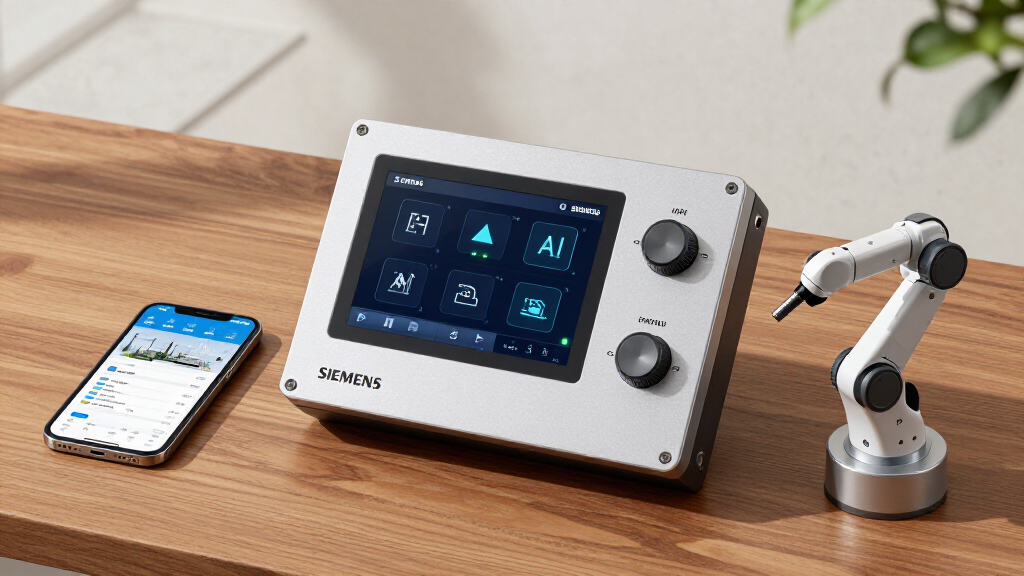
Siemens has revealed a major strategic push into industrial AI, partnering with NVIDIA to develop a comprehensive Industrial AI Operating System designed to embed AI across all stages of manufacturing. This move aims to transform factory automation and digital twin technology, with a fully AI-driven factory set to open in Erlangen, Germany, in 2026.
At CES 2026, Siemens announced its plan to leverage AI tailored for physical industrial environments, emphasizing that general-purpose language models are less effective in factory settings. The company’s Industrial Foundation Model (IFM), first introduced at Hannover Messe 2025, is a specialized AI designed to process 3D models, engineering drawings, sensor telemetry, and automation data to optimize manufacturing processes.
The partnership with NVIDIA is central to this strategy, aiming to build an Industrial AI Operating System that integrates GPU-accelerated simulation, physics-based models, and generative simulation to create active digital twins. Siemens plans to launch a fully AI-driven, adaptive manufacturing site at its Erlangen factory in 2026, exemplifying this new approach. Early applications include digital twin tools like Digital Twin Composer and industrial copilots supporting supply chains and engineering workflows.
Siemens claims its proprietary data, domain expertise, and existing customer relationships provide a competitive advantage in developing physical AI solutions, with partnerships spanning sectors such as automotive, pharmaceuticals, and electronics. The company emphasizes that its physical AI initiatives are built on decades of industrial data and knowledge, which are difficult for competitors to replicate.
At a glance
announcementWhen: announced at CES 2026, with a planned l…
The developmentSiemens has announced a strategic expansion into AI for factory operations, partnering with NVIDIA to develop an industrial AI platform and launching a fully AI-driven factory in 2026.
AI Dispatch · Company
JULY 2026 · THORSTENMEYERAI.COM
The factory floor,
not the chat window.
Siemens’ bet: the biggest untapped AI value is physical — machines, factories, infrastructure — and 175 years of industrial data plus NVIDIA compute beats any frontier lab there. The vehicle: an Industrial Foundation Model and an “Industrial AI Operating System.”
A different language than text
What LLMs speak
Text, code, chat
General-purpose models — close to useless on a shop floor where the “language” isn’t words
vs
What factories speak
3D CAD · sensor telemetry · PLC logic · physics
The Industrial Foundation Model is shaped for the modality — not a generalist stretched to cover it
Proprietary + physical data no frontier lab can scrape — the same “specialist beats generalist” logic this week keeps documenting, applied to steel and silicon.
Erlangenfirst fully AI-driven adaptive factory — 2026 target
9industrial copilots across the value chain
175 yrsof industrial domain data as the moat
NVIDIAPhysicsNeMo + CUDA-X power the OS
Honest bull / bear
Bull
- Proprietary physical data no lab can replicate
- Domain expertise IS the barrier to entry
- Customers (PepsiCo, Audi) already in the base — warm motion
- Generative simulation: digital twins that engineer, not just mirror
Bear
- The “OS” runs substantially on NVIDIA’s stack — American silicon under a European champion
- No validated performance metrics or timelines disclosed at CES
- Geological sales cycle: decade-scale replacement
- “Industrial AI” now crowded (Palantir, Qualcomm moving in)
SOURCES: SIEMENS PRESS CES 2026 · HANNOVER MESSE 2025 · INTERESTING ENGINEERING · CIRCUITROUTE (JAN–JUN 2026)
© THORSTEN MEYER · AI DISPATCH
industrial AI platform software
As an affiliate, we earn on qualifying purchases.
As an affiliate, we earn on qualifying purchases.
Why Siemens’ Industrial AI Strategy Matters
This investment signifies a shift in industrial AI focus from generic chat and language models toward specialized, physical-world AI tailored for manufacturing. Siemens’ approach could redefine factory automation, making processes more efficient, adaptable, and intelligent. The partnership with NVIDIA accelerates this transition by providing advanced simulation and AI infrastructure, potentially setting new standards for industrial digital twins and autonomous manufacturing. For industrial sectors, this could mean faster innovation cycles, improved operational efficiency, and a competitive edge for early adopters.
Background on Siemens’ Industrial AI Initiatives
Siemens has a long history in automation and industrial software, with recent efforts focused on integrating AI into manufacturing. The company’s announcement at Hannover Messe 2025 of the Industrial Foundation Model marked its first step toward specialized AI for industrial data. The move to CES 2026 builds on this foundation, emphasizing a strategic partnership with NVIDIA announced earlier this year. The broader industrial AI landscape is becoming increasingly competitive, with other tech firms and startups also investing in edge and factory AI solutions, though Siemens maintains a domain-specific advantage due to its extensive industrial data and customer base.
“Industrial AI is no longer a feature; it’s a force that will reshape the next century.”
— Roland Busch, Siemens CEO
Unconfirmed Details and Potential Challenges
It is not yet clear how quickly Siemens’ AI solutions will be adopted at scale across its customer base, given the long sales cycles typical in industrial sectors. The performance metrics, deployment timelines, and specific hardware configurations for the Industrial AI Operating System remain undisclosed. Additionally, much of the announced progress is roadmap-oriented, with limited third-party validation or independent testing results available at this stage. The reliance on NVIDIA’s infrastructure also raises questions about data sovereignty and dependency, especially for European customers concerned about hardware sovereignty.
Next Steps for Siemens’ Industrial AI Roadmap
Siemens plans to launch its fully AI-driven factory in Erlangen in 2026, serving as a blueprint for global expansion. The company will also introduce tools like Digital Twin Composer and expand its industrial copilots, with ongoing development and performance validation expected throughout 2026. Industry observers will be watching for real-world deployment results, customer case studies, and performance benchmarks to assess the maturity and impact of Siemens’ AI initiatives.
Key Questions
What is the Industrial Foundation Model?
The Industrial Foundation Model (IFM) is Siemens’ specialized AI designed to process and contextualize industrial data such as 3D models, drawings, and sensor telemetry to optimize manufacturing and automation processes.
How does Siemens’ partnership with NVIDIA enhance its AI efforts?
The partnership provides GPU-accelerated simulation, physics-based AI models, and generative digital twins, enabling Siemens to develop an integrated industrial AI platform capable of active, real-time optimization of factory operations.
When will Siemens’ fully AI-driven factory open?
The first fully AI-enabled manufacturing site is scheduled to launch in 2026 at Siemens’ Erlangen factory in Germany.
What are potential challenges Siemens might face?
Challenges include long sales and deployment cycles typical of industrial sectors, undisclosed performance metrics, and dependency on NVIDIA’s infrastructure, which could raise concerns about data sovereignty and supply chain resilience.
Source: ThorstenMeyerAI.com
