


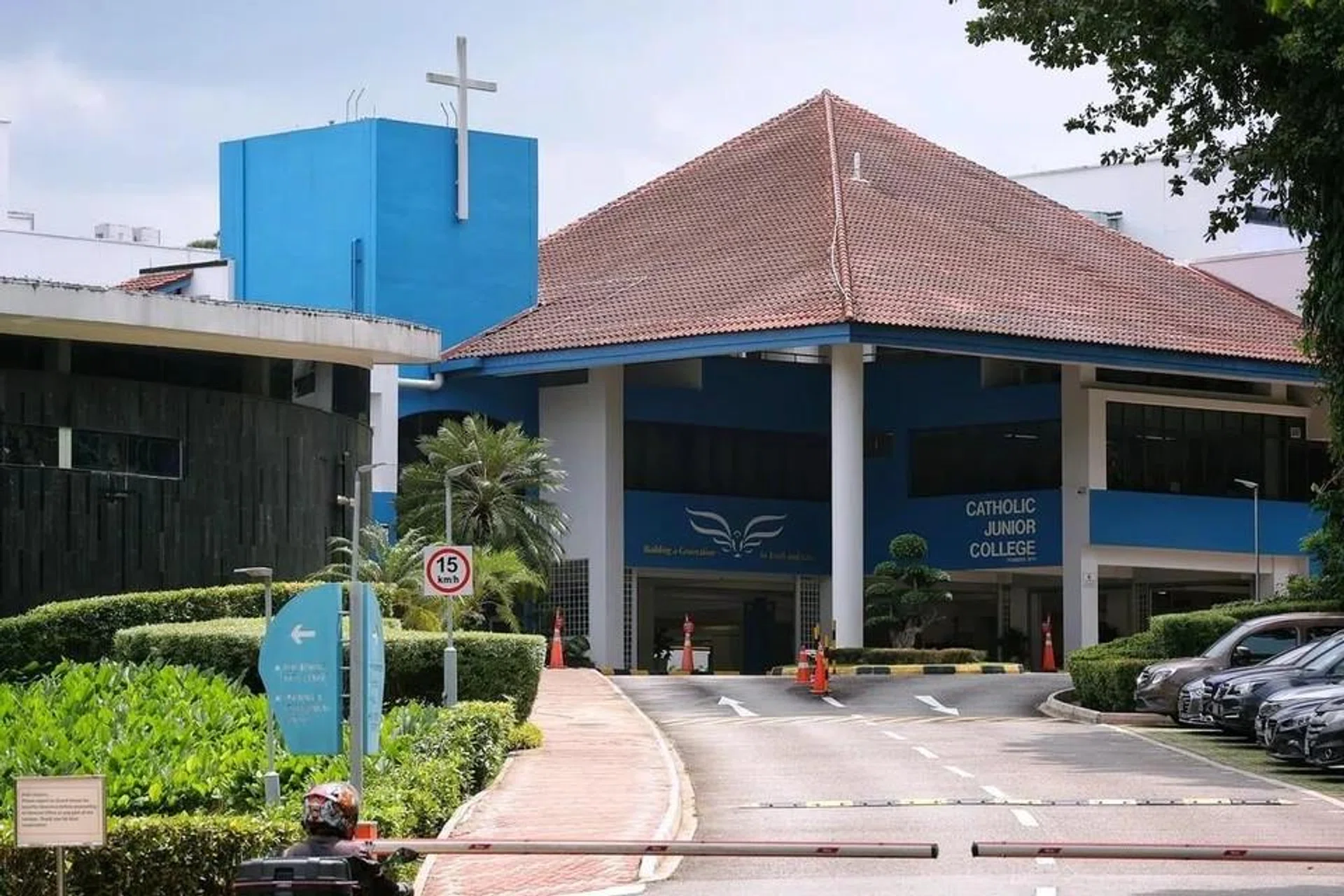
[SINGAPORE] Come 2034, Catholic Junior College (CJC) will move from its Whitley Road campus to the vicinity of Punggol Digital District.
The new campus, which will be built near the Singapore Institute of Technology (SIT), is tentatively slated for operation in 2034.
JTC Corporation’s Punggol Digital District is a hub for technology sectors like cyber security, AI and robotics.
CJC, Singapore’s third oldest junior college, has been at its current campus at 129 Whitley Road since it was founded in 1975 by the Roman Catholic Archdiocese of Singapore.
The relocation was announced by CJC on Jan 16 at an event in the Punggol Digital District.
CJC School Management Committee chairman Bernard Tan said the decision to move the college was a complex one, and was studied carefully over the course of two years, with stakeholders consulted.
Navigate Asia in
a new global order
Get the insights delivered to your inbox.
“In view of the ageing Whitley Road campus, and having been offered the Punggol site, we realised there was a strategic opportunity to reshape CJC moving forward,” he said.
The Catholic Church’s lease for the Whitley Road site will expire in August 2029.
Mr Tan said: “This will not just be a change in address. Being close to the Punggol Digital District would offer us significant educational synergies to fundamentally improve the offering to our students, and in return, the presence of CJC will add to the vibrancy of the district.”
The Ministry of Education (MOE) said in a release that CJC’s move is part of the second phase of the Junior College Rejuvenation Programme, which aims to improve the infrastructure of JCs by upgrading or rebuilding their facilities.
This phase will cover CJC, Anglo-Chinese JC, National JC and Victoria JC.
MOE said it will work with CJC to ensure a smooth transition and preserve CJC’s heritage as it moves to Punggol. This includes preserving the college’s traditions, culture and historical artefacts, and exploring the feasibility of relocating significant architectural elements from the current campus.
Mr Tan said a committee will be formed to study the move, and the feasibility of moving or retaining features and elements “that mean a lot to either the history of CJC or to students”.
These include statues, niches, or items like a bench or tiles from the current campus, he said, adding that the school will consider how to recreate the look and feel of lecture theatres and classrooms at its new site, as well as iconic areas such as the open assembly area.
In remarks at the event on Jan 16, Deputy Prime Minister Gan Kim Yong, who is an MP for Punggol GRC, said CJC’s move to the vicinity of Punggol Digital District is not just a simple relocation.
“It is a deliberate choice to situate pre-university education within an ecosystem where knowledge is applied, skills are developed, and students can better connect what they learn to the world beyond college,” he said.
MOE said the school’s move will serve the wider community and provide quality pre-university education in the north-east region of Singapore.
The relocation will place CJC in close proximity to digital firms and institutions such as SIT, the ministry added. This will allow the school to explore tie-ups in the area, giving students exposure to opportunities in the digital sector.
On Jan 16, CJC signed MOUs with several partners to work on joint initiatives from 2026. The partners include Cyber Security Agency of Singapore (CSA), JTC Corporation, National Parks Board (NParks), National Youth Council (NYC), Pathlight School and SIT.
In a statement, CJC said programmes with these partners will start over the next year, ahead of the physical move.
MOE said that CJC will also be able to conduct more outdoor and sports activities in the nearby Punggol Regional Sports Centre and recreation spaces such as Punggol Heritage Trail and Punggol Waterway Park.
Its new campus will offer learning spaces such as configurable areas that cater to seminar style teaching and project work discussions, along with multi-functional work spaces for staff.
Mr Gan, who is also Minister for Trade and Industry, said the Punggol Digital District is designed to integrate physical spaces with shared digital infrastructure.
“This will reinforce CJC’s strengths in education across both the sciences and humanities, by enabling science students to apply theory in real settings, and humanities students to explore ethics, society and the human dimensions of technology in a lived environment,” he said.
“It also aligns closely with the direction CJC is setting for itself: being digitally fluent, environmentally grounded, and connected to the wider community, while remaining academically rigorous and anchored in its Catholic ethos,” he added.
“I hope that your students will not just study here, but also take part in the life of the area, building social friendships with residents through joint programmes, shared spaces and regular interactions,” he said.
CJC, a government-aided school, has a graduating cohort of about 700 to 750 students each year.
CJC is the only Catholic junior college here, with a chapel on campus. It is affiliated to Catholic secondary schools here.
The late Pope Francis went to CJC during his state visit to Singapore in September 2024, and took part in an inter-religious dialogue with youth. THE STRAITS TIMES
Decoding Asia newsletter: your guide to navigating Asia in a new global order. Sign up here to get Decoding Asia newsletter. Delivered to your inbox. Free.
