


Summary created by Smart Answers AI
In summary:
- AI-generated music now comprises 44% of Deezer uploads by 2026, yet only 3% of listeners can identify it as artificial, according to PCWorld’s analysis of industry data.
- Spotify and other streaming platforms are implementing labeling systems for AI tracks while legal battles continue between record labels and AI companies over copyright infringement.
- An industry-wide metadata system expected by 2027 will help distinguish AI from human-created music as tools like Suno and Udio make text-to-music generation accessible to everyone.
Using AI to generate music is nothing new. As early as 1957, composer Leonard Isaacson and mathematician Lejaren Hiller generated a number of compositions on the early computer Illiac, and machine learning has been in use for many years.
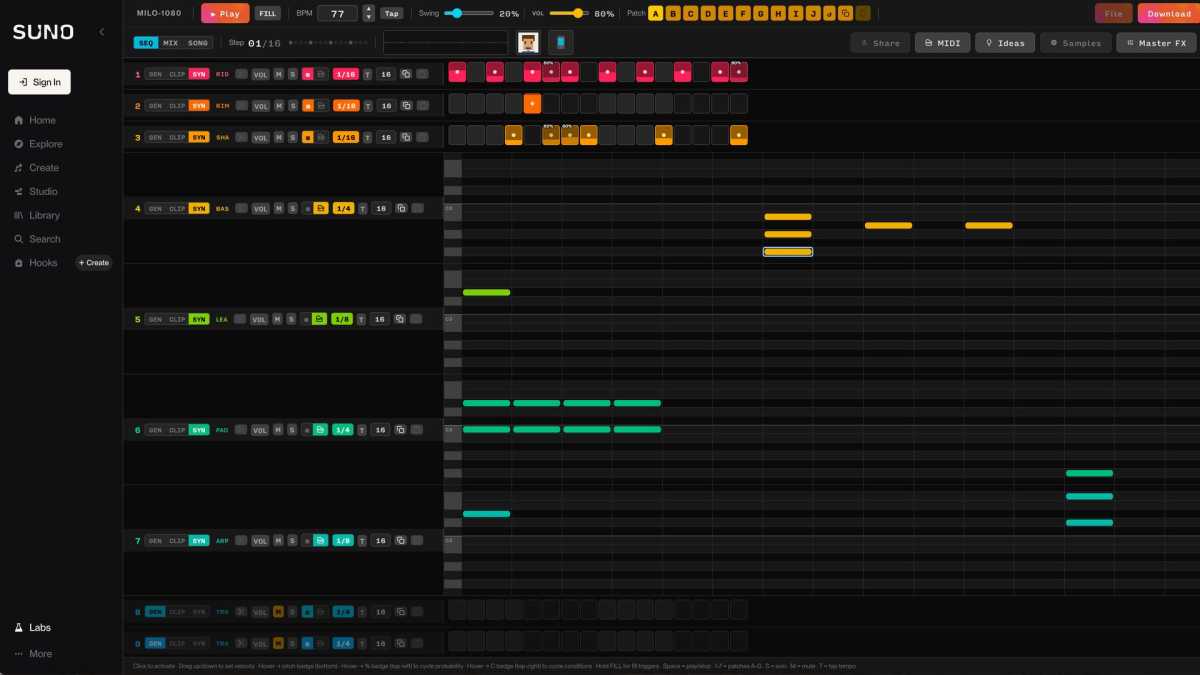
With the launch of Suno in late 2023 and Udio in early 2024, it suddenly became possible for anyone to generate songs in various genres entirely based on text-based input, just as with text, images, and video using other generative AI.
Skärmdump
The new tools are so powerful that they generate songs that are difficult to distinguish from human creations. A survey by Ipsos on behalf of Deezer, published in November 2025, revealed that only 3 percent of listeners can tell the difference, while virtually everyone is calling for clear labelling of AI-generated music.
The quality of the generated music and the simplicity of the tools have led to an ever-increasing production of AI-generated music. In April 2026, AI-generated tracks accounted for 44 percent of all uploads on Deezer, and the situation is much the same on Spotify.
Millions of tracks, few listeners
At the same time, interest among listeners is minimal. On Deezer, AI-generated music accounts for just 1 to 3 percent of all streams, and Spotify said last autumn that the figure there was below 1 percent. 40 percent of all listeners would not listen to AI-generated music at all if they could avoid it.
“The reason why people don’t listen to entirely AI-generated music very much is that the majority of it is really bad. However, this is changing as the music being released is a combination of human creativity and AI. It is only now that there are tools good enough to move away from the simple prompting that generates 100 percent AI-generated music — which is rather uninteresting to most people, even if it’s high quality — towards a combination of human and machine,” says Daniel Johansson of the trade magazine Musikindustrin.
Copyright issues
Just as in other areas where generative AI has made a breakthrough, the legal situation surrounding AI-generated music is not entirely clear. A number of legal proceedings are underway, particularly between record labels and AI companies. Much like the publishing industry, which has launched a fierce attack on companies such as OpenAI and Anthropic, record labels want compensation from AI firms that train their models on copyright-protected material. Not everyone is willing to pay.
“Suno is having the greatest impact on the industry because its actions are forcing the industry to spend an enormous amount of time on legal proceedings, as Suno refuses to obtain the necessary licenses as required by copyright law. However, the majority of platforms launched in the past year are licensed, and the trend is clear: Most AI companies realize they must have the correct licenses in place,” says Daniel Johansson.
There are also major question marks on the other side. Many amateurs have started using services such as Suno and Udio to generate music, and a look at forums such as Reddit shows that there is considerable uncertainty regarding the extent to which copyright applies to such creations.
In many countries, including Sweden and the U.S. (where most services are based), human involvement in the creative process is required to obtain copyright, which means that anyone who has generated a song entirely using generative AI based solely on a text prompt does not own any copyright to it. Yet questions remain that future court cases will need to clarify: How much human involvement is required? Does someone who uses a service that has trained its models on copyright-protected music without a license themself infringe copyright?
Sunos’s terms of service place all legal liability on the user. If you use the service to create music that is so similar to an existing work that the rights holder considers it an infringement and sues you, you must defend yourself, with all that that entails. To be able to make money from music created using the service, a subscription is required, as the free version only allows private use.
Udio previously had similar rules, but in early 2026 the company amended its terms of service and no longer permits any commercial use of generated music. You could therefore be banned from the service if, for example, you use a track you have generated in a YouTube video you are trying to monetize.
The difference between AI and AI
The use of AI in the music industry has become widespread, but it is difficult to determine exactly how big it has become, says Anders Ekman, senior lecturer at Örebro University.
“But it is reasonable to assume that its use is increasing. On the one hand, the tools are being refined, making them more useful; on the other, we are seeing an increase in instances where AI has been used that reach the general public. Two songs in this year’s Melodifestivalen were written partly with the help of AI, and perhaps there are more that we are not aware of. There is still a great deal of skepticism among many musicians and songwriters regarding generative AI, so we do not know how large the unreported figure is,” Ekman says.
Daniel Johansson points out that there is a difference between generative AI and other forms of AI.
“You have to be clear about what is generative AI and what is functional or problem-solving AI. Professional songwriters have been using plugins and tools for functional AI for over 10 years, so it’s nothing new.”
The industry uses a lot of generative AI too, but not just for music creation, but also for everything else, such as marketing.
“Many people think the music industry is lagging behind when it comes to AI, but it’s exactly the opposite; they’re just careful to protect their rights.”
Skärmdump
Clearer labelling on the way
Daniel Johansson says that so far it has been difficult to determine which music is generated by AI, but that this is something the industry is aware of and agrees must be addressed.
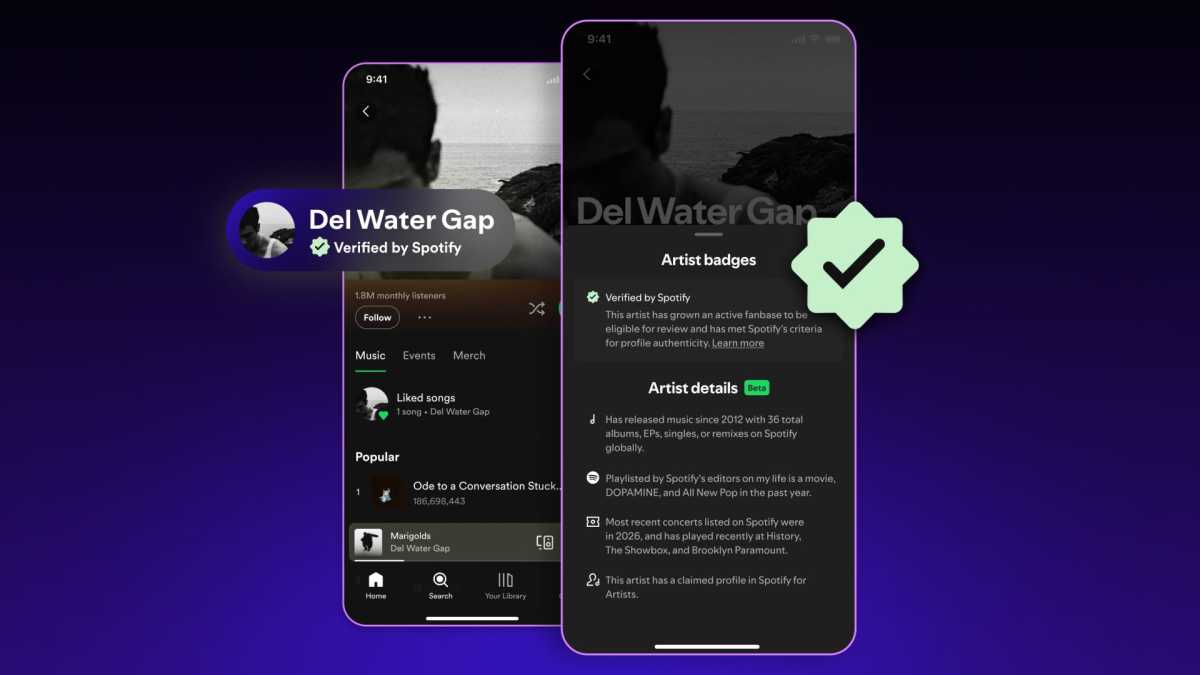
“All streaming services, distributors, copyright societies, record labels, music publishers, and also the AI companies that are licensed and wish to collaborate with the industry, are working hard to develop new metadata formats and update the existing systems that already identify who played the guitar or was the sound engineer, or wrote the melody or lyrics, and so on,” he says.
Spotify
He believes that an AI metadata system will be in place by 2027. Currently, only a handful of companies, including Suno, have chosen to opt out of this collaboration.
How to tell if a song is made with AI
If and when the industry manages to implement effective labelling of AI-generated music, it will hopefully be easy to, for example, filter out all AI-generated music on services like Spotify if you prefer to listen only to music made by humans. But until then — and even outside the major streaming services — it can be useful to know how to check whether a song has been made by humans.
Trying to tell just by how it sounds is difficult. Even if you’re among the 3 percent who can tell the difference, it’s difficult and getting harder all the time. Instead, you’ll have to play detective, and it’s rarely possible to say with 100 percent certainty that no AI was involved.
Here are some warning signs that may indicate that music is AI-generated:
An artist churning out new music
Few people are capable of producing several albums in just a few months. It’s not unusual to have to wait several years between each album. There are, of course, exceptions, and if we’re talking about, say, two albums in a year, that doesn’t give much of a clue.
Lack of information
Check the artist’s page on streaming services or their own website: Is there one at all? Is there any information or photos? Have they shared lyrics and other material? Is there information about which musicians, producers, and others have worked on an album? If it’s a band you’re wondering about, you should be able to look up the individual members and find information about each one and what they’ve done previously. Wikipedia can often be helpful here, with pages even for artists who are themselves very private outside of their music.
AI-generated covers and other elements
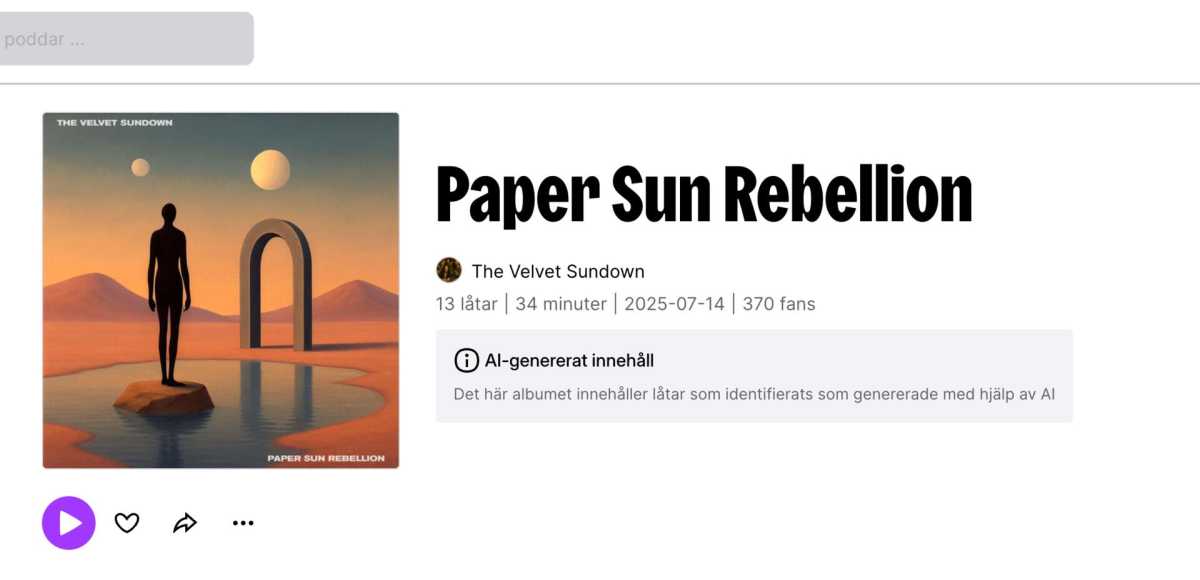
Another sign that music is AI-generated is that even the album cover has been generated by AI. The same applies to music videos and other graphics. The fewer people who appear to have been involved, the more likely it is that the whole package is an AI creation.

Cottonbro Studio
No live performances
There are, of course, many human artists who never perform in front of an audience, not least among those who have become famous and secured record deals after publishing self-produced music on YouTube and other sites. But overall, live performances have become a more important source of income for musicians, as reduced revenue from record sales has not been offset by streaming revenue, except perhaps for the very biggest artists.
If an artist or band has been on tour or played at festivals, you can be pretty sure that they are real people and that the music they release is made by people. Of course, established artists can also use generative AI to create new music, but in that case they have at least been involved. And if the music doesn’t meet their usual standards, you’ll probably notice it and won’t want to listen to it on repeat.
No social media presence
Another sign that a new artist you’ve discovered is in fact AI-generated is that they either have virtually no social media presence at all, or their presence doesn’t feel natural. If all the posts feel very glossy and contrived, it could of course be because a marketing department is behind them, but it could also be a sign of AI.
The same applies to traditional media. It’s odd if someone has racked up millions of streams and has never been interviewed in a music magazine, a podcast, or anywhere else.
None of these signs are foolproof, and ultimately it comes down to trust and gut feeling. But perhaps it’s not so surprising that many choose to listen mainly to established artists and music made before generative AI came into being.
This article originally appeared on our sister publication PC för Alla and was translated and localized from Swedish.
