


Hello, this is Priyanka Salve, writing to you from Singapore.
Welcome to the latest edition of “Inside India“ — your one-stop destination for stories and developments from the world’s fastest-growing large economy.
Over the last decade, China reversed its brain drain, luring thousands of skilled workers back home to help fuel its rise as a technology powerhouse.
India is taking the opposite approach. It is sending more of its vast, young workforce overseas. This week, I unpack why India is signing mobility pacts with several of its trading partners even as anti-immigration sentiment is on the rise across the world.
Any thoughts on today’s newsletter? Share them with the team.
The big story
From Europe to New Zealand and Russia to the Middle East, labor mobility pacts have become a common feature in many of the recent deals India has finalized with its trading partners.
The lack of opportunities for highly skilled labor in the country, with one of the largest working-age populations, coupled with India’s increasing reliance on remittances to fund its finances, is driving the government to secure passage for its workforce overseas.
Unlike China, which has become a manufacturing powerhouse generating jobs at scale, India has not been able to fully address its “grave challenge of an unemployment rate hovering around 5% to 6%,” Jayant Krishna, senior fellow and chair on India and emerging Asia Economics at the Center for Strategic and International Studies, told CNBC.
“If we add under-employed people, the rate jumps up alarmingly,” Krishna said, adding that by placing skilled and semi-skilled workers in overseas markets, India manages “the aspirations of our ever-expanding working-age population.”
India’s government has become increasingly reliant on money sent home by its overseas workers, receiving the highest amount of remittances globally, equal to roughly 3% of its GDP, experts said.
The backlash
But this policy doesn’t come without resistance, especially at a time when anti-immigration sentiment is on the rise across the world. Last week, Prime Minister of New Zealand Christoper Luxon hailed the country’s free trade deal with India that also enhances labor mobility for Indian workers.
Narendra Modi, India’s prime minister, left, and Christopher Luxon, New Zealand’s prime minister, at the Viaduct Events Center in Auckland, New Zealand, on Saturday, July 11, 2026. India and New Zealand will elevate their relationship to a “strategic partnership,” as both seek closer trade and security ties. Photographer: Brendon O’Hagan/Bloomberg via Getty Images
Bloomberg | Bloomberg | Getty Images
“You have enriched our country economically, socially and culturally,” Luxon told a crowd of Indian diaspora in Auckland. But the deal, which is awaiting final clearance from parliament, faces strong opposition from coalition members of Luxon’s government.
The country’s Foreign Minister, Winston Peters, in a post on X, said the trade deal with India is creating “unprecedented immigration settings” and will make it harder for “kiwis finding jobs.” Months earlier, Shane Jones, a minister in the Luxon government and a member of Winston’s party, NZ First, said the deal would lead to a “butter chicken tsunami” coming to New Zealand.
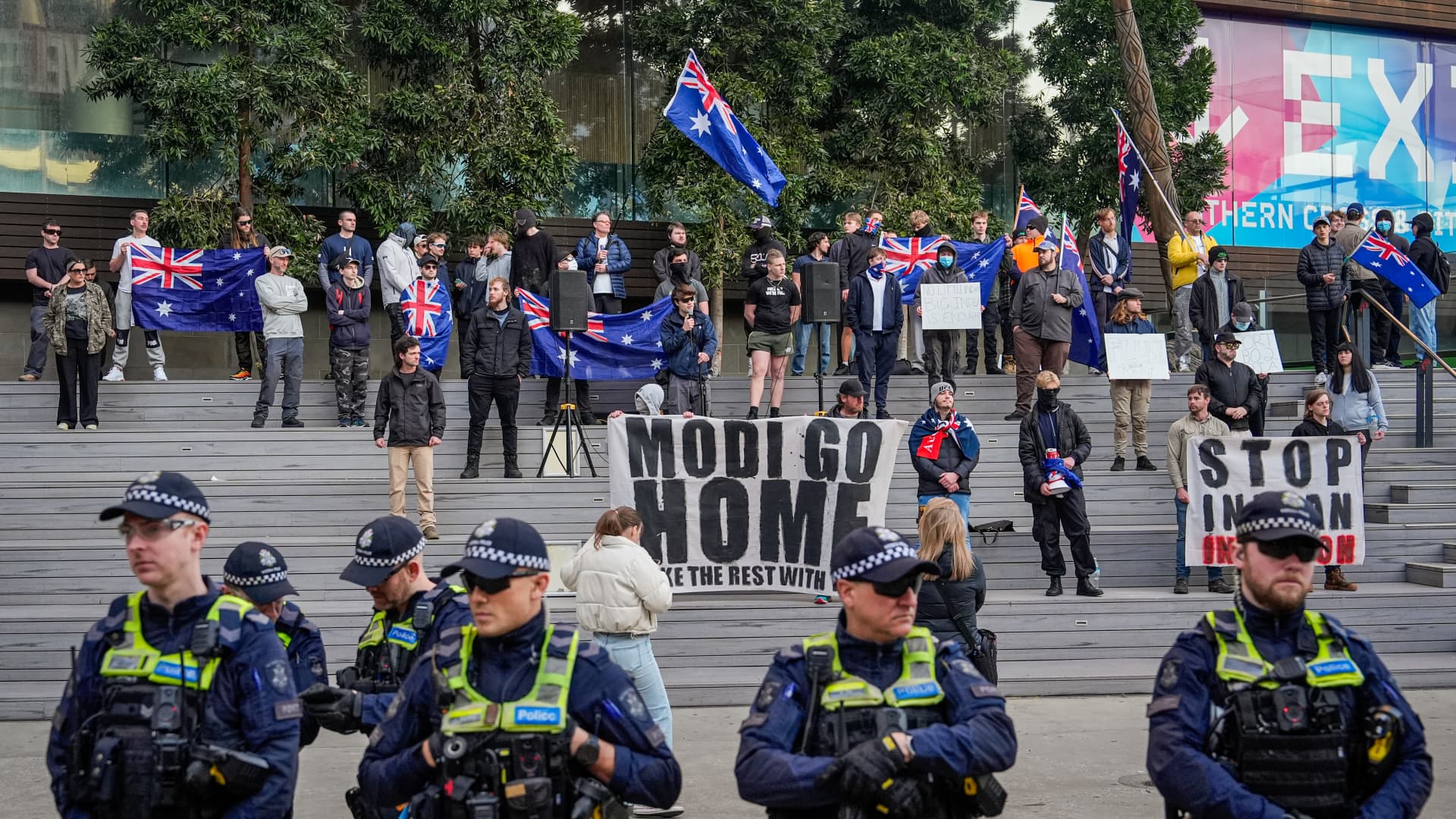
Modi’s recent visit to Australia – where India overtook the England as the top country for Australians born overseas last year – also sparked anti-India protests. Australian social media personality Hugo Lennon heckled Modi in Melbourne, shouting, “No more Indians! This Country is for Australians,” according to local media reports.
Meanwhile, the U.S., one of the biggest recipients of Indian workers, is tightening visa rules even as negotiations are ongoing for a trade deal with New Delhi. Washington’s move has only given India an added incentive to strike labor mobility deals to export workers to Russia, Israel and the European Union, and Finland earlier this year.
The U.S. created H-1B visas in 1990 and they’re used heavily by U.S. tech giants to bring in highly skilled workers from overseas. India has been, by far, the biggest recipient of H-1B visas, but the Trump administration is trying to drastically reduce the country’s reliance on the scheme.
India observed the vicissitudes of H-1B politics in the U.S. and “drew the evident lesson: do not leave your diaspora’s access to foreign labor markets hostage to another nation’s domestic politics,” Ronak D. Desai, visiting fellow at Stanford’s Hoover Institution, told CNBC.
“Mobility grounded in treaty is politically far more durable than mobility granted by unilateral visa policy,” he added.
The Chinese example
India’s move to export labor stands in sharp contrast to its fellow billion-plus-people neighbor, China, which has seen a flood of returnees in the last decade, partly due to the geopolitical tensions that led to the expulsion of Chinese scientists from the U.S.
China has a term for the phenomenon: Haigui, literally, a “returning from across the sea,” according to the Boym Institute think tank.
“Haigui” has seeded its semiconductor, biotechnology, and artificial intelligence sectors, experts said, adding that Beijing also created the domestic capacities to absorb this highly skilled talent.
“Professionals with portable skills have been extremely valuable to help China’s technological advancement,” Rafiq Dossani, adjunct senior Economist at RAND Corporation, told CNBC.
While Beijing offers both incentives to return and infrastructure, India lacks the ability to spur development of advanced technologies like artificial intelligence, he added.
India spends about half of one percent of its GDP on research and development, lower than the global average of 1.7% and significantly below the over 3.5% spent by the U.S.
In the absence of comparable opportunities in India, the Modi government does not see “brain drain” as a major concern, Pramit Chaudhuri, South Asia practice head at Eurasia Group, said.
Rather, they are choosing to promote it, he added.
Need to know
India’s inflation accelerates to 4.38% in June, exceeding forecasts
India’s consumer price inflation rose to 4.38% in June, up from 3.93% in May as the U.S.-Iran war and a weak monsoon raised food and fuel prices, adding to cost pressures. The headline inflation number was above economists’ expectations for a 4.30% rise, according to a Reuters poll.
India ramps up missile sales in Indo-Pacific as China’s assertiveness turns neighbors wary
India will supply its BrahMos and Astra missiles to Indonesia, the country’s third such agreement in the Indo-Pacific, underscoring New Delhi’s rise as a defense supplier in the region amid growing concerns over China’s assertiveness.
Coming up
July 16: SBI Fund Management IPO closes.
