


A US Navy aviation boatswain’s mate directs a F/A-18F Super Hornet assigned to Strike Force Squadron (VFA) 154 on the flight deck aboard the aircraft carrier USS Theodore Roosevelt (CVN-71) while the ship is moored in Honolulu, Hawaii, during Exercise RIMPAC (Rim of the Pacific) 2026 on July 17, 2026. (Photo by Michelle Bir / AFP via Getty Images)
Michelle Bir | Afp | Getty Images
The U.S. said on Sunday that a third American service member was killed in action during recent fighting with Iran, and American forces found unidentified remains near the site of an attack by Iran that left two American service members dead and one missing.
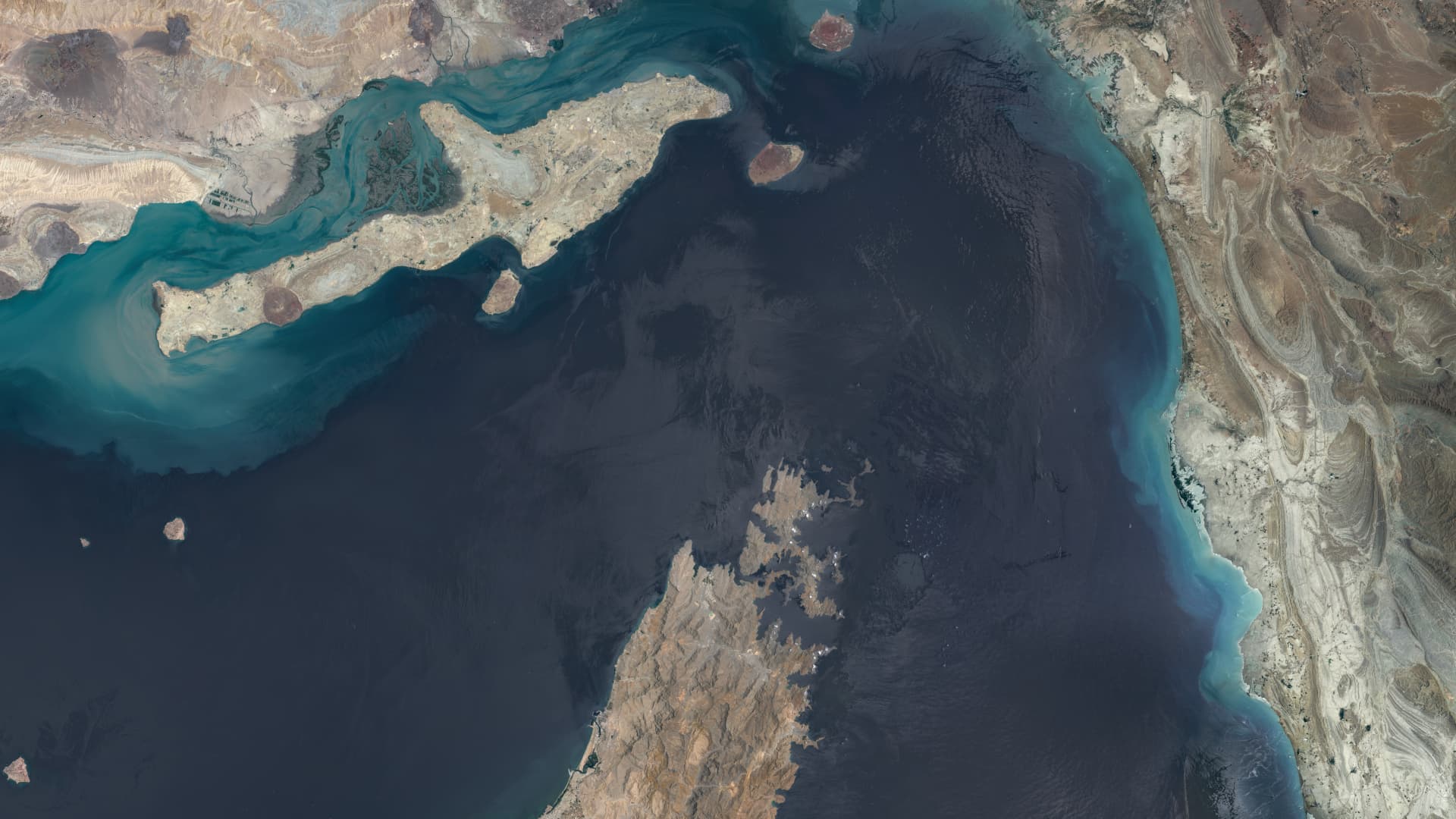
American forces earlier Sunday conducted their eighth straight night of attacks on Iran in retaliation for Tehran’s deadly strikes and to attempt to guarantee safe passage in the Strait of Hormuz.
The developments over the weekend further jeopardized last month’s fragile truce between the two sides, raising fresh concerns over oil shipments through the Strait of Hormuz. And it indicates that the war with Iran could be entering a new, deadly phase that could throw the world economy back into chaos.
U.S. Central Command said Sunday American forces “found unidentified remains at the location” of the Jordan strikes that killed two on July 17, and they are working to identify the remains. A third service member was killed in Iraq on Saturday “during a controlled detonation of unexploded ordnance from a downed Iranian one-way attack drone.”
The fatality brings the U.S. death toll to 17 since the conflict began in February.
Earlier Sunday, Central Command said it completed an eighth straight night of strikes against Iranian targets.
“CENTCOM forces successfully hit Iranian military coastal surveillance and air defense facilities, maritime capabilities, and missile and drone storage sites to continue degrading Iranian military capabilities,” it said in a post on X.
“American military assets also targeted Islamic Revolutionary Guard Corps forces that launched attacks against U.S. service members in Jordan on July 17,” it added.
The Washington Post reported that the military is growing concerned with a dwindling U.S. munitions stockpile brought on by the war dragging on. Congress is currently debating whether to provide additional funding to rebuild the U.S. stockpile.
Meanwhile, the U.S. Embassy in Jordan’s capital, Amman, issued a security alert Sunday, saying Jordanian authorities evacuated the international airport and seaport in Aqaba “due to a specific and credible threat” without elaborating.
However, Jordan reportedly denied issuing any decision to evacuate the facilities.
“No potential threats have been recorded by the relevant Jordanian authorities in the past few hours,” Reuters quoted government spokesperson Mohammad Al-Momani as saying in a written statement. “The airport and port are operating normally.”
U.S. President Donald Trump ordered military forces to launch new airstrikes, starting late Saturday, in order to “degrade Iran’s ability to threaten commercial shipping in the Strait of Hormuz” and “punish Islamic Revolutionary Guard Corps forces who launched attacks against American service members in Jordan last night,” according to Centcom.
Energy Secretary Chris Wright on Sunday sought to allay concerns that the renewed fighting will again close the Strait of Hormuz and spike energy prices.
“The seven-day trailing average right now is just under seven million barrels a day flowing through the waterway, and just under seven million barrels a day additional flow through the bypass pipelines,” Wright said during an appearance on ABC News’ “This Week.” “What we’re doing is assuring that oil and gas and other products can flow through the Strait of Hormuz with or without Iranian cooperation.”
Pressed on recent data that showed slowing traffic in the strait, Wright said: “Almost all the public data I’ve seen is incorrect.” Research firm Kpler said on Friday that crossings in the strait on Thursday had decreased to 8 vessels.
Meanwhile, U.S. gas prices are on the rise again. The national average for gas per gallon was over $3.99 on Sunday, according to AAA, up from over $3.87 a week ago.
Truce unravels
Iran’s Deputy Foreign Minister Kazem Gharibabadi said Saturday the country has suspended its commitments to the memorandum of understanding signed last month with the U.S.
“The United States has violated and suspended all of its commitments under the Islamabad Memorandum of Understanding,” he said. “We have also suspended our commitments; we are not implementing them and are busy defending our country.”
When asked about Iran saying it is no longer abiding by the interim peace agreement, Trump told a NewsNation reporter, “I couldn’t care less.”
The memorandum of understanding signed by the U.S. and Iran last month continued to unravel amid the latest round of fighting, with both sides trading targeted airstrikes in the region. The interim agreement was intended to reopen the strategically vital Strait of Hormuz and end the conflict.
Iran’s Supreme Leader, Ayatollah Mojtaba Khamenei, said the country has “unforgettable lessons in store” for the U.S.
“Now that the American enemy seeks to ignite war and endure heavier costs, it should know that the Iranian nation and the Resistance Front have #unforgettable_lessons in store for it,” the Islamic Republic of Iran Broadcasting said in a message from Khamenei on X.
In this photo released by the Office of the Supreme Leader of Iran, members of the public attend a memorial ceremony service for the late Supreme Leader Ali Khamenei at the Grand Mosalla of Tehran on July 14, 2026 in Tehran.
Handout | Getty Images News | Getty Images
Khamenei said that repeated U.S. attacks have shown that Trump’s signature on the memorandum of understanding is “utterly worthless and devoid of credibility.”
The White House did not immediately respond to a CNBC request for comment on the remarks.
The two additional U.S. military service member fatalities in Jordan add to previously confirmed deaths of 14 other service members killed in action since the war began with U.S. and Israeli strikes on Iran on Feb. 28, according to MS Now.
Trump, in a telephone interview with a NewsNation reporter, called the deaths of the two service members “very sad, it’s a very sad thing.”
“We hate to see it happen. It’s in service to our country,” and he reiterated his pledge that the U.S. is “never allowing Iran to have a nuclear weapon.”
‘Godspeed heroes’
Secretary of Defense Pete Hegseth responded to the deaths on X: “Godspeed, heroes. Their sacrifice only stiffens our resolve.”
On Saturday, the IRGC said it blocked four vessels as they attempted to move under U.S. protection through the Strait of Hormuz.
And Iran continued to target regional neighbors.
Kuwait said Sunday its air defenses were facing missile and drone attacks by Iran.
The Gulf country has come under repeated Iranian strikes in recent days, with one hitting its critical water desalination facility.
Despite the renewed attacks, Trump has insisted the war with Iran is going well, saying Thursday in a primetime address to the American public: “We are likewise winning big in Iran, and you will see the fruits of that labor very, very shortly.”
The U.S. president had threatened to strike Iran’s bridges and power plants in the coming week if the country refused to return to the negotiating table.
Oil prices were sharply higher on Friday due to the ongoing unrest in the Middle East.

Brent crude oil futures price (dollars per barrel), year to date
International benchmark Brent crude futures with September delivery advanced 4.6% to $88.10 a barrel on Friday, while U.S. West Texas Intermediate futures with August delivery gained 4.5% to settle at $82.49. Both were at their highest since mid-June.
For the week, both benchmarks gained about 16%, with Brent on track for a third consecutive weekly gain and WTI set for its second.
— Reuters and the Associated Press contributed to this report.

