


Chinese regulatory authorities have unveiled draft revisions to the country’s foundational e-commerce law, marking the first systematic overhaul of the legislation since it took effect in 2019. The proposed changes aim to bridge regulatory gaps that have emerged over seven years of explosive digital growth, aligning the legal framework with a domestic internet retail market that reached nearly 16 trillion yuan, or approximately 2.2 trillion U.S. dollars, in 2025.
The State Administration for Market Regulation and the Ministry of Commerce jointly released the draft revisions for public comment. Officials stated that the updates are designed to strengthen platform accountability, enhance regulatory coordination, and establish stronger legal guardrails for the modern digital economy.
When China’s E-Commerce Law was first drafted, live-streamed shopping, instant retail delivery, and social commerce were still in their infancy. At the time, regulators focused primarily on traditional online storefronts. Today, China has spent 13 consecutive years as the world’s largest online retail market, with live-stream e-commerce transactions alone exceeding 6 trillion yuan in 2025.
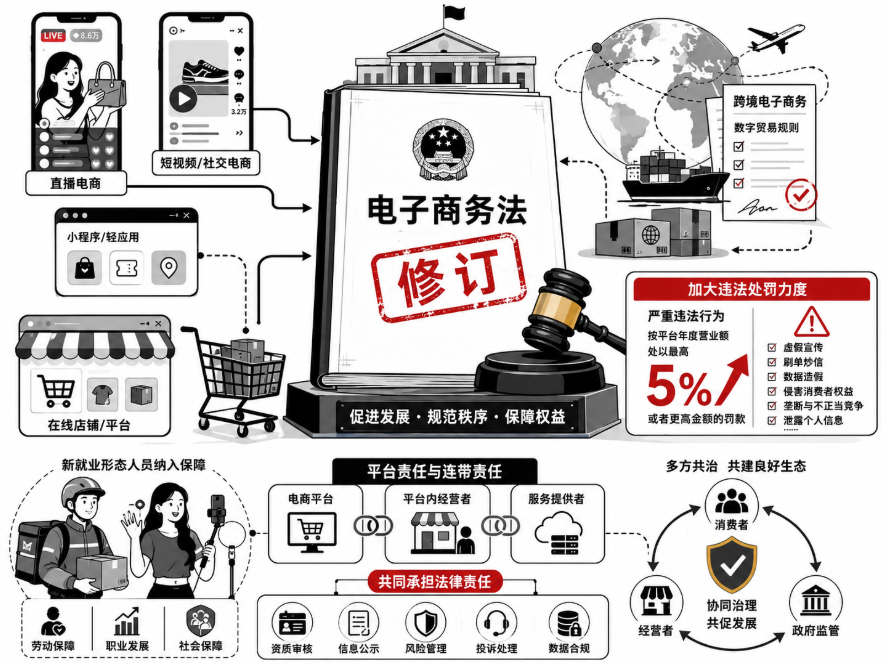
To address these shifting market dynamics, the draft revision expands the definition of an e-commerce platform. By adding the phrase “order generation” to the legal definition, the draft extends regulatory oversight beyond traditional digital storefronts. Under the new guidelines, short-video platforms, social media networks, and mini-programs that control order intake, payment processing, or fulfillment linkages will be legally classified as e-commerce platforms and held responsible for the transactions they facilitate.
The changes also establish joint liability between platforms and third-party service providers. This adjustment prevents major platforms from evading regulatory obligations by outsourcing merchant vetting and compliance tasks to external entities.
To deter non-compliance among multi-billion-dollar technology conglomerates, the draft revision significantly increases the financial consequences of severe violations. Under the existing 2019 framework, the maximum statutory fine for platforms was capped at 2 million yuan, an amount critics argued was too minor to influence the behavior of dominant industry players.
The proposed amendments address this in two ways. First, the cap for standard fixed-sum fines will be raised from 2 million yuan to 5 million yuan. Second, the draft introduces a revenue-based penalty system. For particularly severe violations that cause extreme public harm, the central market regulator can impose fines of up to 5 percent of a platform’s total revenue from the preceding fiscal year.
Legal scholars note that this percentage-based penalty is modeled after China’s existing anti-monopoly and personal data protection laws. The steep revenue-based fine is intended to act as a powerful deterrent, forcing large platforms to integrate comprehensive internal compliance programs directly into their corporate governance structures.
In a notable shift, the draft revisions explicitly integrate gig workers, such as delivery riders and live-stream hosts, into the official co-governance framework of the e-commerce market. While these workers are critical to the daily operation of the digital economy, they have historically been excluded from formal labor and e-commerce classifications, leaving them vulnerable to aggressive platform algorithms and unilateral commission changes.
By formally recognizing workers alongside consumers, industry organizations, and businesses within the regulatory ecosystem, the law aims to establish a more balanced marketplace. Because front-line gig workers directly experience the day-to-day operations of platform algorithms, their inclusion serves as an early-warning mechanism to help regulators identify unfair operational practices or safety hazards.
The draft also introduces measures to align China’s e-commerce sector with international digital trade rules. The proposed changes task the Ministry of Commerce with drafting policies to help domestic e-commerce companies expand into global markets. Furthermore, the law outlines plans to promote the cross-border recognition of electronic signatures and digital transaction documents.
For inland provincial economies, these international provisions offer significant trade opportunities. Streamlined customs procedures, simplified document authentication, and clear national mechanisms to resolve international disputes are expected to help regional logistics hubs expand their direct digital export pipelines to global consumers.
